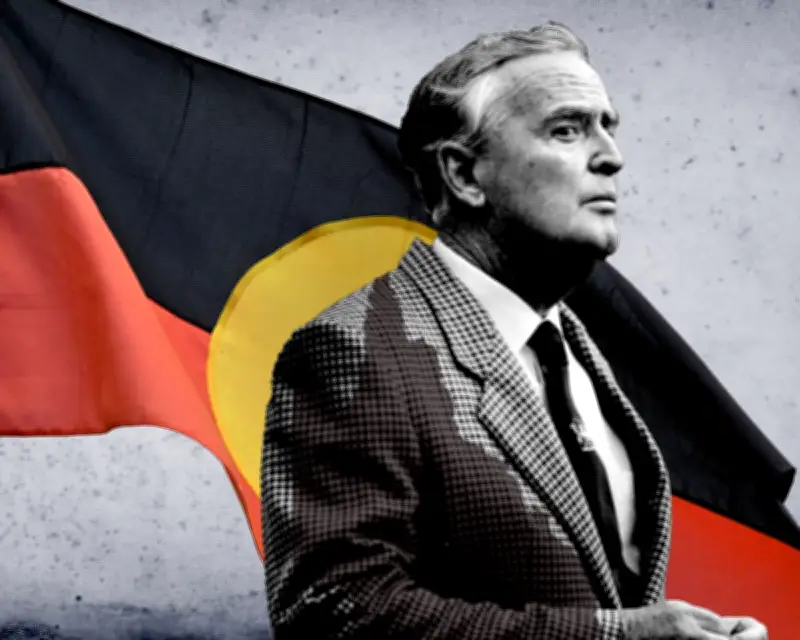
The spectre of Joh Bjelke-Petersen, Queensland's former premier known as the "hillbilly dictator," continues to loom over the state's political landscape, with the current Liberal National Party (LNP) government drawing comparisons to his repressive decades. At a recent protest against an Olympic stadium in Brisbane's Victoria Park, an elder of the Yagara, Quandamooka and Bundjalung people, Aunty Sandra King, was stopped in her tracks by a homemade placard reading "I Preferred Joh." For those who lived through the Bjelke-Petersen era, such comparisons are never made lightly.
Indigenous Affairs Under Fire
King says the LNP's unapologetic moves to remove Indigenous people and programs from government are a throwback to the sorts of days many thought had come and gone. "That is going back to Joh Bjelke-Petersen, who we did not like. Who was just against us," she said. "No, Joh was not better, I can say. None of them, no Liberal party's better for us."
This month, prominent Indigenous barrister Joshua Creamer told ABC Radio he had heard the government's quiet purge of First Nations people, policies and programs described by a public servant as "project invisibility." This has included the defunding of programs like Murri Watch, which provides services to Indigenous children in watch houses, as well as plans to contest all native title claims. "There's an organised strategy and that is to ultimately eliminate, remove, reduce the Indigenous affairs, Indigenous initiatives, Indigenous voices," Creamer said.

A Simple Calculation for Marginal Voters
Many of the government's shifts that have most concerned civil libertarians rely on a simple calculation: that the issues are marginal for most suburban and regional voters, whose concerns are mostly the cost of living and crime. This calculation was central to the government's "adult time" crime laws, introduced after a populist election campaign that focused on juvenile crime and included accusations of "radicalised dog whistling." The same calculation underscores banning of puberty blockers for transgender healthcare in public hospitals, or "hate speech" laws that have banned expressions linked to pro-Palestine protests.
Several groups compared arrests under those laws to police-led suppression of protests under the Bjelke-Petersen government, particularly its 1977 ban on all protest marches and declaration of a state of emergency during a tour of the state by an all-white rugby team from apartheid South Africa. Others have pointed out that even Bjelke-Petersen didn't go so far as to ban expressions where the meaning is contested.
Controversial Legacies and Comparisons
The government has exempted its planned Olympics venues from 15 state laws, including the heritage and planning acts, drawing comparisons with Bjelke-Petersen's enabling act for the 1988 World Expo which compulsorily acquired 40 hectares of inner-city riverfront land. Cultural institutions like the state library pulped books in the 1980s. Last year, apparently on political orders, the library stripped author Karen Wyld of her $15,000 black&write! fellowship, less than five hours before it was to have been awarded to her, over comments about the conflict in Gaza.
Queensland Premier David Crisafulli has to cast back almost 70 years for a palatable political hero. Crisafulli has repeatedly compared himself to "honest" Frank Nicklin, who became premier in 1957 after a long period in opposition. Since Nicklin, the only other conservative leaders to win general elections in Queensland are Bjelke-Petersen and Campbell Newman. Both have controversial political legacies. Privately, at least one senior Liberal describes Bjelke-Petersen as the "best premier Queensland ever had," but such a comment is rarely made publicly.
Political Tightrope
Paul Williams, an associate professor of politics and journalism at Griffith University, says Queensland voters tend to "think the LNP is a centrist government, or at least centre-right. But it's not. It's a capital-C conservative government." He notes that the electorate sees the government as moderate, but there is a disconnect. "I think we might be at the cusp of a change of gears in the way the electorate is perceiving the government."

Even so, Williams says comparisons between the Crisafulli government and the Bjelke-Petersen era are "exaggerated" and unhelpful. "I lived through Joh. A One Nation state government would be a repeat of Joh." Polling shows the LNP government has protected itself from the damage inflicted on the Liberal and National parties elsewhere by the rise in support for One Nation. For now, the government appears to have offered just enough to maintain its appeal in rural Queensland and regional cities, where voters want harsh populist solutions on crime, while presenting itself to urban voters as more moderate. Whether that tightrope can hold in the long term remains to be seen.