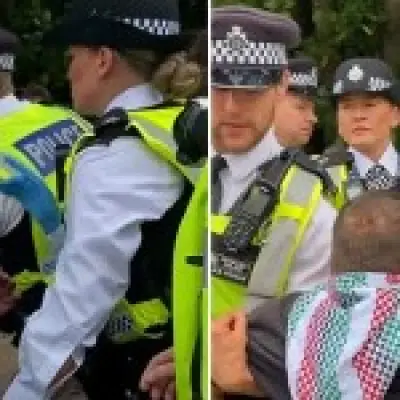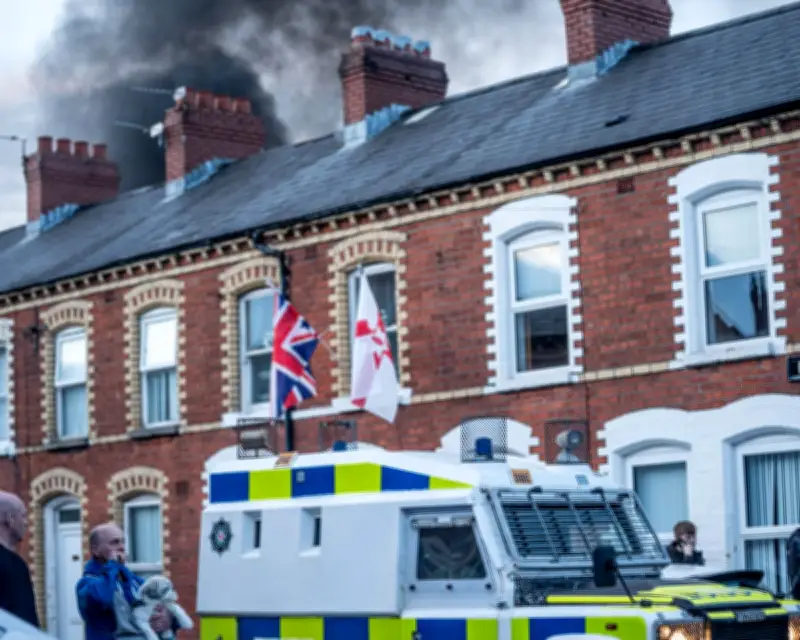
Riot police arrived at the scene of a fire lit by anti-immigration protesters in Belfast, as violent disturbances prompted renewed scrutiny over the influence of loyalist paramilitary groups. The racially motivated violence unfolded in a nationalist area but played out against a backdrop of union jacks and loyalist murals, highlighting a stark dissonance.
Background of the Violence
The knife attack that triggered the unrest occurred in a nationalist area, yet the mayhem was marked by union jacks and loyalist imagery. Rioters hurled missiles and targeted foreigners on Shankill Road, while just a few blocks away on Falls Road, adorned with Irish tricolours and republican murals, calm prevailed. History, demographics, and psychology explain some of the diverging community reactions, but paramilitaries also play a familiar role beneath the surface.
Paramilitary Presence and Influence
Security services and academics indicate that there are more loyalist paramilitaries today than in 1998 when the Good Friday Agreement ended the Troubles. A 2020 estimate placed the number as high as 12,500, though many members are inactive. The Ulster Volunteer Force and Ulster Defence Association, proscribed as terrorist groups in the UK, have persisted despite a state-sponsored transition process intended to phase them out. These groups have splintered into sub-groups, some involved in drug dealing, extortion, and racketeering, while others cooperate with politicians and civic organizations seeking to consign them to history.

The riots have renewed scrutiny because they occurred in areas where paramilitaries wield influence. Assistant Chief Constable Ryan Henderson stated that police found no evidence of paramilitary orchestration of the violence. Instead, evidence suggests some paramilitary leaders chose neutrality—neither stoking nor impeding the violence—to make a point about the consequences of a security vacuum.
Warnings of a Vacuum
Jamie Bryson, a prominent loyalist activist, remarked, "The chickens are coming home to roost. You don't want loyalists to play any part in society? You want the groups to go away? Well, there you are, there's the wild west. Be careful what you wish for because you're going to create a vacuum." Bryson explained that under pressure to disband, loyalist groups decided not to intervene when trouble flared. "People don't want you to exist on a Monday and all of a sudden want you to partially exist when it suits on a Tuesday? No. The groups are not going to exercise influence and coercion when it suits the great and the good. They're saying very clearly: 'We're not stepping into these community policing roles any more.'"
This is Northern Ireland's version of the warning attributed to French King Louis XV: "Après moi, le déluge"—after me, the flood. Remove authority, however unpopular, and you risk anarchy. The dilemma prompted Linzi McLaren, a former police officer and Ulster Unionist party councillor, to urge authorities to engage with paramilitary groups—"as unpalatable as it is"—to rein in the rioters.
Opposing Views on Engagement
Aaron Edwards, a historian and authority on loyalism, argued that engaging with paramilitaries would be a mistake. "People see this as a lever to pull against race-based violence. But what you get is morally repugnant. It's completely indefensible to talk about engaging in paramilitaries on this issue given their long history of violence and coercive control against their own communities." Edwards, author of UVF: Behind the Mask, noted that paramilitaries may prevent one form of violence while inflicting another. "For people in the rest of the UK, if things quiet down, they don't really care how that happens. But it's almost like the sausage factory, if people realised what went into making sausages, they probably wouldn't eat them."

Unrest and Its Aftermath
The unrest erupted after graphic footage of a knife attack that left Stephen Ogilvie seriously injured was disseminated. The suspect, a refugee from Sudan, was charged with attempted murder. Disturbances dwindled after Wednesday, but the mood remains febrile, marking Northern Ireland's third consecutive summer of racially motivated riots. Edwards said paramilitary activity is lucrative—"they're not going away because it's in their interests to stick around"—and that the riots could bolster recruitment by creating a fresh pool of boys and young men with criminal records.
Given the fractured nature of the groups, individual members likely joined the rioters. In Ballymena, however, one senior loyalist said he and like-minded colleagues intervened and helped avert violence. "People think we're all rightwing. We're not. Both my grandfathers fought in the war against Nazis. I don't want Nigel Farage as my prime minister." Another factor was memories of riots last year that terrified foreign families and left dozens of local youths facing prosecution. "People had had enough. Last year in Ballymena it was horrible." Visiting gutted homes, some saw pencils and homework left by children forced to flee. "You see the human side, it makes you think."
Underlying Causes
Some analysts attribute anti-immigrant sentiment in loyalist areas to a siege mentality honed over centuries, with recently arrived people of colour taking the place of Irish rebels. Others cite the fact that a falling Protestant population creates vacant properties that in some cases are filled with new arrivals. Xenophobia is not confined to loyalist areas. According to evidence from the Institute of Irish Studies at the University of Liverpool, most Catholics and Protestants believe that immigrants do not make a positive contribution to society and the economy.
Richard O'Rawe, an author and former IRA prisoner, said, "People want to be decent and be seen to be decent. At the same time people want immigration controlled, they don't want the borders opened and it's come one, come all. They don't want to end up like Birmingham." However, racism was anathema to republicanism, which motivated community leaders to curb racist eruptions. "They'd be out there saying 'don't do this'."
Bryson said loyalist paramilitaries lacked the civic structures for such "soft power" and would still—if minded to snuff out a racist riot—require coercive control. "Do people think they're going to send a nice letter to 100 masked men on the rampage and that that's going to have any impact? They would need to forcefully put an end to it. They would still have to do it the old way."