
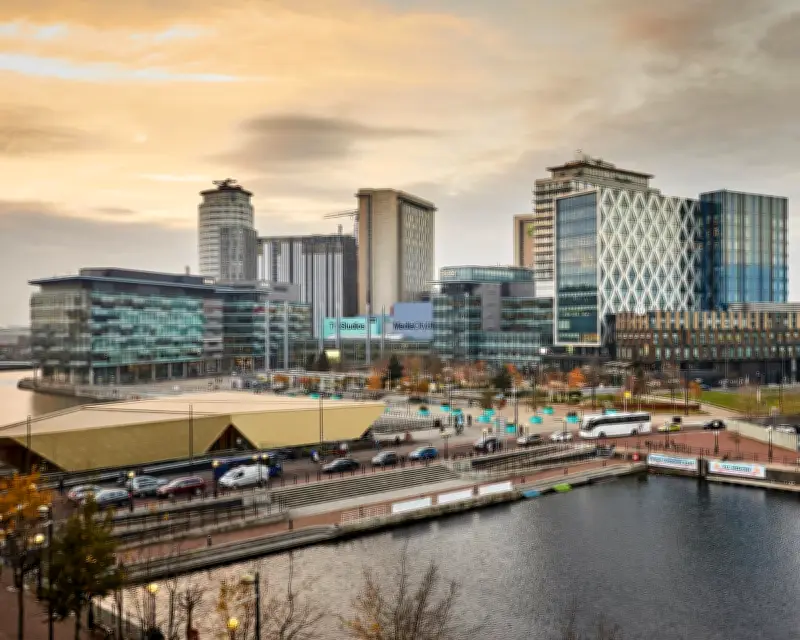
Fifteen years after the BBC began moving operations to Salford, MediaCity has become a thriving media and technology hub, housing 3,500 BBC staff and 250 other creative and tech businesses. The move, part of the BBC's 'Out of London' plan announced in 2004, initially faced significant skepticism from senior staff and talent who were reluctant to leave the capital.
Initial resistance and transformation
When the BBC first announced its intention to move a significant chunk of its operation to Salford in Greater Manchester, there were plenty in the organisation who were scornful that it could ever work. Senior staff would never leave the capital, and star talent wouldn't dream of travelling. Breakfast presenter and Strictly Come Dancing winner Chris Hollins said it 'didn't take a brain surgeon' to see that the prime minister would never appear in person. Jeremy Clarkson, then presenting Top Gear, said he would rather quit than relocate to 'a small suburb with a Starbucks and a canal with ducks'.
Despite the resistance, the move went ahead. The 200-acre MediaCity in Salford docks now leads significant parts of BBC output, including its current World Cup coverage. Some think enabling people from the north-west to have broadcasting careers closer to home is a good thing.
A model for government devolution
New Prime Minister Andy Burnham, formerly Manchester's mayor, has promised to create a 'No 10 North' by moving part of his executive office to Manchester. A dedicated department in the city will oversee plans to devolve power and resources to cities and regions across the UK, aiming to become 'the nerve centre of a rewired Britain'. Details are sketchy, and some have been sceptical, with one Labour MP calling it 'performative' and 'a gimmick'.
The BBC is not the only major organisation to shift resources out of London. Channel 4 is now headquartered in Leeds; the largest hub for HMRC is in Newcastle; the Office for National Statistics (ONS) moved its head office from London to Newport, south Wales in 2007. Successive governments have committed to moving tens of thousands of civil servants out of the capital, notably at a 'multi-department government hub' in Darlington, county Durham, which now houses nine departments including a major Treasury outpost.
Key factors for success
Alice Webb, who oversaw the BBC's Salford move and later became director of BBC North, says a number of things were key in making it successful. 'Yes, there was a lot of resistance, but there was also a deep, deep conviction, a very strong sense of leadership from the top of the BBC, that this was the right thing to be doing,' she says. The change had to be big enough to meaningfully shift the broadcaster's centre of gravity. Rather than moving representatives from a range of departments, the entirety of BBC Children's, 5 Live, 6 Music and BBC Sport relocated wholesale – the last despite the fact the Olympics were due to be held in London shortly afterwards.
One former BBC exec who enthusiastically relocated from London said the technological step-change made possible by the move – as well as a more flexible way of working once out of the sometimes suffocating institutional culture – made BBC North an exciting place to work at the time. 'I don't think that would have been possible if we hadn't moved north in such a short time. It might have happened over 10 years, but it wouldn't have happened effectively over one year,' she says.
Civil service moves and challenges
Many see the Treasury's hub in Darlington – already described by Chancellor Rachel Reeves as 'a No 11 of the North' – as a similar success story, albeit on a much smaller scale. According to one Treasury source, that comes down to the commitment of senior people to base themselves there. 'I think this only works when there is a senior minister behind it,' says the source. As well as a fifth of all Treasury staff, the second permanent secretary, Beth Russell, is based in Darlington full time, 'and having someone at that level sent a message to people who were still ambitious that moving wouldn't be the nail in the coffin for your career'.
Other civil service moves have seen the Ministry of Housing, Communities and Local Government setting up a base in Wolverhampton, and an official second HQ of the Department for Energy Security and Net Zero in Aberdeen. While only 21% of the civil service is based in London, according to Hannah Keenan, associate director of the Institute for Government, the proportion in senior roles is closer to two-thirds, making it an ongoing challenge to move real decision-making outwards. 'Civil servants understand where the power is,' she says. 'That sounds quite Machiavellian, but it is a sensible response because that's how decisions get taken.'
Mixed results and symbolic importance
Not every relocation is an unqualified success. The ONS shift from London to Wales saw 90% of staff resign rather than relocate, leading to a huge loss of institutional expertise and a measurable slump in its output, according to a later review. Channel 4 has faced criticism that the move to Leeds of its national headquarters did not go far enough, with its most senior executives and presenters remaining in London. In response, the broadcaster said it had undergone 'a significant and rapid transformation from a London-centric organisation to a UK-wide one', with a third of its staff based in Leeds, Manchester, Glasgow and Bristol.
According to Anthony Breach, director of research at the Centre for Cities, while there can be direct economic benefits from moving a big department or employer to a new city, it can be just as important symbolically. 'It's a signal to the wider business and policy-making communities that this is a place that is worth investing in, that we see talent and appeal in this place, that it's worth us sticking our necks out and putting our money in this particular place.' Webb, now CEO of MediaCity, agrees that successful examples of devolution of power can be key in persuading others to follow. 'It can only help to have a very powerful role model to help galvanise what people instinctively know – that making sure that all parts of the country have a part to play in decision-making is the right thing to do.'




