
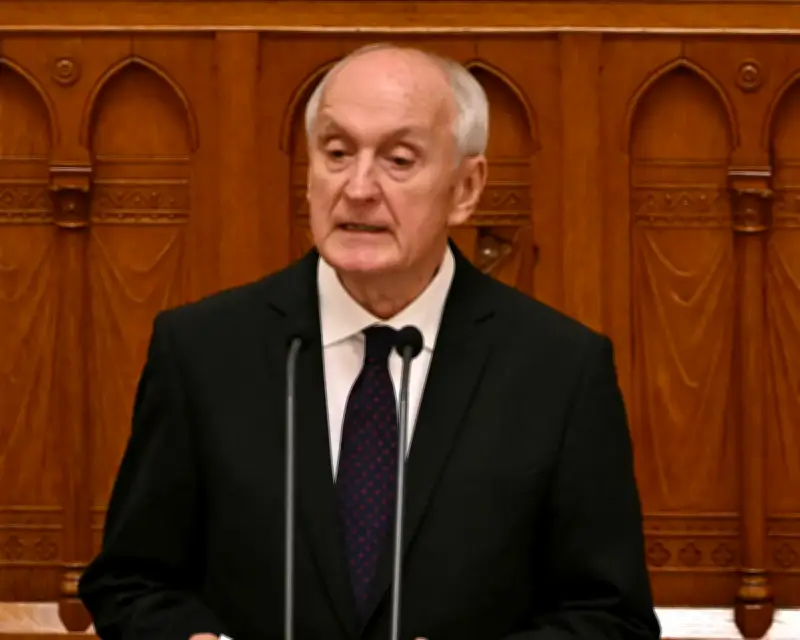
Former European Court of Human Rights and Hungarian Supreme Court judge András Baka has been elected as the new Hungarian president, receiving 140 votes in favor and six against out of 146 cast. The 72-year-old lawyer, nominated by the governing Tisza Party, assumes the role amid a period of significant political transition in Hungary.
Election and Background
Baka's election is seen as another example of the new government's explicit departure from the policies and practices of the Viktor Orbán era. In 2011, then-Prime Minister Orbán removed Baka from his position as president of the Supreme Court, three years before his term was scheduled to end. Baka subsequently won a case at the European Court of Human Rights against Hungary, underscoring the contentious nature of his dismissal.
The election took place during an extraordinary plenary session of the Hungarian Parliament, as reported by Zoltán Balogh/EPA. Baka's nomination by the Tisza Party reflects the party's influence in the current political landscape.
Acceptance Speech and Vision
In his acceptance speech, Baka articulated his belief that Hungary has "reached a period in its history when a serious reflection is needed about the functioning of the state." He referenced the last two decades as a period of "a serious crisis" under the previous government, characterized by deep societal divisions. His remarks signal an intention to address these divisions and reassess the state's operations.
Baka's election comes as he replaces Tamás Sulyok, a loyalist of Viktor Orbán who stood down, or was effectively removed, from the post last month. This transition marks a notable shift in Hungary's political trajectory, as the new administration seeks to distance itself from the previous leadership's legacy.
Impact and Next Steps
Baka's presidency is anticipated to bring a new approach to the role, potentially influencing Hungary's judicial and political landscape. His background as a judge who has challenged the state in international courts may inform his tenure. The six votes against his election indicate some opposition, but the overwhelming support suggests a broad mandate. As he assumes office, observers will watch for concrete actions addressing the societal divisions and state functioning he highlighted in his speech.




