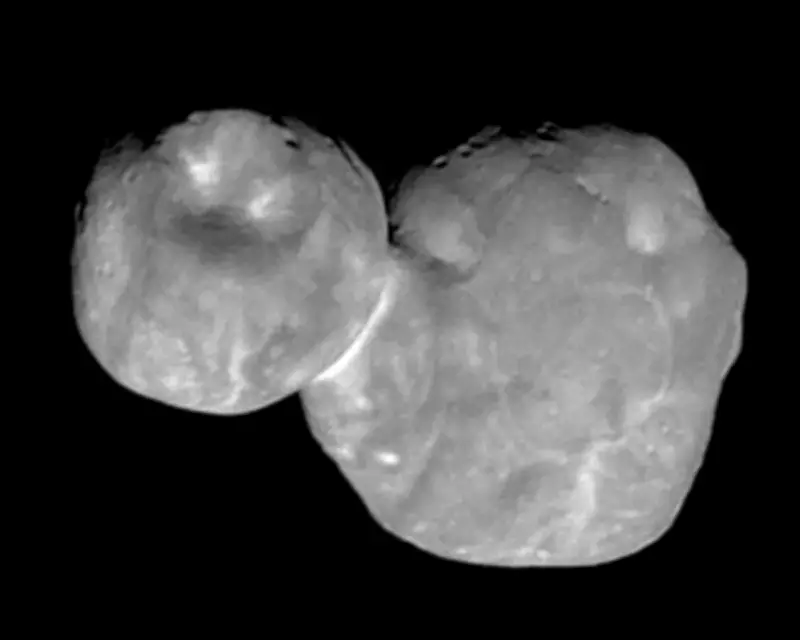
NASA's Arrokoth Formation Mystery Solved: Snowman-Shaped Kuiper Belt Object Explained
Researchers have unveiled groundbreaking insights into the formation of Arrokoth, the most distant and primitive object ever visited by a spacecraft from Earth. This ultra-red, 4-billion-year-old body, located in the Kuiper belt beyond Neptune, boasts a distinctive snowman-like shape that has long puzzled scientists. New computer simulations now shed light on how this unique double-lobed structure likely emerged through a process known as gravitational collapse, adding substantial weight to existing theories.
The Kuiper Belt: A Cosmic Nursery for Planetary Building Blocks
The Kuiper belt is a vast, thick ring of icy objects that serves as a remnant of the solar system's primordial protoplanetary disk. This region is home to most known dwarf planets, comets, and small, solid rubble heaps called planetesimals—the fundamental building blocks of planets. Not all planetesimals are rounded; astronomers estimate that 10-25% of those in the Kuiper belt, including Arrokoth, feature two lobes, resembling a peanut or a snowman. Previous research suggested that Arrokoth's shape, composition, and minimal cratering indicate both lobes formed simultaneously in a non-violent manner, but the specifics remained debated until now.
Simulations Confirm Gravitational Collapse Mechanism
In a study published in the Monthly Notices of the Royal Astronomical Society, a team led by Jackson Barnes of Michigan State University conducted 54 computer simulations to explore gravitational collapse. They modeled an initial pebble cloud containing 105 particles, each with a radius of about 2 kilometers (1.25 miles), representing a low-resolution version of real pebble clouds thought to contain about 10^24 millimeter-sized particles. The simulations revealed that in some cases, two small planetesimals orbited each other, eventually spiraling inward at velocities of 5 meters per second or less until they touched and merged, forming a double-lobed planetesimal or "contact binary."

"It's so exciting because we can actually see this for the first time," said Barnes. "This is something that we've never been able to see from beginning to end, confirming this entire process." Unlike prior simulations that ignored particle interaction physics, this new approach accounted for how particles rest upon contact, preventing collisions from simply creating larger, spherical objects. Barnes noted that some contact binaries in the model look strikingly like Arrokoth, providing compelling evidence for the gravitational collapse theory.
Expert Reactions and Implications for Planetary Science
Alan Stern, a planetary scientist at the Southwest Research Institute and principal investigator of NASA's New Horizons mission to the Kuiper belt, welcomed the findings. "It's in agreement with previous work and supports the hypothesis that Kuiper belt object Arrokoth, which New Horizons explored in a close flyby, is the result of gentle formation processes," he said. The simulations also bolster the long-held view that planetesimals in general formed through gravitational collapse, offering a clearer picture of early solar system dynamics.
However, Alan Fitzsimmons, an emeritus professor of astronomy at Queen's University Belfast, pointed out a discrepancy: the simulations suggest only 4% of objects form as contact binaries, whereas telescopic surveys imply much higher fractions. "It may be that Mother Nature prefers other ways of making them, or that future even more complex simulations can close the gap between what is calculated and what we see," he remarked. This highlights the need for further research to refine our understanding of cosmic formation processes.
Overall, this research not only solves the mystery of Arrokoth's snowman shape but also advances our knowledge of how planetary building blocks evolve in the distant reaches of our solar system.