
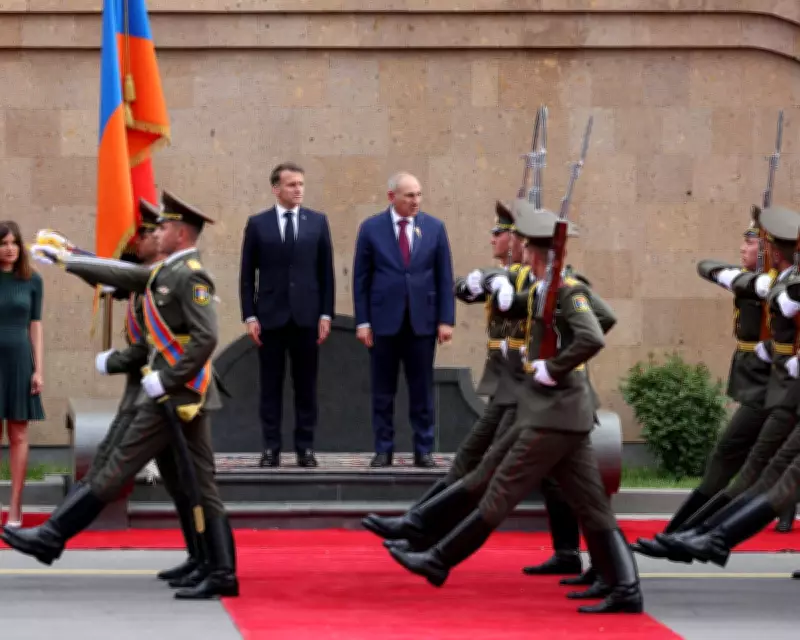
To describe Yerevan, a charming city of liberal values encased in imposing Soviet architecture, as the centre of the world is a stretch. However, Armenia's claim that it can become the strategic crossroads of Eurasia is becoming less fanciful. As the former Soviet Republic goes to the polls on 7 June for national elections, it finds itself in a five-way tug of war between Russia, the US, Turkey, Europe, and Azerbaijan.
The Promise of Peace and Connectivity
The interest has been sparked by the possibility of an end to Armenia's conflict with Azerbaijan, offering a chance to end its physical isolation and become part of the middle corridor—a vital trade route linking western China and Europe, bypassing Russia's northern corridor and the Suez Canal. Prime Minister Nikol Pashinyan claims that opening borders with Turkey and Azerbaijan could transform not just Armenia but the entire South Caucasus. 'The shortest route between east and west goes through Armenia,' he said.
Foreign Minister Ararat Mirzoyan stated that the government's aim is to turn Armenia's geography into a strategic asset. 'The challenge after decades is how to become a bridge rather than an obstacle. We can connect Europe with Central Asia, the far east, India, and China, guaranteeing our peaceful prosperity,' he explained.
The Real Armenia Doctrine
This geopolitical vision is central to Pashinyan's campaign for a third consecutive term. The Real Armenia doctrine requires making painful peace with Azerbaijan and pivoting away from Russia toward the EU—described as a 'more diversified foreign policy.' It involves controversial moves, such as sacking the director of the Armenian genocide museum for giving JD Vance a book on Azerbaijan massacres and removing Mount Ararat from passport stamps.
Early polls suggest Pashinyan's Civil Contract party may win, despite overseeing two humiliating military defeats to Azerbaijan in 2020 and 2023. The second defeat led to the forced displacement of 100,000 Armenians from Nagorno-Karabakh. Nineteen prisoners remain captive in Baku, including former minister Ruben Vardanyan.
Election Campaign and Opposition
The campaign promises to be wild. Pashinyan's near-constant Facebook presence and high energy produce a stream of video content, from eating pastries to listening to Russian rock star Zemfira. He often engages in heated rows with voters, accusing opposition leaders of being brainless foreign spies.
Pashinyan faces at least three pro-Russian nationalist parties, including Stronger Armenia, led by billionaire Samvel Karapetyan. Karapetyan, under house arrest for alleged coup support, has accused Pashinyan of hallucinogenic mushroom use and promises a Ministry of Sex to address demographic decline. Human rights activists like Kenneth Roth have questioned whether European leaders should support Pashinyan, whose populism borders on authoritarianism.
The Peace Deal Hurdle
The final hurdle to ratifying the peace agreement initialed in the White House last August is Azerbaijan's demand that Armenia remove a constitutional reference to unification with Nagorno-Karabakh. Civil Contract says it will rewrite the constitution and put it to a referendum, requiring a two-thirds parliamentary majority—a tall order. Pashinyan insists, 'We will not give up. Peace and open borders are the right path.'
Civil Contract's chances would improve if Azerbaijan makes concessions before polling day, such as reopening the Turkish border or releasing Armenian prisoners. Tigran Grigoryan from the Regional Center for Democracy and Security warns of a 'no peace, no war' scenario if the constitution cannot be changed.
Russia's Shadow
Vladimir Putin recently suggested a referendum on EU versus Eurasian Union membership, injecting a polarizing topic. Russia has banned imports of Armenian mineral water Jermuk as a subtle signal. Grigoryan warns that nationalizing Russian-owned railways could cross a red line, potentially leading to gas subsidy cuts.
French President Emmanuel Macron, visiting Armenia, accused Russia of treachery for failing to aid Armenia during the Nagorno-Karabakh war. Pashinyan's warm handshake with Volodymyr Zelenskyy, speaking English not Russian, infuriated Moscow. Maria Karapetyan denies the EU pivot is a mirage: 'We are not looking for saviours. It's OK that no one wants to save us.'




