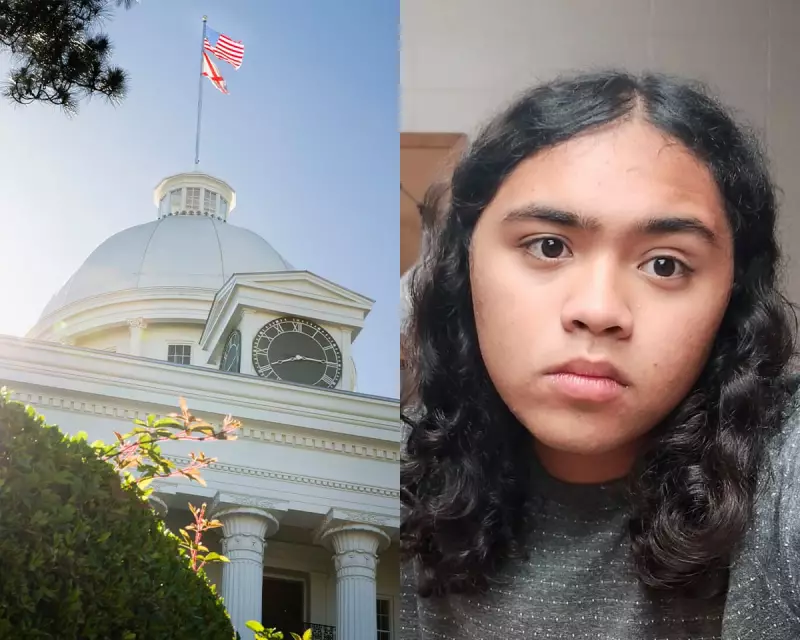
In an extraordinary turn of events that has captured national attention, an 18-year-old university freshman has successfully redrawn Alabama's state senate voting map, seeing his creation adopted as official law after a federal court selected it over proposals from professional cartographers.
From Dorm Room to Courtroom
Daniel DiDonato, a first-year student at the University of Alabama, was preparing for his 9:30am political science class when he discovered the federal court had chosen his voting district map to remedy violations of the Voting Rights Act. The teenager had submitted his proposals under the anonymous initials "DD" and was the only member of the public to participate in the court's public submission process.
"I was absolutely surprised," DiDonato admitted in an interview. "Now, nearly 300,000 Alabamians will be voting under new district lines that I drew up at two in the morning in a dorm, a cramped dorm study room."

The remarkable outcome highlights how technological advances have democratised the redistricting process, transforming what was once the exclusive domain of political insiders with sophisticated equipment into an activity accessible to anyone with determination and free software.
The Making of a Mapmaker
DiDonato's journey began about a year ago when he developed a fascination with redistricting and started experimenting with Dave's Redistricting App, free online software that has revolutionised public participation in electoral cartography. Growing up in Russell County near the Alabama-Georgia border gave him particular insight into the state's political geography.
In early October, working late into the night fueled by soda but avoiding caffeine, the student created six potential maps over several days. He deliberately turned off racial and partisan data while drawing the lines to ensure population equality and minimise changes to the existing Republican-adopted map.
"The federal court has a very limited mandate to impose remedial legislative districts," DiDonato explained, demonstrating his understanding of the legal constraints. Only after completing the demographic-blind drafting did he activate the racial and partisan data to verify that Black voters would gain an additional opportunity to elect their preferred candidates, fulfilling Judge Anna Manasco's requirement.
Legal Battle and Unexpected Victory
The case originated in August when US District Judge Anna Manasco, appointed by President Trump, ruled that Alabama Republicans' 2021 map illegally diluted Black voting influence around Montgomery, violating the Voting Rights Act. When state legislators declined to create a compliant map, the judge appointed a special master to develop alternatives.
Richard Allen, the special master overseeing the case, included one of DiDonato's maps alongside two professional proposals but appeared to use the student's work as a contrast to demonstrate the superiority of the expert-drawn alternatives. Allen criticised DiDonato's plan as providing only a "weak" remedy for the Voting Rights Act violation.
Both Alabama officials and the plaintiffs who originally challenged the map objected to DiDonato's proposal. The state accused him of racial gerrymandering while paradoxically describing his map as "the least bad of several bad options." The plaintiffs argued it didn't provide sufficient opportunity for Black voters in one district.
Seeing these objections proved "demoralising" for DiDonato, who described the state's gerrymandering accusation as "offensive and disingenuous," noting he had drawn the maps "entirely blind to the racial and partisan configurations."
Community Impact and Legacy
DiDonato's success has electrified the online community known as Election Twitter, where political enthusiasts, data analysts, and amateur mapmakers share forecasts and district proposals. The 18-year-old acknowledges belonging to this community dominated by politically engaged teenagers seeking meaningful ways to participate in democracy.
"Let's just say the entire Election Twitter community has spent the last week rallying around the fact that one of their own got an actual map that's in law," DiDonato said. "I think that this is a motivation that says one of our own did this really cool thing, I think I can do a cool thing too."

Chaz Nuttycombe, a 26-year-old who founded the non-profit State Navigate after building a reputation for accurate state legislative forecasts while at Virginia Tech, observed: "You have a whole bunch of these kids who are snippy and savvy and know about the Voting Rights Act. I've seen maps put together by special masters that I disagree with, and I've seen kids on Election Twitter put forward better maps."
DiDonato also reflected on the historical significance of addressing Voting Rights Act violations in Alabama, a state with a painful legacy of voting discrimination. "The Voting Rights Act has a long and storied history that dates back here to Alabama, here very locally, to the Montgomery region, and knowing that Black voters are continuing the struggle for voting rights, and that I got to be a part of the history to fix that... it just feels, it feels like an honor, and it's kind of humbling."
While the special master will receive payment for his work, DiDonato will not be compensated, though he remarked with characteristic humility: "I don't want payment. That would be nice, I guess. They did professional work, I did not."
The state of Alabama is currently appealing Judge Manasco's decision to the US Court of Appeals for the 11th Circuit, meaning the teenage mapmaker's work may yet face further legal scrutiny.