
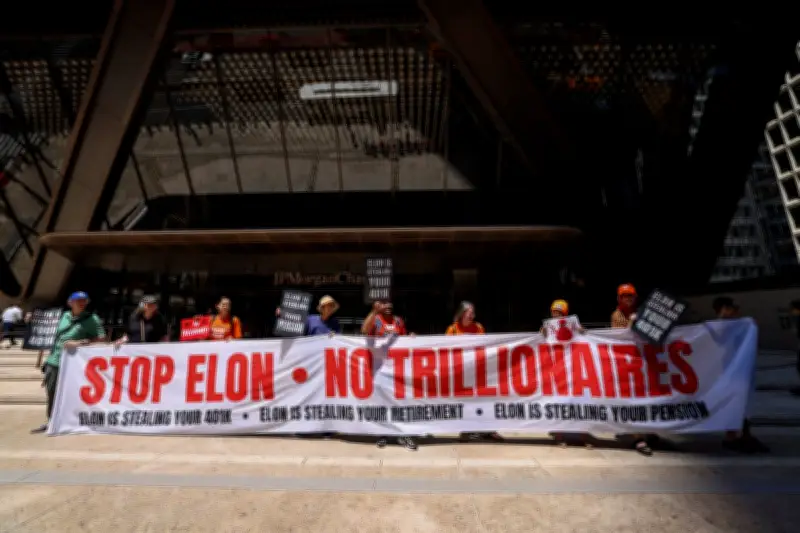
Protesters gathered outside JPMorgan Chase in New York City on 12 June 2026 to oppose the SpaceX initial public offering, highlighting the stark contrast between soaring billionaire wealth and the struggles of American workers.
Billionaire wealth surges as workers fall behind
The day Elon Musk became the world's first trillionaire, Gilberto Rubio, a security officer in the San Francisco area, was thinking about cutting back on meals to save money. Jessica Ordeñana, a Manhattan bartender, worried about affording air conditioning during a heatwave due to high electricity bills. Both are among millions of US workers struggling as inflation erodes wage gains and consumer confidence hits record lows.
On Thursday, California's controversial billionaire tax measure officially made the ballot after a hard-fought campaign. The fight will continue until November's general election, with Silicon Valley expected to spend heavily to defeat it.
Wealth concentration reaches historic levels
The wealthiest 0.00001%—about 20 individuals—hold wealth equal to 12% of US GDP, roughly four times the level during the Gilded Age, according to economists Gabriel Zucman and Emmanuel Saez. Musk lost his trillionaire status temporarily as investors soured on AI, but he added $327bn to his fortune in the last year alone. His wealth rise from $28bn in 2020 was cemented by SpaceX's stock listing, with more millionaires and billionaires expected from upcoming IPOs of AI rivals Anthropic and OpenAI.
The US is home to 989 billionaires, owning over $9.2tn in 2026, up 31.8% since 2025, according to Americans for Tax Fairness.
Workers' share of economy shrinks
In 2025, US workers took their smallest share of GDP since 1947, falling to 53.8% in the third quarter. Inflation hit 4.2% in May 2026, wiping out 3.4% wage growth. About 45% of workers (66 million) earn less than $25 an hour, while a living wage exceeds $25 in most major metro areas, per MIT's living wage calculator. Credit card debt hit a record $1.277tn in Q4 2025, up 63% since Q1 2021.
Rubio, who works three jobs and lived out of his car, said: “I haven’t been able to get ahead working one job. Your life is working and we don’t have anything to show for it.” He makes $25 an hour with no raise in years, below the living wage of $30 in San Francisco. He added: “I don’t think [Musk] hitting that milestone really affected anybody in a positive way, other than himself.”
Ordeñana earns $11 an hour plus tips, which fluctuate. “I can’t afford air conditioning, so this will be my second summer without AC,” she said. “The fact that the rich keep getting richer for no good reason is really, really, really disgusting to me.”
Backlash and calls for change
Worker advocates see opportunities for change. Saru Jayaraman of One Fair Wage said: “I’ve never experienced this kind of explosive campaign growth over the last year as I have in 20 years, 25 years of organizing.” Support for wage rises crosses party lines.
Zucman warned of potential oligarchy: “Is it when the wealth of the ultrarich exceeds 50% of GDP, as in the US today? 100%? Nobody knows the exact concentration at which plutocratic collapse becomes inevitable.”
Cienna Pangan, a Starbucks barista in Chicago, noted CEO pay disparity: median worker pay was $14,674 in 2024 vs CEO Brian Niccol's $97.8m. CEO pay grew 20 times faster than average worker pay in 2025, per Oxfam. Pangan said: “We aren’t making enough to pay for groceries, we’re not making enough to pay rent.”
Daniel Mandell, professor emeritus at Truman State University, said: “Will the current awareness of the dangers of this yawning economic chasm, spotlighted by the outrageous behavior of ‘tech bros’ like Elon Musk with his $1tn, lead to policy changes? I hope so.”
Starbucks and SpaceX did not respond to requests for comment.




