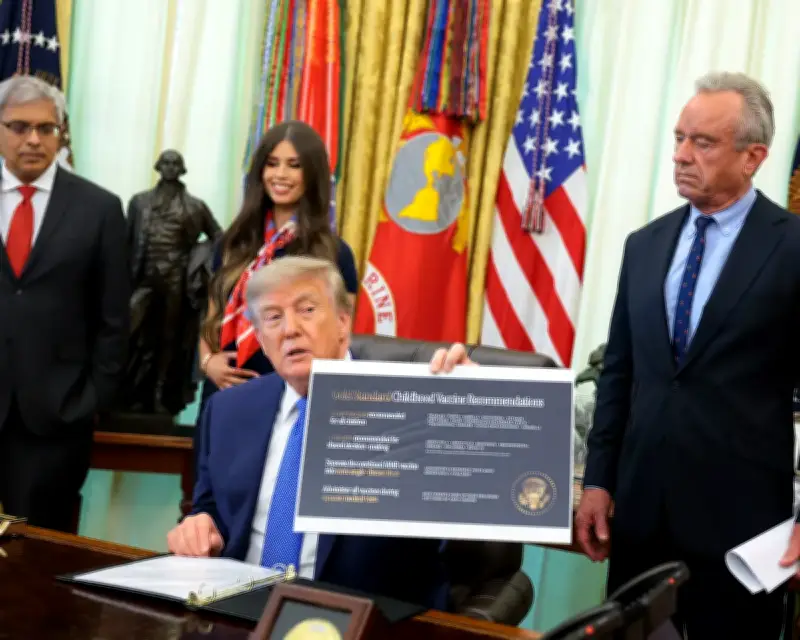
President Donald Trump signed an executive order on Monday directing that the measles, mumps, and rubella (MMR) vaccine be split into three separate shots, and that all childhood immunizations be administered at separate medical visits to the maximum extent feasible. The order, based on the president's stated feelings rather than scientific evidence, has drawn sharp criticism from medical experts, including Robert B. Shpiner, a clinical professor of medicine at the David Geffen School of Medicine at UCLA, who warns of severe consequences.
No Evidence Supports the Order
Shpiner, who has practiced and taught intensive care medicine for over 40 years, notes that the order rests on a single complaint: American children are recommended more vaccine doses than children in any other developed country—84 doses across 57 injections by 2024, compared to 23 doses in seven injections in 1980. However, the most thorough review of the American childhood immunization schedule, conducted by the Institute of Medicine in 2013, found no safety signal and no case for spreading doses out. A delayed-schedule trial could not ethically be run, as delay only lengthens the time a child is unprotected.
The president and Health Secretary Robert F. Kennedy Jr. repeatedly cited autism as a rationale for the order. Yet, a 2019 study of 657,461 Danish children found no association between MMR and autism, and a study last month of 2.56 million American children found none between the timing of a first MMR dose and a later diagnosis. "Studies were designed to answer whether vaccines are the cause of autism, and they have answered it. They are not," Shpiner said.
Reduced Protection Against Serious Diseases
Under the order, the number of diseases every child is recommended to be protected against falls from 18 to 11. Seven are removed from universal recommendation: hepatitis A, hepatitis B, rotavirus, influenza, Covid-19, meningococcal disease, and RSV. Some are now recommended only for children at high risk, while the rest are moved to "shared clinical decision-making."
Hepatitis B is a clear example of the danger. An infant infected at delivery has roughly a 90% chance of chronic infection, and the dose given in the first hours of life prevents about three-quarters of that transmission. Meningococcal disease kills 10% to 15% of those it infects even with prompt antibiotics, and up to one in five survivors is left with deafness or an amputated limb. RSV was the leading cause of hospitalization among American infants until universal immunization began in 2023; in the first season with those products widely available, hospitalization among infants under eight months fell by about 43%.
Instinct Over Evidence
Shpiner highlights that the order is based on the president's instinct, not evidence, citing a televised briefing in April 2020 where Trump asked whether disinfectants could be injected into the body. He argues that a president is entitled to be a layperson, but the question is what a layperson's instinct is doing where evidence belongs.
The splitting instruction cannot currently be carried out, as the order conditions it on single-disease products becoming domestically available, and none exist. Merck stopped making them in 2008 and told federal advisers in 2009 that it would not resume, at the urging of pediatricians who warned it would mean more needles and longer vulnerability. Restoring them would take years.
Impact on Vulnerable Families and Legal Threats
If the products did exist, federal survey data describe who is unable to complete a multidose series: uninsured, low-income, renting, recently moved, or with more than one child at home. In a county with no pediatrician, one well-child visit already costs half a day of wages; asking for three visits would be prohibitive for many.
The order also directs the attorney general to pursue legal action against state laws that conflict with obligations to provide religious and medical exemptions to school entry rules. This could undermine the last enforceable layer of protection for American children, as school entry rules are state law and no president can rewrite them.
Shpiner concludes by noting the real-world consequences: kindergarten MMR coverage is 92.5%, below the 95% needed to interrupt transmission, with exemptions at a record 3.6%. There has been more measles this year than in any of the past 35 years, and in November the Pan American Health Organization will decide whether the country still qualifies as having eliminated the disease. He recalls a neurocritical care conference reviewing a child left with profound and permanent brain damage by measles encephalitis, a disease preventable by a vaccine that has existed for decades. The order, he says, does not have to persuade a single parent; it only has to remove a recommendation, add visits, and point a government lawyer at a state legislature. A feeling cannot be tested, and it cannot be proven wrong. The children it reaches cannot be counted.