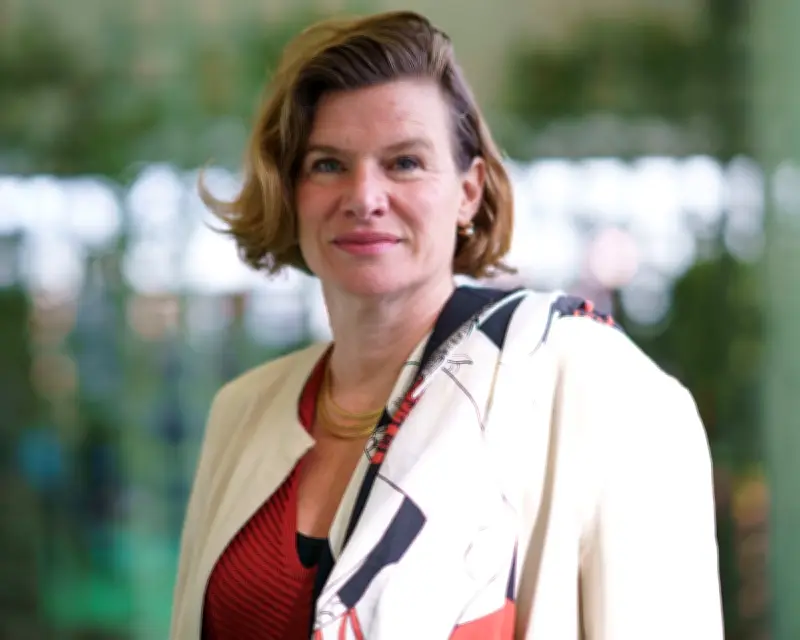
Economist Prof Mariana Mazzucato asserts that governments must reclaim their vision and direction to build an economy for the common good, addressing inequality and the climate crisis. In her new book, The Common Good Economy: A New Compass, she calls for a fundamental remaking of economic theory and government practice.
Governments must stop cringing before bond markets
Mazzucato argues that governments need to 'get back their mojo' and believe they can change the world. 'If there's no purpose or direction, then what the hell are we doing?' she asks. She insists that governments are the supreme actors and shapers of markets, not passive fixers. 'They need to start believing they can govern, wield their power without apology, and stop cringing in the face of the bond markets,' she says.
Her judgment on the UK Labour government under Keir Starmer is withering. 'Fine, come in, say the Tories were shit, but once you've said it, move on!' she exclaims. 'You've got five years, so what's your plan? What's the positive narrative? It was always half baked … [now] it's half assed.'

The failure of neoliberal economics
Mazzucato traces the loss of the common good to the early 1980s under Reagan-Thatcherism, when people became consumers instead of citizens. Governments recast themselves as administrators focused on efficiency and cost-cutting, adopting business school paradigms. This brought the debasement of the public sphere, she argues.
In her 2013 book, The Entrepreneurial State, she exploded the myth that only the private sector can innovate, showing that economic success comes as much from the public sector. For example, the internet started as a government project. In The Big Con (2023), she and co-author Rosie Collington exposed how reliance on consultants weakens businesses and warps economies.
A new compass for the common good
Mazzucato distinguishes the common good from 'public goods' in economic jargon. 'Public goods are merely corrections for what the private sector won't do; the common good, however, is a shared objective,' she writes. She advocates for 'pre-distribution' – ensuring citizens get a fair share from state investments from the outset – rather than redistribution through taxes and benefits.
She rejects the 'tragedy of the commons' framing of the climate crisis. 'In the old economics, doing good is a correction. In an economics of the common good, it is an objective we design and work on together,' she says. She also distances herself from degrowth movements, stating: 'The problem is not growth, but that we've been growing in the wrong way.'
Community and joy at the heart of the common good
Mazzucato points to practical examples like turning food banks into food cooperatives in Camden, north London. 'Just literally the facial expression that I've seen in women – it's mainly women who use it. There's a Somalian women's food cooperative near here where they just feel good,' she says. 'Look at people walking into a food bank – they don't feel good. It just goes to our human soul.'
She also highlights Arsenal FC's community programmes, including children's football teams. 'My kids all used to play there on Friday nights, and I used to almost cry when I'd go there. You just see hundreds of kids and their parents, lots of them from the local estates, and I used to think, imagine if this was normal,' she says. 'I literally would bet that if you made a kind of Marshall plan investment in soccer pitches, public libraries, public pools, and made it beautiful, you would see health benefits and lower crime and a lower cost to the state.'
Paying for the common good
Regarding financing, Mazzucato insists: 'There's plenty of money, it's just not directed towards anything, and government's part of the problem.' She dismisses fears of bond market penalties for strategic investment, citing Liz Truss's tax policy as a case of 'the most idiotic tax policy ever' rather than an investment issue.

Mazzucato's ideas draw from biology, Indigenous knowledge, and carnival culture. 'We unfortunately talk too much to economists, too little to poets,' she says. Her overarching message is one of hope: 'The reason I'm hopeful is that all of this is possible. [You need] a happy narrative [for the common good] that would inspire young people. Like the Artemis going to the moon – it doesn't have to be space, but really ambitious missions make people dream. They're all looking up at the sky.'