
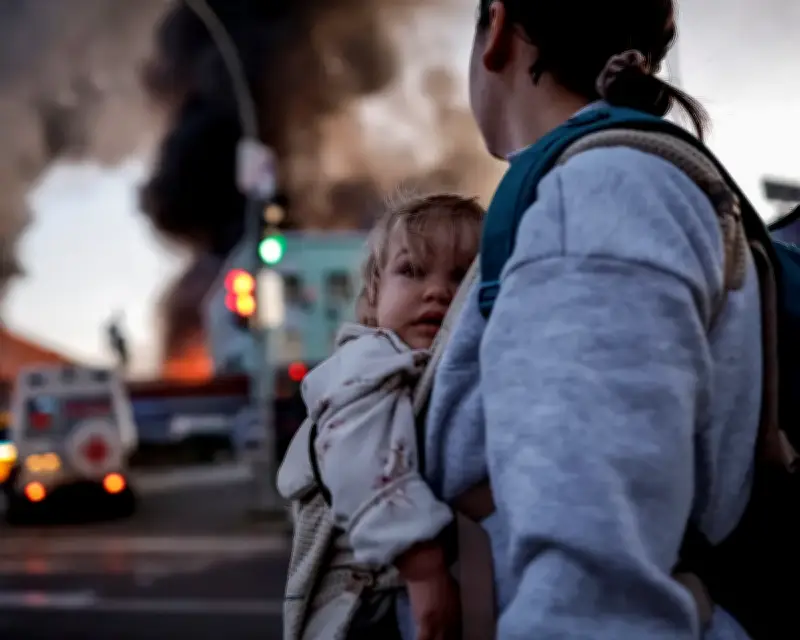
Ukrainian writer and war veteran Alina Sarnatska has described how women in Kyiv are experiencing shaking hands during Russian airstrikes, a symptom she says reflects the psychological toll of nearly five years of war. In a personal account, she notes that two friends recently told her their hands have started shaking during attacks, a condition she herself has lived with since a meltdown during an airstrike in the Donetsk region.
Friends Report New Symptoms During Airstrikes
According to Sarnatska, two friends in Kyiv independently reported the same phenomenon: their hands never shook before but now do during Russian airstrikes. Both wrote to her, "I don’t understand what’s just happened to me." Sarnatska, who says she is now "an ambassador for people whose hands shake during airstrikes," notes that many women she knows share similar stories.
The attacks have been relentless. Over the past five years, Russia has targeted Ukrainian cities with drones, rockets, jet-powered drones, and missiles, according to Sarnatska. She lists threats of nuclear weapons, the use of an Oreshnik intermediate-range ballistic missile in combat, a siege, destruction of heat and power systems in winter, the blowing up of a dam that flooded two city districts, and multiple terror attacks.
A Massive Attack on Kyiv in July
Sarnatska recounts that in the early hours of 19 July, the general staff of the armed forces of Ukraine reported a massive combined attack: 41 missiles and 125 drones, with Kyiv as the main target. The next morning, a friend named Valya messaged her: "Everything was fine, and then all of a sudden something happened. Everyone but me is at home asleep. I’m the only one who’s so anxious."
Despite the danger, Sarnatska observes that women "pull themselves together" after each airstrike, taking children to preschool and going to work. They sleep with their children in corridors, underground parking garages, metro stations, or pedestrian tunnels. They say "Everything’s fine" even after dozens of missiles hit overnight, then wonder why their hands shake, blaming themselves for weakness.
Personal History and the Armour of Resilience
Sarnatska draws on family history, describing her grandmother Dina, who survived Nazi occupation as a teenager, was captured and sent to Germany, and escaped, walking hundreds of kilometres home. Her grandmother, she says, was "as hard as nails," suppressing emotions and showing little compassion, which Sarnatska now understands was a survival mechanism.
Sarnatska argues that war has irreversibly changed Ukrainian women, thickening their skin into armour. They participate in combat, live under constant airstrikes, and continue working and caring for families. Yet she insists, "I would keep my belly soft," valuing love and tenderness over hardened resilience. She writes, "I do not want survival to take away my tenderness towards other people, or towards myself."




