
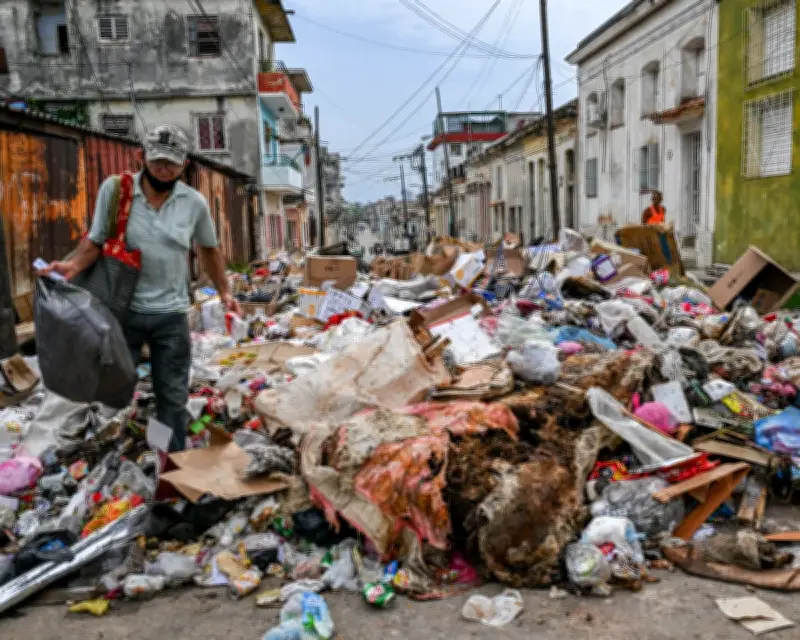
The US government's latest allegations that Cuba is behind "many of the most significant upheavals in recent American political history" and poses "a unique threat to American homeland security" contrast sharply with the reality in Havana, where a six-month US oil blockade has left people searching through uncollected rubbish for food and enduring 24-hour-plus blackouts.
State Department Report Blames Cuba for US Unrest
The unsigned 100-page report, titled Cuba: Capital of 21st-Century Communism, was published by the US state department on Monday. It blames Havana for everything from "the George Floyd riots to the rise of antifa to the explosion of pro-terrorist activism on American college campuses." The report is the latest push in a maximum-pressure campaign to bring down the island's government, which began with the abduction of Nicolás Maduro, president of Cuba's ally Venezuela, on 3 January. Since then, Cuba has been crippled by the oil blockade, sanctions on foreign businesses, and threats of military intervention.
The report also appears to target the US left ahead of November's midterm elections. It states: "Cuba's assault on the United States was never, at root, a quarrel over economic policy or sovereignty or even ownership of a particular territory. It was a revolution against western civilisation itself – waged, in part, via the novel and insidious method of persuading the children of the west to turn against their own inheritance."
Historical Claims and Omissions
The report, authored by an unnamed writer with apparent historical knowledge, notes that "almost immediately after taking Havana in January 1959, Castro began plotting armed assaults against neighbouring governments – launching expeditions against Haiti, the Dominican Republic, Nicaragua and Panama in just that year alone." However, it omits that Haiti was then ruled by François "Papa Doc" Duvalier, who killed an estimated 60,000 of his own people; the Dominican Republic by Rafael Trujillo, who perpetrated the "parsley massacre" killing 20,000 to 35,000 Haitians; and Nicaragua by the Somoza family, responsible for up to 50,000 murders.
One Cuban, reading the report, commented: "Fidel would have been quite proud of this."
Racial Undertones and Intelligence Claims
The report emphasises race, quoting an intelligence officer from a 2002 Miami Herald article: "We're much more open to Latins than we are to people with steel teeth and a Slavic accent." It bemoans the ideological commitment of Cuban-recruited spies but fails to mention that several were inspired by CIA assassination attempts against Castro or the US shelter given to exiles Luis Posada Carriles and Orlando Bosch, who organised the 1976 bombing of Cubana flight 455, killing 73 people.
The report reframes the US's internal struggle for civil rights as a battle between foreign actors and "western civilisation," highlighting groups like the Black Panthers. While several black revolutionaries, including Assata Shakur, found sanctuary in Cuba, fugitive Nehanda Abiodun said her politics came from growing up in 1970s New York, not love for Cuba, and that she was racially profiled by Cuban police upon arrival.
Cuba's Current Crisis and Response
For five years, the Cuban government has been unable to feed its 9.5 million people, who largely blame it for the crisis. The report counters: "To mistake Cuba's poverty for harmlessness is to misunderstand the threat entirely. Its material weakness was never the measure of its danger." It concludes: "Today, Cuban agents and operatives maintain a foothold in hundreds of front groups, activist organisations, solidarity centres, and ideological NGO and nonprofit networks. These groups collectively represent one of the single largest, most sophisticated and dangerous vectors for hostile foreign influence in modern American history."
In response, Cuban President Miguel Díaz-Canel said the US had fallen prey to a "new and more dangerous version of McCarthyism." A Cuban academic, who preferred to remain anonymous, offered a damning critique: "It reads just like a report Cuba's state media might write about the United States."




