
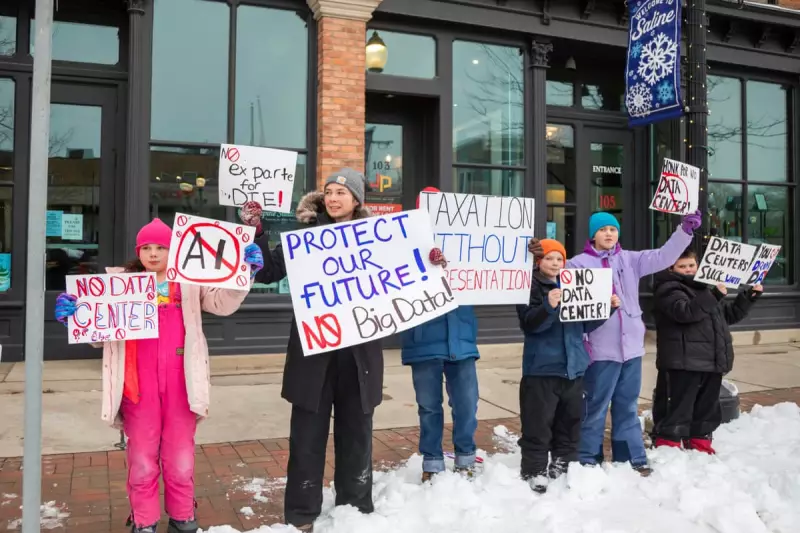
In an extraordinary display of unity, residents from across the political spectrum rallied in Saline, Michigan, on 1 December 2025, to protest a proposed data centre development on local farmland. The scene, captured in photographs, symbolises a growing, nationwide conflict pitting communities against the relentless expansion of tech infrastructure.
A 'Perfect Storm' of Opposition Meets Political Inertia
This local action in southeast Michigan reflects a broader, potent dynamic across the United States. Data centres, crucial for housing AI infrastructure, have become a 'great unifier', forging unlikely alliances. In late October, a coalition formed in Michigan that included right-wing 'Stop the Steal' activists and the Democratic Socialists of America, united by common concern.
Polling indicates only 28% of Michigan residents support new data centres. In response, state congressman Dylan Wegela introduced a bill to repeal data centre tax credits. Despite what seemed an easy political win, the bill has scant support and is unlikely to progress, with most developments poised to be built. Wegela partly attributes this to 'a lack of political courage' among fellow politicians.
The Powerful Forces Driving Expansion
Advocates describe a formidable confluence of interests ensuring political inaction. 'It is a perfect, wild storm,' said Christy McGillivray, a former Sierra Club Michigan lobbyist. National leadership from both major parties is vying for big tech's financial favour after a record-spending election cycle. Meanwhile, a potent alliance of big tech, the fossil fuel industry, utility companies, and the AFL-CIO labour union backs the centres, touting job creation.
Furthermore, the political establishment frames AI expansion as a national security issue. Some pro-business Democrats in Michigan, like Governor Gretchen Whitmer, champion projects like a proposed $7bn Oracle and OpenAI data centre as historic economic wins, despite offering massive tax breaks and creating few jobs.
Grassroots Fears and a Scattered Political Response
Community opposition stems from tangible fears: higher energy bills, water source depletion, pollution, loss of rural character, and increased fossil fuel dependency. With state and federal lawmakers largely supportive, David vs. Goliath battles are erupting at the local level nationwide.
Political pushback varies. At the federal level, Senator Bernie Sanders and Congresswoman Rashida Tlaib have called for a moratorium, while others like Senators Ed Markey and Elizabeth Warren seek stricter regulations. At the state level, Florida's Republican Governor Ron DeSantis has proposed protective measures, and Virginia's Democratic Governor Abigail Spanberger focused on capping utility bills.
Yet, this response is fragmented. 'It's all happening really fast, and at the national level, a lot of elected leaders I meet with just don't know that much yet,' said Michelle Deatrick of the DNC's Climate Council. Campaigns like one spearheaded by Food and Water Watch, which sent a December letter signed by over 230 groups demanding a moratorium, aim to educate lawmakers and harness local opposition.
Money, Unions, and a 'Magical Unicorn'
The core issue, advocates argue, is money in politics. A Guardian analysis found tech oligarchs spent $240m supporting Republicans and $52m supporting Democrats in the last session, influencing policy. The AFL-CIO's support for projects its members might build further complicates the Democratic Party's stance.
Some critics see a deeper cultural problem within the Democratic establishment. 'There's almost no risk involved in embracing this issue, so it's like it's a cultural thing from the party's top leaders,' Deatrick added. Former Michigan legislator Yousef Rabhi argues pro-business Democrats view data centres as a 'magical unicorn that will solve everyone's problems,' while ignoring externalised costs.
As the 2026 midterm races approach, more candidates may take up the issue. For now, the stark contrast between overwhelming public concern and tepid political action risks further alienating citizens. 'It's incredibly dangerous for elected officials to feed into the perception that democratic governance cannot do what the vast majority of people want,' warned Christy McGillivray.




