
UK Protest Rights Under Threat: A Call to Defend Democratic Freedoms
In a stark warning for civil liberties across the nation, the fundamental right to protest in the United Kingdom is facing unprecedented challenges. As ministers consider reforms to public order legislation, many fear that the historic freedoms cherished by generations could be severely curtailed, disproportionately affecting marginalised communities and undermining the very essence of democratic expression.
The Uneven Application of the Law
Home Secretary Shabana Mahmood has emphasised the need for laws to be "fit for purpose and consistently applied," appointing Lord MacDonald to lead a review of public order and hate-crime legislation. However, as Imran Khan KC, a practising solicitor with experience in high-profile cases like that of Stephen Lawrence, points out, the law often fails to listen to everyone equally. Despite being available in theory, it does not respond to all citizens as equals, a lesson that remains unlearned thirty years after Stephen Lawrence's murder.
This inconsistency is particularly evident in how racialised groups are treated. Muslim communities, who experience the highest levels of recorded hate crime in England and Wales, find themselves in a precarious position. They are told they do not fall within the scope of race law, yet the threshold for religious discrimination is set too narrowly to address Islamophobia effectively. This racialisation, where groups are ascribed shared characteristics regardless of individual belief, shapes their experiences when exercising rights such as protesting against the genocide in Gaza.
Policing and the Criminalisation of Protest
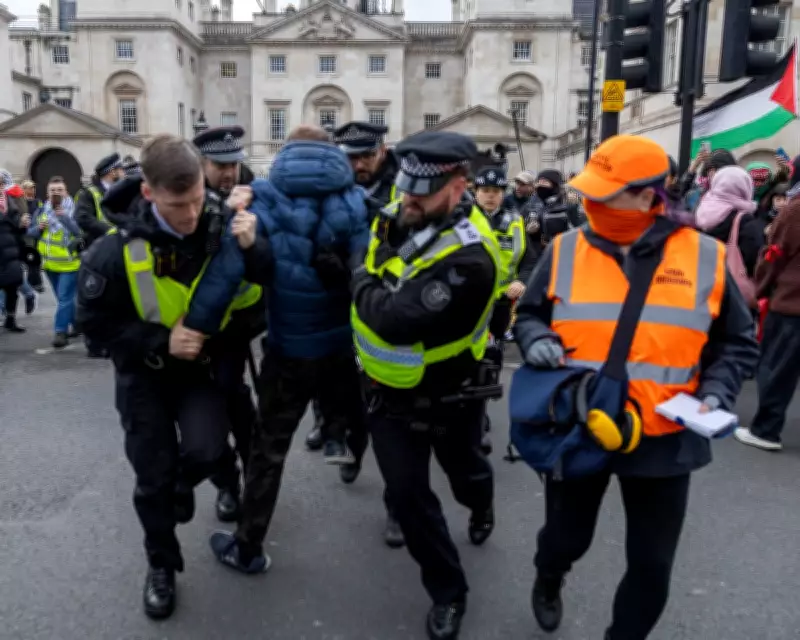
Peaceful demonstrations calling for an end to violence in Gaza, often family-oriented, are met with preemptive restrictions, heightened policing, and public warnings that blur the line between protest and criminality. Counterterrorism language is increasingly used to justify extraordinary measures, including false imprisonment and terrorism charges, treating protest as a source of risk rather than a democratic right.
This pattern is familiar to Black communities, where assumptions about aggression and disorder have long influenced stop-and-search practices, public-order policing, and criminal-justice outcomes. These biases, though rarely codified in statute, exert a powerful influence on discretionary enforcement, highlighting how racialisation connects disparate experiences of injustice.
The Threat of Cumulative Impact
Against this backdrop of skewed thinking and uneven enforcement, the looming review of protest laws raises alarm. Rather than facilitating protest as a right, the focus appears to be on constraining it, with particular emphasis on the cumulative impact of repeated demonstrations. This approach treats lawful protest as a collective nuisance rather than a series of individual exercises of protected freedom, recasting inconvenience as justification for restriction.
Such a shift contradicts the principles enshrined in Articles 10 and 11 of the European Convention on Human Rights, which protect political expression and assembly as rights exercised each time they occur, not as privileges that diminish through repetition. If applied, this could undermine the effectiveness of collective action, as seen in historical movements.
Historical Lessons and Future Risks
History teaches us that progress often requires persistent and disruptive protest. The suffragettes did not secure women's vote through a single demonstration; their campaigns were sustained and widely condemned at the time. Similarly, civil rights movements reshaped law and public life through ongoing protest in the face of significant inconvenience to those in power. Curtailing such efforts based on cumulative disruption alone would have stifled much of this progress.
Today, there is much to be concerned about from a review that threatens to entrench existing inequalities and restrict rights to preserve the comfort of others. Once the law begins to treat persistence as a problem rather than a feature of democratic participation, free speech risks becoming a matter of political permission rather than an inalienable right.
This is a critical moment for all who value democracy. As the review nears its report, it is imperative to speak up and defend the right to protest, ensuring it remains a cornerstone of British civic life for generations to come.




