
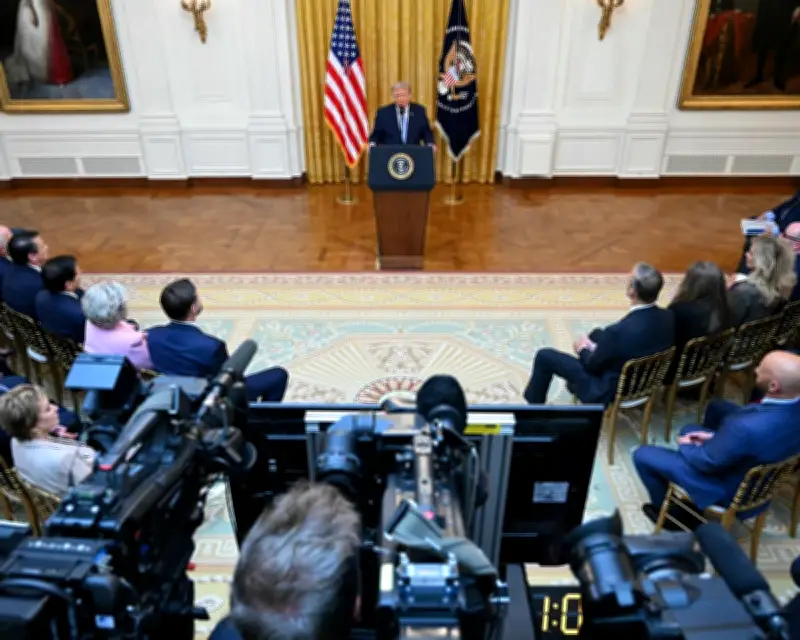
Donald Trump's primetime address on election security failed to prove foreign interference but succeeded in justifying federal investigations, targeting Fulton County and setting the stage for 2026, according to a Guardian US column by Jamil Smith.
Trump's address: claims and contradictions
In his speech, Trump assembled old intelligence, vulnerabilities and lies into a conspiracy: 220 million US voter records in Chinese hands, 'extremely exposed' voting machines, 278,000 supposed noncitizens on the rolls and a deep-state burial of proof. Yet some documents he released contradicted him. A 2021 intelligence-community assessment distinguished foreign influence from interference with registration, ballot casting, tabulation or results, and found no indication that any foreign actor attempted the latter. A newly released document judged tabulation systems difficult to manipulate at election-changing scale; a report on Venezuelan voting never confirmed large-scale electronic fraud even there.
Federal intervention in Fulton County
The speech named Michigan, but omitted Georgia. In January, FBI agents seized roughly 700 boxes of 2020 election materials from Fulton county, including about 150,000 mail ballots, 116,000 cast for Biden. The bureau redirected 260 analysts nationwide to work on an investigation into that year's election. One day before Trump's speech, ProPublica reported that the FBI had explored using artificial intelligence to re-examine ballot-envelope signatures, possibly against only one registration signature. The allegations behind the seizure had been found false; Georgia's ballots were counted three times, once by hand. Yet an FBI source told ProPublica the hunt would continue 'whether they find anything or not'.
Impact on voters of color
Signature-matching errors fall hardest on voters of color and other vulnerable groups. Fulton county was no random choice. Georgia is where Black opposition to Trump became governing power. Black voters made up about 29% of the 2020 electorate; nearly nine in 10 supported Biden. Fulton gave Biden an advantage approaching 243,000 votes in a state he won by 11,779. That coalition then elected Raphael Warnock and Jon Ossoff, transferring the Senate to Democrats. Trump's falsehoods made targets of Ruby Freeman and Shaye Moss, two Black women who counted ballots; the federal project now extends suspicion to their county.
Legislative and executive actions
Trump's justice department has lost its first 15 district-court attempts to obtain states' unredacted voter rolls, containing driver's license numbers and partial social security numbers. The day before the speech, House Republicans attached Trump's Safeguard American Voter Eligibility Act, or Save America Act, to a state department spending bill and passed it, 217–209. The bill would impose new identification requirements on mail voting, require documentary proof of citizenship to register and compel every state to send its complete federal voter list to the Department of Homeland Security within 30 days.
Enforcement and threats
On Friday, the DHS secretary, Markwayne Mullin, claimed that a database known as Systematic Alien Verification for Entitlements had identified more than 250,000 potential noncitizens registered in California, New Jersey, Nevada and Pennsylvania. His department offered no evidence and gave those four states two weeks to confirm cooperation. Mullin separately threatened election officials nationwide with criminal charges if they refused to run their rolls through the database. The database can misidentify naturalized citizens; last month, a federal judge blocked the revamped system from checking voter rolls, finding it less accurate and a threat to privacy and voting rights.
Jamil Smith concludes: 'Trump can neither erase his loss nor the Black political power essential to it. So he no longer treats the people who defeated him as voters. He treats them as suspects. To this president, any election he loses is a crime scene.'




