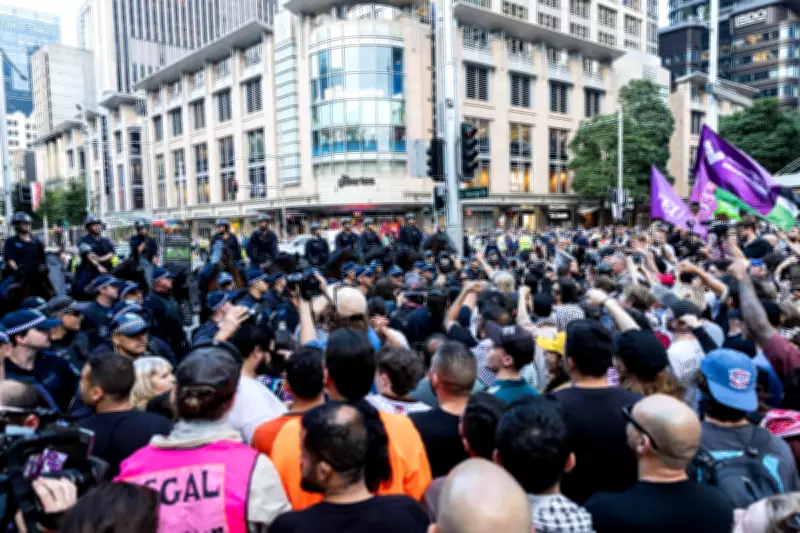
Sydney MP Advocates for Nuanced Perspective on Police and Protest Dynamics
Following the recent clashes at Sydney's anti-Herzog rally, NSW Labor Member of the Legislative Council Stephen Lawrence has called for a move beyond simplistic narratives that pit "totally amazing and perfect police" against "horrible dangerous protesters." Lawrence, who participated in the demonstration alongside hundreds of Labor party members, observed what he described as instances of excessive police force, as well as some assaults on police officers.
Avoiding Political Rhetoric in Favour of Objective Analysis
In the aftermath of the Town Hall incident, Lawrence has declined to engage in standard political rhetoric that involves fawning praise for police or strident condemnation of protesters. Instead, he emphasises his respect for both the challenging work of police officers and the right of citizens to peacefully engage in political protest. "Most people in both groups are decent and good, but not perfect, and all people deserve the benefit of the doubt," Lawrence stated, highlighting his parliamentary role in representing all people in New South Wales.
Over the past three years, this approach has led Lawrence to consistently defend police while also standing up for protest rights. He acknowledges that many community members will understandably form immediate views and take sides, often emphasising wrongdoing by the side they don't politically favour.
Systemic Issues Creating Inevitable Conflict
Lawrence argues that the conflict was nearly inevitable given the circumstances: "There were a lot of people there, strong differences of opinion over a most incendiary state visit and a conflict between the law, police operational decisions and the desire of some protesters to march to state parliament." He notes this wasn't wisdom in retrospect, as he actually predicted such conflict in parliament last year.
The central question for Lawrence concerns the legal framework that placed police and protesters in this situation of almost inevitable conflict. Currently in Sydney, under the public assembly restriction declaration continuously extended by the police commissioner, there is no independent arbiter to decide what protest routes will be lawful. The police themselves determine whether a protest route in the declaration area can proceed.
Historical Parallels and Unlearned Lessons
Lawrence draws parallels between the Town Hall riot and the 1978 Mardi Gras riot, noting similar dynamics where protesters wanted a particular march route and police disagreed, resulting in violence, arrests and significant social concern. He observes that while the 1978 protest involved a stigmatised minority with prejudice playing a major role, last night's protest involved several minorities within a movement that has been thoroughly demonised.
Following the 1978 excesses, Lawrence notes that lessons were learned and parliament engaged in serious law reform, removing from police the role of arbiter for street protests and granting that power to independent courts. Another important change related to removing police "move on powers" from lawful protests.
"Since those reforms as a community, we seem to have unlearned those lessons," Lawrence contends. "We have adopted a view that it can legitimately be the role of the state to suppress mass protests. We have done so despite the obvious potential for violence."
Political Context and Future Considerations
Lawrence acknowledges that contentious legislative reform often relates closely to political ebb and flow within the community. He identifies what he calls a "pernicious injection" into public debate following the Bondi atrocity: the suggestion that the attack was caused by lawful and peaceful protest, which has driven many subsequent developments.
The MP expressed encouragement at seeing shadow attorney general Damien Tudehope recently reject this link, describing it as "a glimmer of the potential for bipartisan sanity in NSW." As the Town Hall riot undergoes examination by NSW police, accountability agencies and likely criminal courts processing charges against protesters and possibly police, Lawrence's perspective offers a nuanced alternative to polarised political discourse.
Ultimately, Lawrence's position represents neither an attempt to find a "sensible centre" nor achieve political compromise, but rather a call to address systemic issues in protest regulation that create conditions for inevitable conflict between police and citizens exercising democratic rights.