
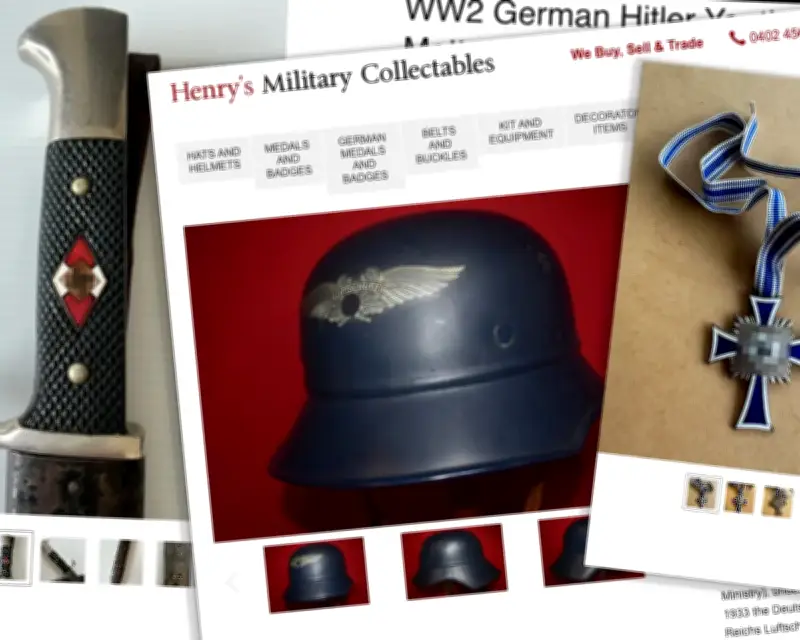
Nazi artefacts bearing prohibited symbols are still being openly sold on Australian websites three years after the federal government made such trade illegal, with vendors claiming educational exemptions. A Guardian Australia investigation identified multiple sellers listing German military items, including helmets, badges, medals, officer's caps, and flags, that display the Hakenkreuz (swastika) or the SS double-sig rune.
Federal ban and exemptions
The federal government outlawed the display and trade of items bearing the Nazi Hakenkreuz and the double-sig rune in 2023, following similar state laws that banned Nazi symbols and the Nazi salute. The legislation included exemptions for religious, academic, educational, artistic, literary, or scientific purposes. However, vendors are using these exemptions to justify sales, claiming their items are for education or research.
Kurt Coleman Military Antiques, a business registered in Queensland's Sunshine Coast region, currently lists 25 pages of Nazi-era German military items on its website. These include military booklets, pins, badges, rings, officer's tunics, officer's caps, and weaponry with visible swastikas. One notable listing is a white porcelain vase with an embossed Nazi eagle priced at $2,500, while a 2-metre by 3.5-metre Nazi warship battle flag is listed at $2,000 (though currently out of stock), and a German Hitler Youth knife is offered for $1,820.
The website's landing page states the seller is "ALWAYS BUYING Military Antiques Medals, Militaria, Edged Weapons," and the webpage title, a key search engine optimisation field, reads "Nazi Militaria For Sale, German Militaria, WW2 Militaria, Nazi Medals Australia." All items listed appear to be Nazi-related. The site includes a disclaimer: "All items offered for sale are for educational purposes only. The seller does not endorse or promote any political ideology, and the items are presented solely as historical artifacts. Buyers are expected to use the items responsibly and in accordance with applicable laws."
Vendor claims and legal interpretations
The site has been active for at least a year, with an associated eBay page operating since 2019 and selling approximately 44,000 items. Guardian Australia has approached Coleman for comment but has not received a response.
Henry's Military Collectibles, based in Western Australia, also lists multiple Nazi-era items, including war merit crosses, belt buckles, and a Luftschutz (civil air defence) helmet. The listing images show stickers placed over the offending symbols. The website states: "Henry's Military Collectibles only deals products with historical value for collectors, museums and research purposes. We do not, in any case, associate or have association with National Socialism, the Third Reich period, Political Parties and/or military organisations. If you do have any association with the above, we would like you to leave the website and we ask you not to contact us."
Owner Henry Fijolek, who previously told Guardian Australia that Nazi items were "strong sellers" and never sold to "Nazi sympathisers," now says he believes he operates within the law. In an email, he stated: "I served in the Army as an officer for 37 years with 17 Years posted to the Australian Army History [unit]." He added: "As stated in my disclaimer on my website I trade in these items without displaying the banned symbols and my intent is to trade in them within the allowed scope." Fijolek also said: "I know that there is some in the community that would to totally ban and eradicate the items however this is history and history regardless should never be eradicated as it serves to educate for the future."
Enforcement and expert perspectives
The Australian Federal Police (AFP) have acknowledged the issue. A spokesperson said: "The AFP has engaged with a number of auction houses in relation to the sale and public display of items containing prohibited symbols. However, the AFP will not confirm details in relation to ongoing assessments and investigations relating to these matters." The spokesperson added: "People need to be aware of their legal obligations in relation to the public display or trading of items containing prohibited symbols."
Associate Professor Romain Fathi, a military historian at the Australian National University, commented on the broader implications. He noted that military objects "are not neutral" and that "the same object can have vastly different meanings based on the hand that is holding it, and the motivations of keeping the objects." He explained that while such objects can serve as historical records when contextualised and critiqued, "collecting militaria becomes more problematic when there's a real attraction for war, for violence." He emphasised that Nazi collecting carries unique dangers: "These objects are not playthings, they are objects of death, by a regime characterised by death. When individuals find power and fascination in them, that becomes very dangerous." He also contrasted legitimate museum acquisitions with far-right collecting, stating that "if a Jewish or Holocaust Museum acquires Nazi paraphernalia to contextualise and evidence the genocide, there's a deep moral, ethical dimension to this," whereas the same act by a far-right activist would be "deeply problematic and express sympathies that are dangerous to democratic societies."
The ongoing availability of these items underscores the tension between legal exemptions and the intent of the ban. While authorities continue to assess compliance, sellers persist in offering such artefacts, citing educational purposes. The AFP's engagement with auction houses suggests potential enforcement actions, but no further details have been disclosed, leaving the situation unresolved as of this report.




