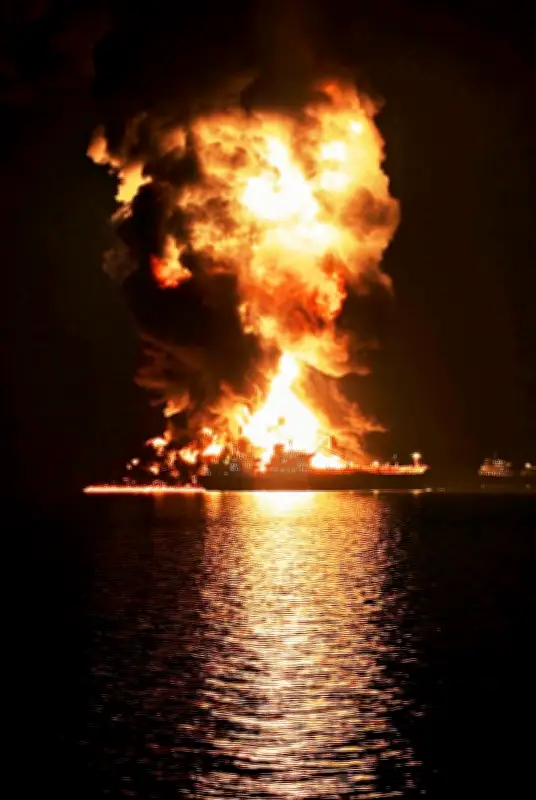
One week after the United States and Israel killed Ayatollah Ali Khamenei and ignited a regional war, drones started flying over Basra in southern Iraq. They targeted Iraq's oil industry, hitting an oilfield operated by BP, a cargo terminal at Basra airport, and a large compound housing foreign companies servicing the oil sector. Another attack on 6 March struck the same compound, hitting offices and warehouses used by Halliburton and KBR, two US companies present since the 2003 invasion. The attack sparked a massive fire that lit up the night sky.
A Weak State Exposed
In the wider war, it was not a particularly notable day, but in Iraq the strikes laid bare how weak the state had become and "how easily sovereignty could be violated," as one senior Iraqi security official put it. For 40 years, the US, Iran, and Israel existed in an uneasy equilibrium. As this has come to a sudden end, Iraq finds itself caught in the middle.
More attacks followed. On 11 March, an Iranian drone boat attacked two oil tankers off the port of Basra, setting them ablaze and killing at least one crew member. In subsequent days, drone strikes hit more oilfields operated by foreign companies. Hundreds of energy sector workers from American, European, and Chinese firms left, many travelling overland because the country's airspace was closed. Thousands of Iraqi workers were sent home.
Militias Behind the Attacks
No one claimed responsibility for most attacks, apart from the oil tanker strikes, which Iran acknowledged. The central government in Baghdad and local authorities in Basra remained quiet, offering empty official statements about sovereignty and promises of investigations. The truth is that most attacks were undertaken by Iraqis acting on Iraqi soil—factions of the country's powerful, Iran-backed Shia militias. "This is an act of treason," a visibly shaken senior official at the oil ministry in Basra said.
Speaking confidentially, multiple officials said the oil attacks were carried out by the Islamic Resistance in Iraq (IRI), an umbrella group of Shia paramilitary organisations originally trained and equipped by Iran to fight Americans after the 2003 invasion. IRI factions are also members of the Popular Mobilisation Units (PMU), a collection of Iran-backed, mainly Shia militias brought together in 2014 to fight the Islamic State. The PMU is theoretically subordinate to the Iraqi government but in reality follows its own agenda, with investments in construction and agriculture giving it economic power.
Internal Divisions
While Iraq is majority Shia, multiple groups with varying degrees of independence—formed after the 2003 invasion—exert huge influence. Today, there are two types of paramilitary militia: those that use weapons to protect economic interests, and those primarily driven by ideology, deeply committed to the Iranian project of defeating Israel and expelling the US from the Middle East.
In 2026, this unstable balance erupted into violence. The US/Israeli war on Iran spurred hardline ideological paramilitaries to Tehran's aid, attacking not just Iraq's oil infrastructure but US military bases and the US embassy in Baghdad. Meanwhile, a new US-backed Iraqi prime minister, Ali al-Zaidi, gave all militia groups a deadline of 30 September to disarm and incorporate into the Iraqi state. While al-Zaidi has had some success, hardcore groups have refused to give up their weapons. As long as there is an American presence in Iraq, with Israeli jets overhead, the IRI will continue to fight.
Economic Impact
Iraqi government officials express anger and exhaustion about the attacks. "The installations that were attacked were on Iraqi soil, paid for by Iraq, as was all the destroyed equipment," one official said. The attackers had highly accurate intelligence, probably leaked from within, about where to strike. The aim was to disrupt oil production, raise global prices, and pressure the US to stop its war on Iran. Within weeks of the war's start, Basra's output fell by two-thirds, with exports essentially halted.
In one of Baghdad's upmarket restaurants, a government adviser said that until recently, the Iraqi government had managed to keep most militia factions under control. But the killing of Ali Khamenei changed everything. "You can't ask the factions not to participate any more," he said. "This is an existential struggle and a religious duty." He noted that Iranian officials had told him that 40,000 Starlink devices had been smuggled into Iran from Iraq to bypass internet clampdowns. "We should be grateful they didn't use their full force and strike Iraq in retaliation, because they could easily have burned half the country."
Military Weakness and Corruption
A high-ranking security official who worked closely with Americans echoed the analysis of Iraq's military ineptness. "The war has proven the weakness of Iraq. I don't mean only militarily. Our country was violated by everyone, our airspace used by both sides." The state could not even protect its own soldiers when under attack by militias. "Everyone in the military command knows exactly who the attackers are," he said. He noted that some rockets and drones were launched from the centre of Baghdad, passing all checkpoints without detection, due to corruption. Many high-ranking posts are awarded after a payment to superiors. "If you pay US$5m to take command of a force, the priority becomes protecting that investment by avoiding confrontation," he said.
Oil Industry Woes
Economics partly explains the division between older militias, which have largely accepted the prime minister's decree, and newer hardline factions. In late May, influential Shia cleric Moqtada al-Sadr called for his militia to be placed under state command, and two other factions followed. But hardline paramilitaries declared their weapons sacred and would not be surrendered until the end times.
On 7 April, a ceasefire between Iran and the US was announced, and the IRI said it would suspend operations during the ceasefire. On the same day, Iraq and Saudi technical teams held an online meeting to explore reopening the Iraqi-Saudi pipeline, closed since the 1990 invasion of Kuwait, to bypass the Strait of Hormuz.
As the oil industry came to a near halt, long queues formed outside petrol stations. The ministry of oil blamed the shortage on the shutdown of refineries after foreign workers left and the inability to export unrefined heavy fuel oil. For a country so dependent on oil sales, which underwrite salaries of 4 million public-sector employees, the attacks might look suicidal. But a civil-rights activist in Basra said, "Many people believe that oil companies are exploiting the country and they find the attacks justified."
Failed Oil Wealth Distribution
How did postwar Iraq fail to use its immense oil wealth to deliver a better life? After the 2003 invasion, Iraq turned to international firms, signing contracts with major oil companies including BP, ExxonMobil, and Shell. The deals were flat per-barrel service fees, not profit-sharing. Baghdad aimed to pump about 12m barrels a day by 2017, but production peaked at 4.5-5m barrels a day. Companies began to abandon projects due to political instability, contractual disputes, and massive delays in government payments caused by bureaucracy where bribes are extracted.
In late May, Deputy Oil Minister Adnan al-Jumaili was detained on corruption charges. Investigators recovered $10m in cash, 3bn dinars, and 1.5kg of gold. Security forces detained 47 people, including 13 MPs and senior officials, seizing hundreds of millions of dollars in cash and gold. A second deputy oil minister, already sanctioned by the US for allegedly diverting oil to Iran, was also arrested.
Double-Edged Politics
In July, the funeral procession of Ali Khamenei crossed into Iraq, drawing 3.8 million people on the streets of Najaf. Iraq's leaders, including Prime Minister al-Zaidi, stood alongside the Iranian president. Six days later, al-Zaidi sat next to Donald Trump in the Oval Office, where Trump declared they had "tremendous chemistry." Al-Zaidi pledged to disarm militias and fight corruption, inviting US companies to invest.
A well-connected government insider noted that Americans have repeated demands about disarming Iran-aligned militias for years. "During all those years, Iraq received a great deal of American support, but did nothing whatsoever to change its relationship with Iran. On the contrary, Iranian influence only deepened." The change this year came with American pressure and economic crisis. The closure of the Strait of Hormuz and attacks on oil installations brought Iraq to the brink of bankruptcy. In April, the US stopped dollar shipments of Iraq's oil revenues held at the Federal Reserve Bank of New York. Al-Zaidi ordered pro-Iranian militias to give up their guns in June, and dollar shipments resumed in July.
Walking through Basra, I met an old man who said Iran is the last chess piece protecting Islam. When asked if he worried about economic collapse, he said America will not abandon its project in Iraq. There, in a few words, was Iraq's impossible predicament—dependent for life on two sworn enemies.