
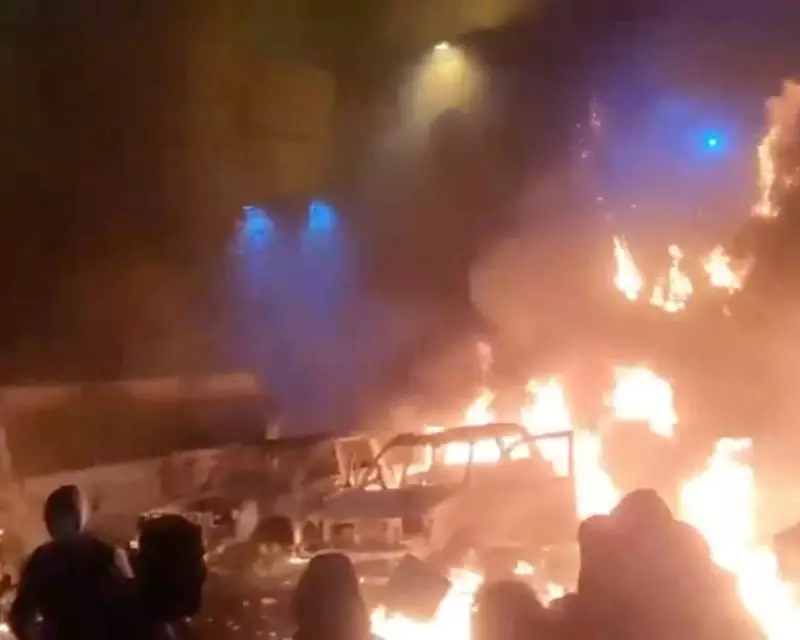
Fresh waves of anti-government protest have erupted in Iran's capital, Tehran, with demonstrators gathering and vehicles set ablaze as public discontent over a severe economic crisis boils over.
Economic Grievances Ignite Widespread Unrest
The latest round of unrest, which began in late December, was initially sparked by rocketing inflation and a collapsing national currency. However, the demonstrations have since broadened in scope and spread geographically. Videos circulating on social media, despite an internet blackout imposed by authorities, showed thousands marching through Tehran on Thursday night, with some participants setting fire to cars and state-owned buildings.
While smaller in scale than the peak of the 2022 'Woman, Life, Freedom' movement, these protests are notable for emerging in segments of society traditionally more supportive of the regime. They have escalated rapidly, with some protesters now explicitly calling for the fall of the government.
A Regime Hardens Its Stance
The response from Iran's leadership has been characteristically severe. Non-governmental organisations report that dozens of people, including children, have been killed in the crackdown. Initially, Supreme Leader Ayatollah Ali Khamenei acknowledged some "legitimate" economic demands. His tone has since hardened considerably.
He now labels demonstrators as "saboteurs" allegedly seeking to please former US President Donald Trump. This shift followed Trump's threat to intervene and "hit hard" if more protesters died. Echoing this aggressive posture, the head of Iran's judiciary promised consequences for demonstrators would be "decisive, maximum and without any legal leniency".
Internal Weakness Meets External Threats
Analysts note that while Iranian authorities have historically managed to crush protests through force, they have consistently failed to address the underlying causes. The regime now faces a potent combination of internal and external pressures. Internally, its economic room for manoeuvre is severely limited. The 86-year-old Supreme Leader has suffered from poor health, and the regime's perceived ability to provide physical security was shattered by June’s 12-day war with Israel and US attacks on nuclear facilities.
Externally, Donald Trump's threats of intervention, following his administration's actions in Venezuela, have provided the Iranian leadership with a propaganda tool to delegitimise protesters as foreign pawns. Israeli Prime Minister Benjamin Netanyahu has also talked up the protests, with a history of encouraging US presidents towards risky ventures in the region.
An Iran embroiled in domestic chaos would suit Netanyahu's strategic goals, but regional stability would likely pay the price. Experts warn that destabilisation could entrench the power of the Islamic Revolutionary Guard Corps rather than weaken it. Iran's defence council has already signalled it could take preemptive military action against perceived threats from the US and Israel, marking a riskier era for the region.
The path forward offers no easy exits. Whether the regime persists or nears its end, those seeking to exploit legitimate Iranian grievances for geopolitical gain risk only increasing the bloodshed and suffering of civilians.




