
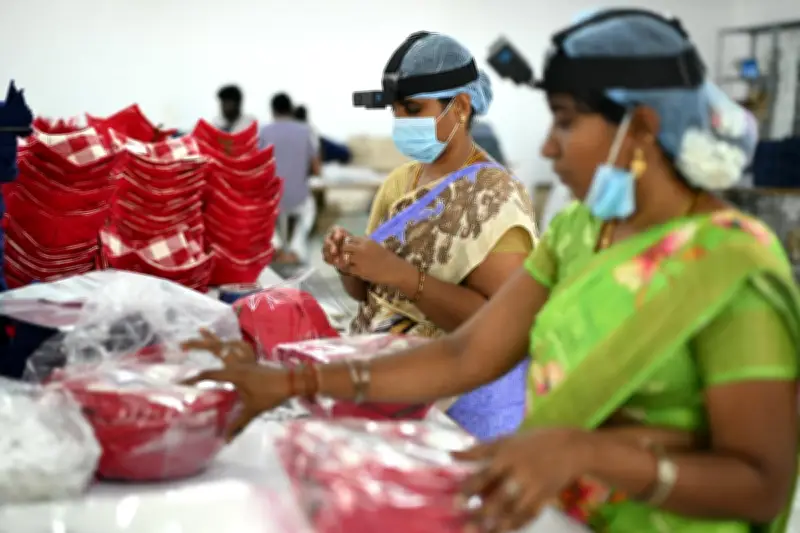
Garment workers in India are being fitted with head-mounted cameras to record their every move for training humanoid robots, often without consent or compensation, according to an investigation by The Guardian across six factories in five states.
Workers fitted with cameras without explanation
Lalita, a 32-year-old garment worker on the outskirts of Delhi, was handed a head-mounted camera by supervisors and told to wear it during her shift. Nobody explained why. The camera recorded her stitching shirts and trousers, her hand movements, and interactions with colleagues. Initially, workers found it funny, but soon grew concerned about productivity monitoring.
Conversations grew quieter, and workers became more conscious of mistakes, pauses, or distractions. The footage is part of a growing effort by companies in India to collect egocentric data — first-person recordings of human movements — which is vital for training robots that might one day replace humans on production lines.
India as a hub for data collection
India is becoming a crucial hub for egocentric data collection. Companies like EgoLab, Humyn AI, FPV Labs, Micro1, Egodata, Neocambrian, XP Robotics, Objectways, Scale AI, and CynLr are building data pipelines for robotics firms. EgoLab, which collects data from Lalita's factory in Gurugram, counts Tesla among its biggest clients. Elon Musk has predicted that roughly 80% of Tesla's future value will come from humanoid robots.
Puneet Jindal, founder of Labellerr AI, said: “South Asia remains the workshop of the world for many labour-intensive industries. If you’re trying to teach a robot how humans work, there are few places that offer the same combination of scale, diversity and density of human labour as India.”
Low cost and lack of worker compensation
Cost is a major factor. A company paying $30 an hour for data collection in the US can often get similar work done in India for less than a sixth of that cost, according to an anonymous tech founder. Firms often strike deals with factories to collect footage at scale without directly compensating individual workers.
Lalita, who earns about $200 a month, said: “Sometimes they give us a soft drink. I’m still not sure whether that’s because we’re collecting footage or because Delhi’s heat is unbearable.” None of the seven technology companies interviewed said they sought consent directly from workers; some stated permissions were obtained through factory management.
Surveillance and privacy concerns
In some factories, footage is used for more than AI training. Records reviewed by Scroll.in showed that some companies generated productivity reports, ranking workers based on active time, estimating losses from idle periods, and tracking social interactions. Geeta Thatra, a researcher at Work Fair and Free Foundation, said: “I’ve heard accounts of women garment workers going to the washroom and forgetting they were wearing head-mounted cameras. What happens to issues of safety and privacy?”
She added that consent in insecure workplaces is complicated: “A worker may appear to agree to wear a camera, but can they realistically refuse without fearing consequences for their job?”
Expansion beyond factories
Egocentric data collection is expanding to informal workers like construction labourers, delivery workers, and street vendors. Munazir, a mason in Bengaluru, earns $30 to $40 a week recording his work, averaging about $3 an hour. He said: “The phone feels heavy and uncomfortable to wear. But I’ve only just started. Maybe I’ll get used to it.” He has little idea what happens to the footage.
Madhumita Dutta, an Ohio State University researcher, said: “Traditionally, workers sell their labour for a wage. Here, they are also generating a valuable digital asset. If they are unaware that their movements are being converted into datasets, they have little opportunity to negotiate compensation.”
Questions of ownership and value
Sarayu Natarajan of the Aapti Institute noted that recordings capture workers' bodily knowledge — movements and skills accumulated through years of experience. Once converted into datasets, that knowledge can circulate through global AI supply chains. She said this raises questions about ownership and compensation that current labour arrangements are ill-equipped to answer.
Lalita, reflecting on her situation, said: “We are not even getting our full worth for the work we do now. Who is going to pay us when we are replaced by robots?”




