
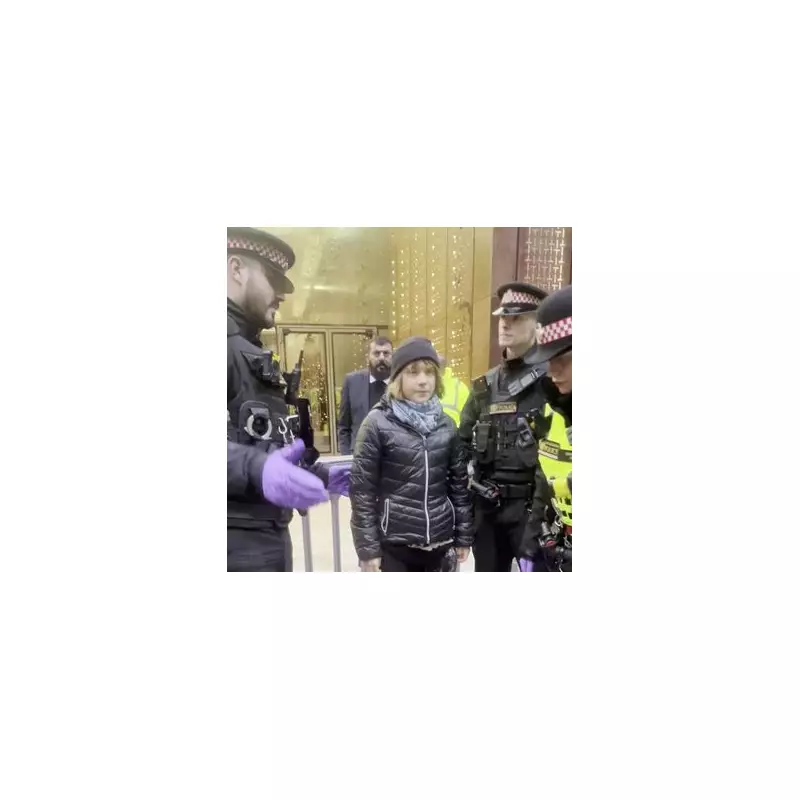
Prominent Swedish climate campaigner Greta Thunberg has been detained by police in central London following a demonstration linked to the proscribed organisation Palestine Action. The 22-year-old was arrested on Tuesday morning under anti-terror legislation for displaying a placard in support of the group.
Protest and Paint Attack Precede Arrest
The incident unfolded on Fenchurch Street in the City of London. According to the City of London Police, the initial disturbance began at around 7am when activists used hammers and red paint to damage a building housing Aspen Insurance. The protest group, Prisoners for Palestine, stated the company was targeted because it provides services to Elbit Systems, an Israeli-linked defence firm.
A man and a woman were arrested at the scene on suspicion of criminal damage after they glued themselves to the location. Specialist officers were required to remove them before taking them into custody.
Thunberg's Involvement and Arrest Under Terrorism Act
Greta Thunberg arrived at the scene a short time later. PA media reports that she was present at the demonstration holding a sign that read: “I support the Palestine Action prisoners. I oppose genocide.” This statement references the ongoing conflict in Gaza, which a UN inquiry in September concluded met the criteria of genocide.
A police spokesperson confirmed: “A little while later, a 22-year-old woman also attended the scene. She has been arrested for displaying an item (in this case a placard) in support of a proscribed organisation (in this case Palestine Action) contrary to Section 13 of the Terrorism Act 2000.”
Context of Palestine Action's Status
The arrest hinges on the legal status of Palestine Action. The organisation was officially proscribed as a terrorist group by the UK government in July of this year. This designation makes it a criminal offence to express support for the group, including through the display of symbols or placards.
The Prisoners for Palestine protest highlighted that members of Palestine Action are currently on hunger strike while in prison. Thunberg's arrest marks a significant escalation in her activism, which has historically focused on climate change but has recently broadened to include other social justice causes.
The use of Section 13 of the Terrorism Act 2000 in this context underscores the serious legal implications of supporting proscribed organisations in the UK, even through symbolic acts of solidarity at a protest.




