
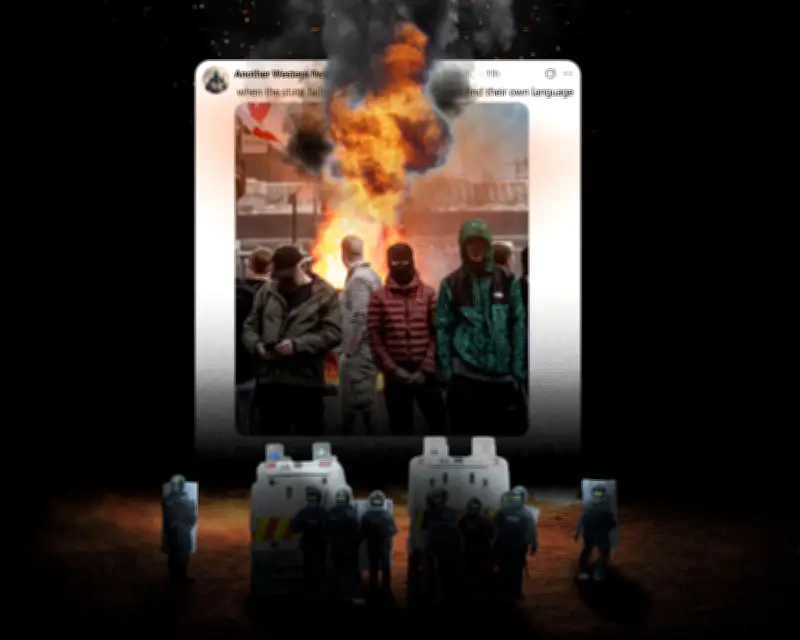
More than half of the accounts posting on Elon Musk's X platform about the rioting in Belfast and civil disorder in Southampton in June were based outside the UK, according to an exclusive analysis by the Guardian. Of the 8,672 accounts whose combined posts on these events exceeded 1,000 views, only 45.3% were shown as originating from the UK, based on the platform's own location function.
The analysis found that 16.8% of these accounts were based in the US, 4.5% in Ireland, and approximately a quarter from other European countries. Notably, seven of the 12 most-read tweets about Belfast and Southampton came from the US, including one from Musk himself and two from other US 'alt-right' commentators, while an eighth was linked to North America.
US Rightwing Actors Exploiting UK Disorder
This data underscores that US rightwing actors are actively seeking to influence the UK and boost their position on X during moments of disorder, exploiting flashpoint events that have only intermittently attracted political attention in Britain. The Guardian collected 43,000 tweets mentioning Belfast, Southampton, Henry Nowak, or Vickrum Digwa during the unrest, covering 2-3 June for Southampton and 8-9 June for Belfast.
Nearly a third of all 43,000 posts contained racist or anti-immigration comments, and almost one in ten relating to Belfast included calls for violence or paramilitary action. Imran Ahmed, chief executive of the Centre for Countering Digital Hate, said the data demonstrated that X had become 'a weapon of choice' for hostile foreign actors seeking to manipulate shocking and divisive content.
Musk's Own Posts Amplify Tensions
A post from Musk after the life sentencing of the killer of 18-year-old Henry Nowak, who was falsely accused of racism by police after being stabbed in Southampton, has been viewed more than 28 million times. Musk posted, 'Legacy mainstream media, same ones who wrote about George Floyd millions of times, are dead silent about Nowak,' effectively promoting his platform during heightened tension. A Guardian analysis last month found Musk posted about race and immigration in the UK twice as often as he did about SpaceX in the run-up to its IPO.
Eleven police officers were injured on the night of 2 June in Southampton as protesters marched to the site of Nowak's death, following a rally addressed by far-right activist Tommy Robinson. Security experts, including Fiona Hill, have warned that the UK is a soft target for online manipulation due to its lack of serious civil defence measures.
Strategic Events for Far-Right Actors
Dr Julia Ebner of the Institute for Strategic Dialogue and the University of Oxford said flashpoint episodes like Southampton and Belfast had become 'strategic events' for far-right actors. 'They are using the UK as a negative example, smearing the UK to promote their own narratives of western civilisational decay or social collapse,' she explained. The goal is to influence UK and European politics, promoting a strengthened far-right wave globally.
Four of the top 12 most-seen tweets came from UK accounts, including two by Rupert Lowe, leader of the Restore Britain party, whom Musk has endorsed, one from GB News, and the most popular with 37.6 million views from commentator Konstantin Kisin. Other US-based accounts were anonymous but familiar, such as @EndWokeness, which posted a blurry image of an attack in Belfast, attracting 16.3 million views.
Inauthentic Accounts and VPN Use
The analysis found signs of inauthenticity, with some top accounts having changed usernames numerous times. One US-based account, C3 (@C_3C_3), had changed its username 14 times, while a UK account with almost 3,800 views had changed its name over 400 times. The analysis did not reveal posts from Russia or China, though posters may have disguised locations using VPNs. X's location data, introduced last November, is inferred from IP addresses and was said to be over 99% accurate.
Valerie Wirtschafter of the Brookings Institution said violent events like those in Belfast and Southampton are 'a point of exploitation' where 'outside agitators' can have a disproportionate impact, aided by reduced content moderation and algorithms that favor shocking content. The findings highlight the growing challenge of foreign interference in UK social media discourse.




