
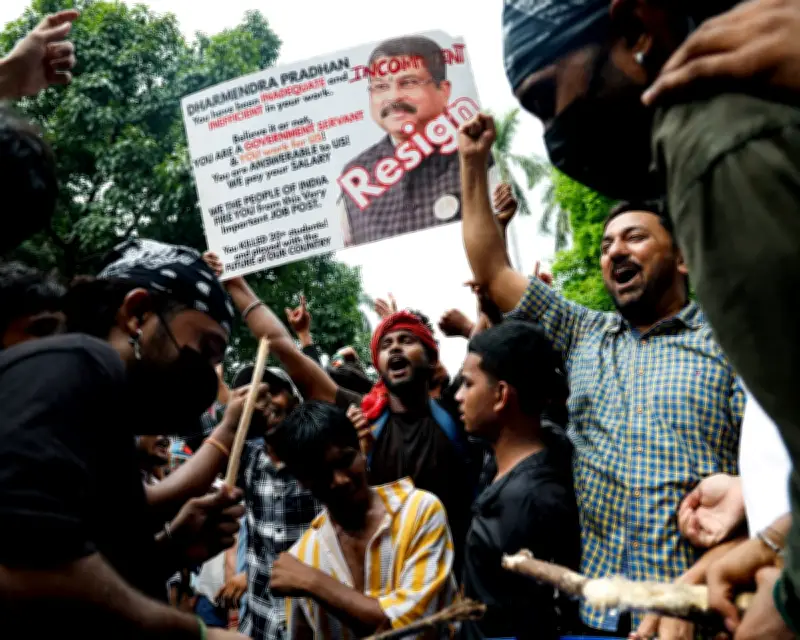
Protests Force Minister's Resignation
India's Cockroach Janta party (CJP) achieved its core demand on Saturday when Education Minister Dharmendra Pradhan resigned, following a week of unprecedented protests that mobilized millions of young people across the country. The movement, driven by Gen Z activists, erupted after a crucial exam paper leak forced 2 million students to resit the test and was linked to more than a dozen suicides.
Prime Minister Narendra Modi accepted Pradhan's resignation less than 24 hours after addressing protesters in a late-night Instagram reel, thanking them for their “thoughtful suggestions.” Analysts describe this as a remarkable humbling for a government that has ruled with impunity since 2014 and rarely bowed to public pressure.
Gen Z Movement Captures Online and Physical Spaces
The CJP, a Gen Z-led movement, organized mass protests in Delhi's historic Jantar Mantar site, with unrest spreading to other cities including states ruled by Modi's Bharatiya Janata party (BJP). The movement also dominated online spaces, flooding Instagram with memes and reels that criticized Modi and the government, overcoming the BJP's powerful IT cell and its control over mainstream TV news channels.
“The online space was totally conquered by the protesters and regime-loving media was seriously delegitimised,” said Ashutosh Varshney, a professor of international studies at Brown University. “The anger was so comprehensive there was no option left but for Pradhan to go.”
Broader Implications for Modi's Government
Pradhan's resignation marks the first time in 12 years that the Modi government has lost control of the political narrative, according to Varshney. “This is a repressive government. It wants obedience, it wants no critical discussion and it generates fear. But now the climate of fear has collapsed.”
Political analysts warn that firing a loyal minister like Pradhan could set a dangerous precedent. “Modi knows once you start firing your most loyal ministers, it sets up the incentives for defections in other ministers as well,” said political columnist Pratap Bhanu Mehta. “If your own cabinet starts to hedge for a future where they may not be backed by your own government, that's when you are in trouble.”
Reinvigorated Opposition and Youth Political Engagement
The CJP protests have also revitalized India's political opposition, with the Congress party having its best week in years as it mobilized protests and shut down parliament. Rahul Gandhi, the party's leader, was dramatically dragged away by police outside Modi's house in support of students.
“After a long time, there's an assertion of political agency across different sections of society,” said Mehta. “And the minute you see that agency out in the street, it empowers lots of other agents.”
CJP spokesperson Saurav Das said the movement aims to increase youth participation in politics. “This is one of our goals. We need to increase youth participation in politics, because right now it's controlled by uncles and aunties who are only interested in looking after their own lifestyles and don't understand the needs of our generation. The answer also has to be political.”
Future Electoral Impact
The next major test for the CJP's electoral implications will come early next year with state elections in Uttar Pradesh, India's largest and most politically important state. Holding on to power there is seen as crucial for the BJP and would have major implications for the 2029 general election.
Analysts say the CJP has reopened a rapidly closing democratic space, making it possible for a new kind of political opposition to emerge. The movement's founder, Abhijeet Dipke, has past experience as a political party organizer but has not yet announced his own ambitions.




