
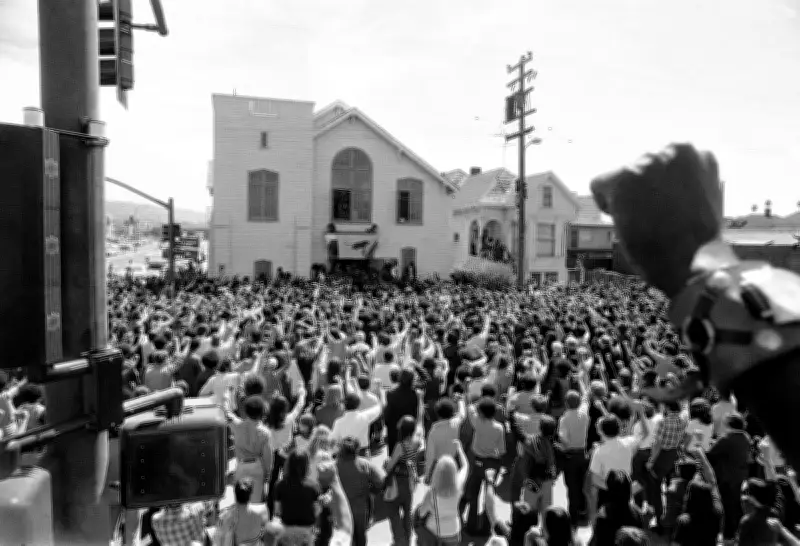
Black August, a month-long commemoration of Black resistance and liberation, originated within California's prison system in the 1970s and has since evolved into a national and international institution, according to Jalil Muntaqim, a community organizer and former Black Liberation Army (BLA) member.
Origins in California's Prison System
In the 1960s and 1970s, California was a hub of radical political energy, which also attracted extreme backlash. The Black Panthers, a revolutionary Black political activist organization founded in response to police brutality, were organizing members while Ronald Reagan, then California's governor and later US president, and others worked to repress the group's growing influence.
During this period, several young men incarcerated at San Quentin prison and elsewhere in the California prison system were under attack, assaulted and murdered by the Aryan Brotherhood, a white supremacist group, and sympathetic guards. In response, men including WL Nolen and George Jackson, a field marshal of the Black Panther party who also founded a prison chapter, formed the Black Guerrilla Family (BGF), a Marxist-Leninist prison gang, to defend themselves.
Many early BGF members, most barely in their 20s, did not survive the decade. Nolen was killed, along with two others, by San Quentin prison guards on 13 January 1970; George Jackson was killed in San Quentin prison on 21 August 1971; his brother Jonathan Jackson was killed on 7 August 1970; and Khatari Gaulden was killed in San Quentin prison on 1 August 1978.
From Commemoration to Global Institution
“As a result of these deaths, the group known as Black Guerrilla Family decided they needed to commemorate the deaths of their comrades Jonathan, George and Khatari, and they began the process of deciding how they were going to do so,” said Muntaqim, who was convicted and imprisoned for several decades for the murder of two New York police department officers. “They began organizing what was called Black August.”
Since its creation, Black August has spread beyond prison walls and is commemorated by both incarcerated and non-incarcerated people. Participants study, meditate, and hone their activism during the month, pushing for the release of Black political and revolutionary leaders, many now in their 70s and 80s.
Today, organizations across the country use the month for local community activation. The Tallahassee Dream Defenders host a Black August showcase in Florida; Black August in the Park in Durham, North Carolina, blends music, dancing, and film screenings with educational opportunities; and in Oakland, California, the Black August Arc of Liberation Commemoration honors the legacy through art. The Brooklyn-based Free Black Women's Library created a reading challenge and hosts events throughout August.
Historical Significance and Purpose
Historian and author Gerald Horne noted “a striking confluence that occurs in August”: 1 August marks Emancipation Day in many Caribbean nations, 11 August the Watts uprising, 21 August Nat Turner's rebellion, and 23 August the Haitian revolution. It is also the birth month of pan-Africanist leader Marcus Garvey, Black Panther Fred Hampton, and Black liberationist Chokwe Lumumba.
“It's important for us to understand that Black August does not come out of a vacuum. It comes out of a movement, out of a determination of people trying to defend themselves against harm and the reality of the US penal slave system,” Muntaqim said.
“They evolved a concept of study, exercise and fasting for the month of August, and by virtue of them promoting Black August, it has now become a national and an international institution,” Muntaqim added. “People are to fast, they are to exercise. They are also to study and reflect, meditate. The primary principle of Black August and the golden objective is to restore our capacity for our humanity, and our ability to resist systems of white supremacy, racial capitalism, colonialism, neocolonialism and imperialism.”
Ongoing Fight and Reading List
The commemoration remains “a way to talk about freeing Black political prisoners generally”, Horne said. Several Black Panthers and other Black radical organization members, despite being in their 70s and 80s and often in failing health, remain in prison, including Mumia Abu-Jamal, Thomas “Tahaka” Gaither, and Veronza Bowers Jr. Many others have died in prison in recent years.
“You're protesting injustice when you protest the fact that people like Mumia [Abu-Jamal] are still behind bars,” Horne said. “By protesting injustice, you're also protesting the spread of injustice. In other words, ultimately, it's an act of self-preservation because if you allow injustice to fester, it can obviously spread right to your front door.”
Black August also fosters international solidarity. “Black August is truly important because it creates a foundational basis for our resistance to other people's resistance and in foreign people around the world, we are resisting,” Muntaqim said. “That's the reason why we have to have international solidarity and build our relationship with others around the world … Black August is one of the areas which we can show or prove our capacity to resist.”
Each year, people across the country and world use Black August to engage with Black radical literature, studying precolonial history, slave rebellions, and the ongoing fight for liberation. Recommended texts include Crusade for Justice by Ida B Wells, Black Reconstruction in America by WE Burghardt Du Bois, Soledad Brother by George Jackson, and Free the Land by Edward Onaci, among others.




