
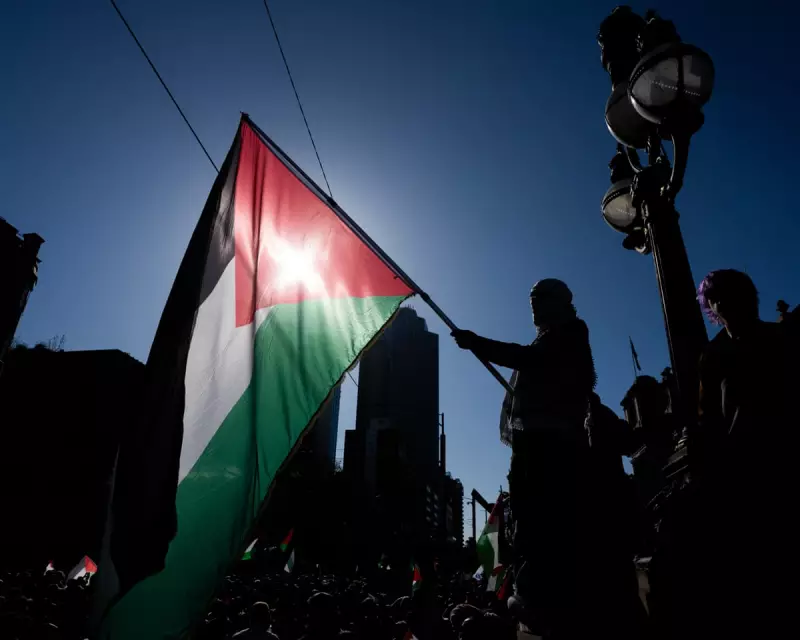
The Premier of New South Wales, Chris Minns, has announced plans to outlaw the slogan 'globalise the intifada', labelling it hate speech and controversially linking its use to the recent mass shooting at Bondi Junction.
What is the NSW government proposing?
In response to the Bondi terror attack, which left six people dead, the state government is introducing a suite of measures to limit protest rights and ban hate symbols. Premier Minns has specifically singled out the phrase 'globalise the intifada' for prohibition.
'You’ve seen what the consequences of globalising the intifada are,' Minns stated. 'It’s the deaths of innocent people... simply for practising their religion in a peaceful way.'
While legislation introduced to parliament this week did not contain the specific ban, a parliamentary committee will investigate 'hateful statements', including this phrase, with new laws expected next year.
Understanding the term 'intifada'
The word 'intifada' is Arabic for 'uprising' or 'shaking off'. It is most commonly associated with two major periods of Palestinian resistance against Israeli occupation.
The First Intifada lasted from 1987 to 1993 and was characterised largely by civil disobedience and stone-throwing protests. Estimates suggest at least 1,300 Palestinians and 100 Israelis were killed.
The Second Intifada, from 2000 to 2005, was markedly more violent, involving suicide bombings and full-scale military engagements. More than 3,000 Palestinians and about 1,000 Israelis lost their lives.
A deeply divisive slogan
The call to 'globalise the intifada' has become a major flashpoint in protests worldwide. For many pro-Palestine activists, it is an expression of international solidarity.
'It’s a basic act of us supporting the uprisings of Palestinians against their oppression,' said Josh Lees, an organiser for the Palestine Action Group.
However, for many in Jewish communities, the phrase is perceived as a direct threat. David Slucki, director of the Australian Centre for Jewish Civilisation, calls it 'offensive' and 'threatening'.
Andre Oboler of the Online Hate Prevention Institute argues there is 'no context' in which the phrase should be used, stating it is 'anti-peace, pro-violence, and specifically pro-terrorism'.
International context and legal concerns
The controversy is not confined to Australia. In the UK, Greater Manchester Police have said they will arrest anyone chanting the slogan, and two people were recently arrested for allegedly using it at a London protest.
In New York, political candidate Zohran Mamdani faced pressure to clarify his stance on the phrase during his mayoral campaign.
Legal experts warn against banning phrases with contested meanings. Luke McNamara, a hate speech expert at the University of NSW, cautions that such a move is 'a problematic development' likely to lead to court challenges.
'We need to be very careful about locking in a particular interpretation of a contested phrase and making that automatically criminal,' McNamara said.
As the NSW government presses ahead, the debate underscores the intense divisions over language, protest, and the conflict in Gaza, raising profound questions about free speech and community cohesion in a multicultural society.




