
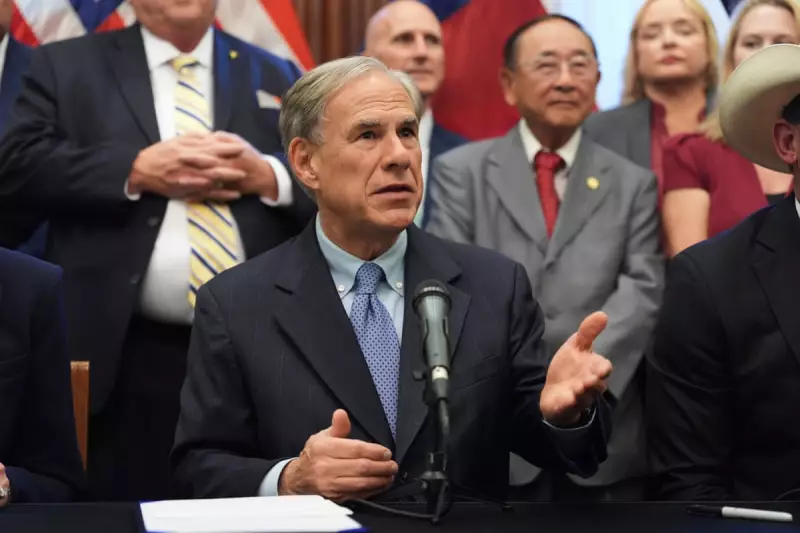
Texas Governor Greg Abbott has ignited a major legal and constitutional battle by unilaterally designating a prominent Muslim civil rights organisation as a terrorist entity, a move critics argue fuels the state's long-standing struggle with Islamophobia.
Proclamation and Immediate Fallout
On 18 November, the hardline Republican governor issued a proclamation declaring the Council on American-Islamic Relations (CAIR) and the Muslim Brotherhood to be terrorist organisations. The governor's statement asserted this designation authorised heightened enforcement and prohibited the groups from purchasing land in Texas.
Just two days later, on 20 November, Abbott directed the Texas Department of Public Safety to investigate CAIR. In swift response, CAIR's Texas chapters filed a federal lawsuit against both Governor Abbott and State Attorney General Ken Paxton.
Legal Challenge and Constitutional Concerns
The lawsuit contends the governor's action blatantly oversteps his authority, as only the federal government can legally make such a designation. It argues the proclamation violates core constitutional protections, including free speech, due process, and property rights.
Edward Ahmed Mitchell, CAIR's national deputy director, told The Guardian the governor is attempting to turn conspiracy theories into state policy. He highlighted that the proclamation named eight individuals with supposed terror links, some of whom have no connection to CAIR. "In some cases, CAIR actually has stood up for someone who was wrongfully charged with a crime they did not commit," Mitchell stated.
Charles Swift, the lawyer leading the case for the Muslim Legal Fund of America, called Abbott's move an "escalation". His reason for taking the case was succinct: "It's constitutional, and the governor is trying to exercise powers he does not have."
A Pattern of Rising Islamophobia in Texas
Advocates see Abbott's action as part of a broader, troubling trend. Dr Omar Suleiman, founder of the Yaqeen Institute for Islamic Research, labelled the declaration "political theatre" and said Islamophobia has become "increasingly normalized and instrumentalized in Texas politics."
This incident follows other high-profile cases, including a Euless woman who was initially released on a $40,000 bail after attempting to drown two Palestinian American children. Earlier this year, Republican congressional candidate Valentina Gomez filmed herself burning a Quran with a flamethrower, while Agriculture Commissioner Sid Miller shared a post depicting Islam as a snake being killed.
The state has also engaged in a legal battle over Epic City, a planned Muslim community in North Texas. After federal authorities closed a civil rights inquiry without charges in June, the Texas legislature passed a bill restricting religious-organisation exemptions used in such developments. Dr Suleiman called this "one of the clearest examples of Islamophobia shaping policy."
Following a shooting in Washington DC by an Afghan national, Texas Republican congressman Brandon Gill questioned in a newsletter why an "Afghan national" was in the US at all, asking "How many times do we have to hear 'Allahu Akbar' in America before we recognize Islam is a problem?"
In the face of this rhetoric, Dr Suleiman argues for a different path: "We need leaders willing to affirm publicly that Muslims are integral to Texas... We need leaders who refuse to weaponize fear for political gain." The outcome of CAIR's lawsuit may prove pivotal in determining which vision for Texas prevails.




