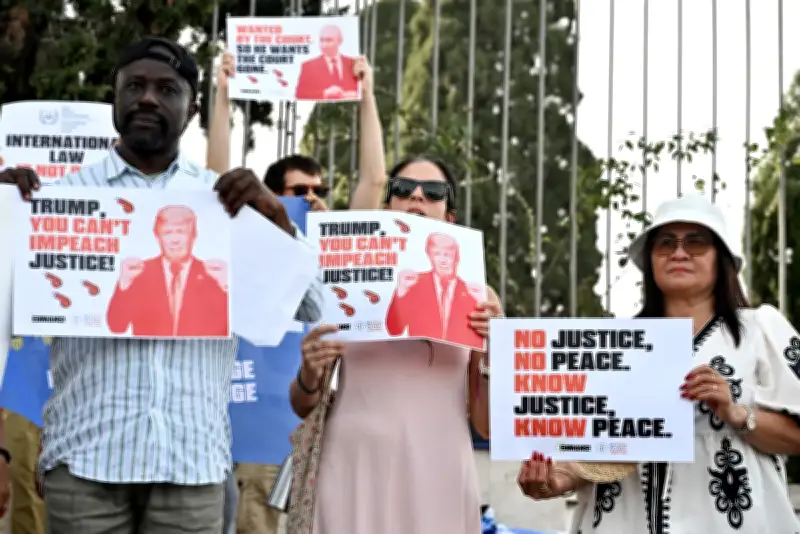
Four prominent US human rights organizations have filed a lawsuit against the Trump administration, challenging its sanctions regime targeting the International Criminal Court (ICC) as a "blatantly illegal attack on international justice." The groups—the American Friends Service Committee, the Center for Constitutional Rights, Human Rights Watch, and the Open Society Institute—argue that the sanctions undermine global efforts to prosecute war crimes and crimes against humanity.
Lawsuit Challenges Executive Order
The lawsuit, filed in federal court on Tuesday, challenges Trump's February 2025 executive order that authorized sanctions on ICC officials, judges, and others supporting its investigation of Israeli crimes in Palestine. This investigation is one of 18 into war crimes and crimes against humanity that the Netherlands-based tribunal is overseeing. The plaintiffs argue that the sanctions violate constitutional protections for free speech and association, as well as US obligations under international law.
The US State Department and Justice Department did not immediately respond to requests for comment. The US government has long opposed the ICC, of which it is not a party, but attacks escalated after the ICC prosecutor issued arrest warrants in November 2024 for Israeli Prime Minister Benjamin Netanyahu and former Israeli Defense Minister Yoav Gallant over crimes committed in Gaza. The US responded by sanctioning ICC prosecutors, judges, three leading Palestinian human rights groups, and Francesca Albanese, the UN special rapporteur on the situation of human rights in Palestinian territory.

Sanctions Impact on Rights Groups
Earlier this summer, US Secretary of State Marco Rubio escalated efforts against the ICC, announcing a campaign aimed at "dismantling" it by pressuring member states to leave the court. The lawsuit argues that these attacks undermine access to justice for victims of major human rights violations and criminalize the work of those seeking to combat impunity by collaborating with the court, including the plaintiffs.
Katherine Gallagher, a senior attorney at the Center for Constitutional Rights who represents victims before the ICC, said in a press conference on Tuesday: "The Trump administration took the extraordinary step to not only deny Palestinians and victims of US torture equal access to justice, but to criminalize and punish them, their lawyers and advocates, and their partners. All victims of international crimes—from Sudan and Ukraine to Palestine and Afghanistan—need and deserve to have an independent and strong ICC able to fulfill its mission of ending impunity, without fear or favor."
Sanctions' Effects on Individuals and Groups
Individuals placed under US sanctions over their work for the ICC have faced travel bans, bank account closures or freezes, and denial of access to digital services. Because of the dominance of US financial and technology institutions, the sanctions have also affected their ability to access services in other countries. The sanctions have also affected rights groups not directly targeted, including the four plaintiffs, by hindering their ability to represent victims before the court, make legal and policy submissions, or collaborate with sanctioned Palestinian groups on litigation, advocacy campaigns, research, and humanitarian aid efforts.
Gallagher said: "Because of the sanctions regime and the threat of severe criminal and civil penalties ... if I continued my work as a lawyer as before, I would have been or could be prosecuted or fined. I have therefore ceased actively practicing before the ICC. The government cannot dictate which clients lawyers can represent, which defendants are off limits from accountability, and what venue for justice and accountability are permissible."

Shawan Jabarin, director of the human rights group Al Haq, one of the Palestinian organizations targeted by the Trump administration, told the Guardian last year that the sanctions had left the group unable to access its bank accounts or process donations, leaving about 45 people without pay. Jabarin also said the sanctions created a climate of fear, with longtime allies cutting communications to avoid penalties of up to 20 years in prison and exorbitant fines. "Most of them—if not all—they stopped working with us or engaging with us formally and openly," Jabarin said, calling on partners to "fight back with all means."
Broader Legal Challenges and Reactions
Tuesday's lawsuit follows one filed last month by Democracy in the Arab World Now (Dawn) and the Taxpayer Alliance Against Genocide, as well as legal challenges from some sanctioned individuals, including Albanese's family and three sitting ICC judges. James Goldston, executive director of the Open Society Justice Initiative, called the sanctions "an assault on the rule of law, independent judges and prosecutors, and civil society in the United States and around the world." He added: "Independent courts can function only when judges, prosecutors and rights advocates are free to do their work without fear of political retaliation. We believe that no one is above the law. The executive order shields the perpetrators of war crimes from scrutiny while punishing those who pursue accountability. Justice must be fair and impartial, not only directed at America's adversaries."