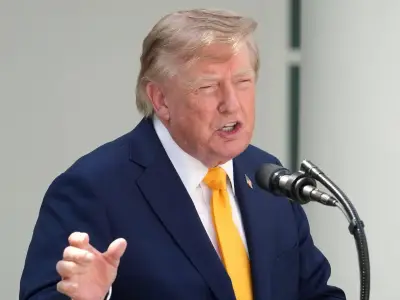
Presidential Pardons Deplete Vital Crime Victims Fund by Millions
A comprehensive analysis by the Trace reveals that former President Donald Trump's pardons of white-collar criminals have resulted in over $113 million being withheld from the Crime Victims Fund. This significant financial shortfall directly impacts organizations that support victims of violent crime across the United States.
The Mechanics of the Crime Victims Fund
Established in 1984 through the Victims of Crime Act (VOCA), the Crime Victims Fund operates exclusively on criminal fines and penalties from federal convictions, predominantly white-collar cases. Federal law mandates that all such financial penalties must be deposited into this fund, which then distributes resources to state and local programs including domestic violence shelters, rape crisis centers, and child abuse treatment services.
Gun violence survivors and families of deceased victims regularly depend on VOCA funding to cover medical expenses, funeral costs, and lost wages. The fund represents a critical financial lifeline for millions of Americans affected by violent crime.

Trump's Unprecedented Pardon Strategy
The Trace examined all 117 pardons and commutations issued during Trump's second term, verifying through court records whether defendants had paid their criminal fines or received pardons before satisfying their financial obligations. The analysis identified at least $113 million in forgiven fines and penalties that would have otherwise contributed to the Crime Victims Fund.
This figure excludes restitution payments that go directly to individual crime victims. Notably, one-third of Trump's second-term pardons include language calling for "remission of any and all fines," a provision absent from his first-term pardons.
The BitMEX Case: A $100 Million Blow
The majority of the lost revenue stems from a single corporate pardon. In 2025, Trump pardoned HDR Global Trading Limited, owner of cryptocurrency exchange BitMEX, just hours before the company was scheduled to pay a $100 million fine for anti-money laundering violations. This marked the first presidential pardon granted to a corporation.
Because the pardon explicitly remitted "any and all fines, penalties, forfeitures, and restitution ordered by the Court," the entire $100 million will never reach the Crime Victims Fund. This single action represents nearly 90% of the identified financial impact from Trump's pardons.
Historical Context and Funding Fluctuations
Steve Derene, co-founder of the National Association of VOCA Assistance Administrators, emphasizes that "just a couple settlements can really mean the difference in keeping this fund afloat." He notes that two-thirds of all money deposited into the fund since its inception has originated from only 90 cases.
The fund's balance has experienced dramatic fluctuations across presidential administrations. Under Barack Obama's second term, the fund reached an all-time high of $13 billion. By the conclusion of Trump's first term, it had plummeted to $3 billion. Although the fund currently maintains a balance exceeding $3.6 billion, the recent pardons threaten its long-term stability.
Real-World Consequences for Victim Services
The financial impact extends far beyond Washington bureaucracy. VOCA funding allocations to states decreased from over $3.7 billion in 2021 to approximately $2.2 billion in 2024—a 40% reduction. This decline directly correlates with fewer victims receiving assistance: nearly 10 million people were served by VOCA-funded organizations in 2021, compared to just 7.1 million in 2024.
States nationwide are feeling the pinch. Maine's governor proposed a $6 million annual allocation to compensate for VOCA shortfalls. Oklahoma programs reported 80% funding reductions over the past decade. Pennsylvania's domestic violence programs face a 7.5% funding cut, while New Mexico sexual assault survivor organizations requested $2 million in state funding to cover VOCA deficiencies.

Broader Systemic Implications
Michaela Weber, executive director of Victim Support Services in Washington state, explains that "the decline in VOCA funding has created significant uncertainty for victim service providers." Organizations must make difficult decisions regarding staffing, capacity, and the number of victims they can realistically assist.
Derene expresses concern that Trump's pardons may discourage federal prosecutors from pursuing cases that typically yield substantial fines, since their work could be nullified by presidential clemency. "We don't know what cases they're not bringing," he notes, suggesting the actual financial impact may exceed the calculated $113 million.
Political Dimensions and Future Prospects
The funding crisis has prompted congressional action, with the House passing the Crime Victims Fund Stabilization Act in January 2026. This legislation would allow the fund to access money collected from individuals convicted of defrauding the government.
Meanwhile, Senate Republicans have criticized the Biden administration for failing to collect $1 billion in outstanding fines and penalties that would have contributed to the fund. The Justice Department has identified nearly $10 billion in additional unpaid criminal fines and penalties.
Derene, who helped shape the original 1984 legislation, reflects on the changing landscape: "I always believed the federal government decided which criminal cases to pursue based on good faith, not partisanship. I'm not so willing to say that now."
As the fund navigates these challenges, millions of crime victims nationwide await resolution, their access to essential services hanging in the balance of political decisions and presidential prerogatives.