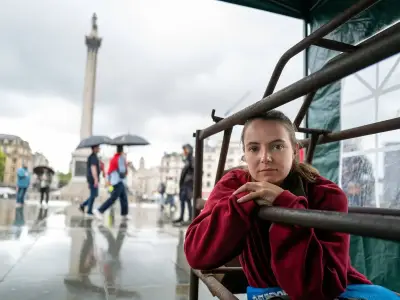
Fifteen years after surviving the Utøya massacre, Bjorn Ihler recalls the terror of being shot at by Anders Breivik and his subsequent work fighting extremism. Ihler, now 35, was 20 years old on July 22, 2011, when Breivik, disguised as a police officer, opened fire on the annual summer camp of the Workers' Youth League (AUF) on the island of Utøya in Norway. The attack followed a car bomb in Oslo that killed eight people, bringing the total death toll to 77.
The Attack Unfolds
Ihler had been enjoying a peaceful third trip to the island when news of the Oslo explosion reached campers. Leaders assured them they were safe, but Breivik had deliberately diverted emergency services. Dressed in a fake police uniform, he arrived on Utøya and began shooting. Ihler heard popping sounds like fireworks and saw a man in dark clothes with guns. People ran toward him, and he shot them down. Then he turned and fired at Ihler's group, forcing them to flee into the forest.
Ihler hid among trees, called his father for advice, and later picked up an eight-year-old boy, the son of a security guard. He eventually took two children and ran through the woods. At one point, they entered a site where Breivik had executed several people. Ihler blacked out but later found himself on the southern tip of the island, where he saw a media helicopter and ambulances. Believing help had arrived, he gave his phone to the children to call their mothers.

Confronting the Gunman
Spotting a police officer walking toward him, Ihler felt relief. But it was Breivik, who had disguised himself to trick security. 'He came out from the bushes behind us, and he said they'd caught the bad guy. As I was conveying that to my father, he started shooting at our group, so I jumped into the water,' Ihler recalled. His phone died, and the last thing his father heard was that the police were there. As he stopped to remove his woolly jumper, Breivik aimed and fired directly at him. 'For a moment I was like: "This is it." And I came to terms with that.' Breivik missed, and Ihler and the children hid under bushes overhanging the lake.
After Breivik's 72-minute killing spree, he was arrested. Only when gunshots stopped did Ihler emerge with the children, whose lips had turned blue from the cold water. They saw bodies scattered across the island. Breivik had murdered 69 people, including the two boys' fathers. The youngest victim was 14.
Aftermath and Investigation
Norway reeled in shock. Historian and political scientist Matthew Feldman noted, 'There was a sense of, how can a person from our society create this kind of havoc and harbour this kind of hate? How can Norwegian society produce someone like this?' Breivik, from an affluent Oslo suburb, was well-educated but radicalized online. He targeted the AUF for promoting multiculturalism. His 1,500-page manifesto became a blueprint for other lone-wolf terrorists, influencing attacks in Christchurch, New Zealand, and Poway, California, both in 2019.
In August 2012, Breivik was convicted on 77 counts of premeditated murder and sentenced to 21 years with indefinite extensions. At a rejected parole hearing four years ago, he flashed Nazi salutes. Ihler commented, 'I'm not seeing a future where he gets out of jail.' Breivik remains in Ringerike Prison, housed largely alone to prevent radicalizing other inmates.
Ihler's Journey to Healing
In the weeks after the attack, Ihler suffered flashbacks, poor sleep, and stress triggered by loud noises. He now says, 'I don't think "recovered" is a word I will ever use. It's more about learning to live with it.' He went on to study extremism, reading Breivik's manifesto and meeting former extremists worldwide. He now runs the Kalifa Ihler Institute, shaping global policy for peace and equality, and Revontulet, which monitors extremist networks.
Ihler remains in occasional contact with survivors and will mark this anniversary quietly with his wife and their dog. Reflecting on his work, he said, 'So many people are dedicated to doing what they can within their corner to make the world safer and better for people, and that is the main thing that gives me hope.'