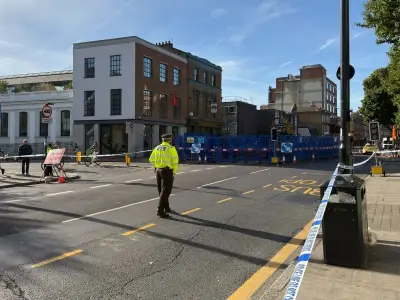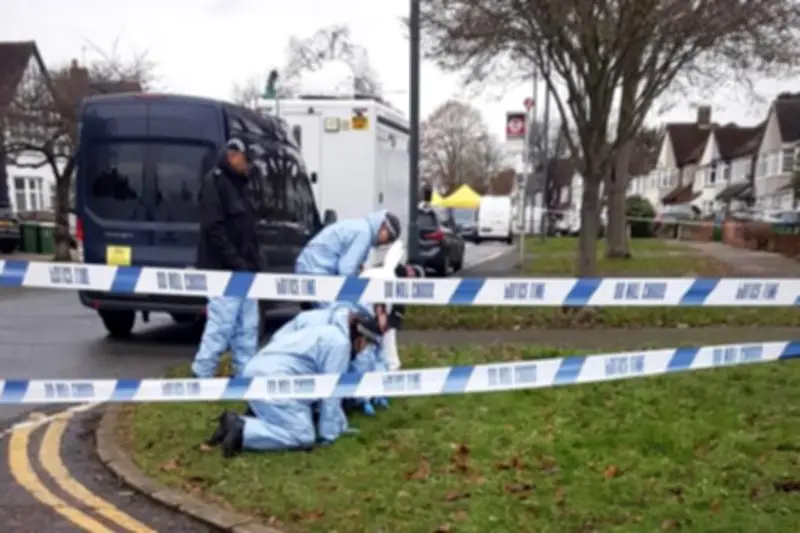
A 64-year-old retired domestic appliance engineer has been jailed for 15 years after planting a homemade bomb next to a ULEZ camera in a residential Sidcup street. Kevin Rees, of Harcourt Avenue, was sentenced at the Old Bailey on Friday after Judge Anthony Bate concluded the offending had a “terrorist connection”. The explosion occurred on Willersley Avenue at around 6.45pm on December 6, 2023, sending shrapnel into nearby vehicles and a child’s bedroom window.
Explosion on residential street
Rees was found guilty of causing an explosion likely to endanger life or cause serious injury to property following a trial at Woolwich Crown Court in January. Prosecutor Simon Denison KC said the ULEZ camera had been installed at around 12pm that day but within a few hours been cut down by another activist, Stephen Harwood-Stamper. Rees later placed a home-made explosive containing a substance commonly used in commercial fireworks next to the camera, lit the fuse, and walked away.
“Willersley Avenue is a residential avenue with houses on both sides and is a bus route. At that time of day there is significant vehicle trafficking passing through and pedestrians walking past,” Mr Denison said. The explosion sent shrapnel flying into a parked van and a passing car, where a piece “mercifully” missed the driver. Another piece of metal was carried more than 100m and damaged the frame of a child’s bedroom window.
Political motive and online activity
“People in nearby said they felt their houses shake, it was sheer chance that nobody was killed or caused seriously injured,” Mr Denison said. “The device was lit by a fuse, so the defendant was unable to control when it exploded or who was around when it was exploded - in fact a bus containing many passengers passed just before it exploded.” Mr Denison argued that the court must treat Rees as having a “terrorist connection” under the Sentencing Act, resulting in a harsher prison sentence than an “ordinary” crime, citing the political motive of furthering the “anti-ULEZ” cause.
Rees had set up his own Facebook group called “Ulez Camaras” [sic] and posted on it “be really careful, sure the bill look at these sites”. The court heard that in September 2023 someone messaged Rees: “Hiya mate – I'm interested in trimming some trees. Can you point me in the right direction?” Rees replied: “Google Julies maps there's [sic] links to all the trees that need pruning.” The terms “trees” and “pruning” are commonly used in anti-ULEZ posts to refer to camera poles and cutting them down. Julies maps is a site that shows the location of every ULEZ camera.
Defence and sentencing
At trial, Rees denied being responsible for the explosion and continues to maintain his innocence. Simon Ray KC, defending, argued that Rees’ conviction did not have a “terrorist connection” within the meaning of the act, saying his actions were a “wholly disproportionate” reaction to a personal grievance. “The purpose of the explosion was to put that camera beyond repair, it was not his intention to influence the political debate or to further any political or ideological cause,” Mr Ray said.
On the day of the explosion, Rees used his wife's car, which was ULEZ compliant, but he had a Jaguar which was not compliant. The author of a pre-sentence report said that while the bomb recklessly posed a risk to life, there was no evidence that Rees intended that anyone was harmed or he was motivated by ideology. The report said Rees had spent too much time at home following his retirement and become obsessed with the ULEZ scheme through online discussions. Mr Ray added that Rees made a “disastrous miscalculation” of the impact the bomb would have.
Turning to Rees’ health, Mr Ray said his client was suffering from a severe neurological disorder likely caused by these events, which had “ruined his life”. He was diagnosed with Functional Neurological Disorder (FND), a medical condition where the brain struggles to send and receive signals correctly. “He is existing but is not really living. That has been the case certainly since his conviction in January, if not since his arrest,” Mr Ray said. “The prosecution will say that his fault. I make no comment but to lay out the reality of what he faces.”
Judge Bates concluded: “I do find that the necessary criteria for Section 69 of the Sentencing Act 2000 are met in this case, so as to find this case has a terrorist connection.” He sentenced Rees to an extended sentence of 16 years - made up of 15 years in custody with a further one year on licence.
Reactions from authorities
Detective Superintendent James Derham said: “It was miraculous that nobody was killed or seriously injured in the large explosion caused by Rees.” Bethan David, Head of the Crown Prosecution Service’s Counter Terrorism Division, said: “This was not an act of protest or momentary vandalism. This was a deliberate and dangerous attack involving a home-made explosive device, carried out in a residential street and designed to destroy public infrastructure. Kevin Rees knowingly and intentionally placed an explosive device next to the ULEZ camera, lit the fuse, and retreated before the explosion, showing clear planning and an obvious disregard for the safety of others. Whatever his views on the ULEZ scheme, Kevin Rees crossed a serious line by constructing a home-made bomb and detonating it in a public place. It was pure chance that no-one suffered serious injury or worse.”