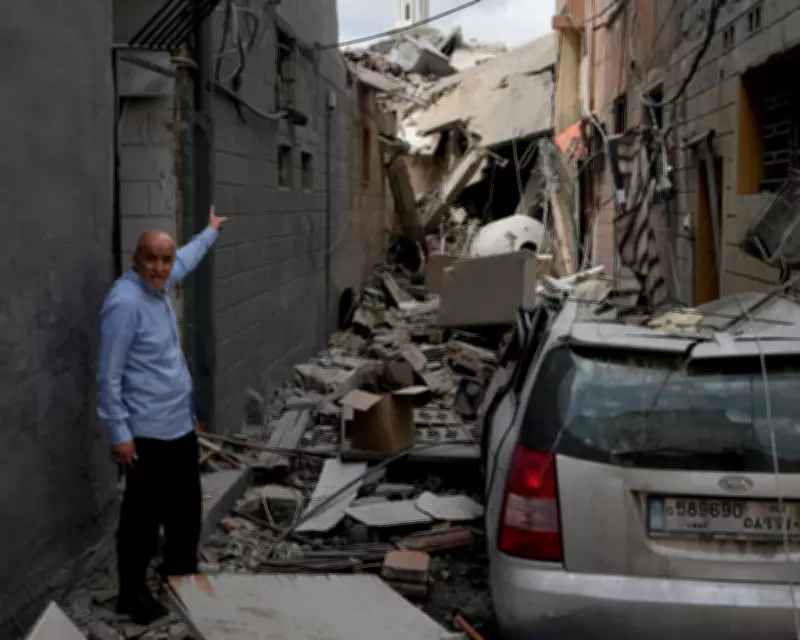
The chaotic, unique, and beautiful Lebanon that I once knew has been reduced to rubble. Suspected war crimes occur almost daily as Israel continues its bombardment, which Unicef estimates is killing nearly 14 children a day. We cannot write this off as just another war in a war-torn region.
A Personal Connection to Lebanon
There are various reasons why, at 43, I still do not know how to drive a car. Clumsiness is one factor. I cannot even walk straight half the time, so I do not think it is a good idea for me to take control of a 2-tonne vehicle. Another reason is that my first driving lesson was in Beirut, and the experience scarred me for life. The car was falling apart, Lebanese drivers ignore traffic rules, and the lesson was in Arabic, which I barely speak. After I veered onto a busy road the wrong way, my teacher made me get out of the car and yelled at me. I did not understand exactly what he was yelling, but it was not good.
Despite that unfortunate incident, Lebanon—chaotic, beautiful, unique Lebanon—holds a special place in my heart. When I was 18, my parents moved to Beirut for several years, and I visited regularly. We would go to the ancient ruins in Baalbek, drop by wineries in the Bekaa Valley, and eat man'oushe in the mountains. We would go on organized hikes, where there would always be a glamorous woman in heels, full makeup, and a designer nose (the Lebanese take grooming and cosmetic surgery very seriously).

Things were never completely calm. Coming home from a swim one summer, my mother narrowly escaped a car bomb intended for a politician. In 2006, my parents were stranded overseas for months because Lebanon and Israel were at war. In 2008, there were a couple of days of clashes that meant my mother and sister could not leave the house. Still, this was a relatively good time; there was investment, tourism, and hope. In January 2009, the New York Times named Beirut its No. 1 place to visit that year. With luxury hotels and restaurants opening, the Times said "the capital of Lebanon is poised to reclaim its title as the Paris of the Middle East."
You may have heard that phrase before: whenever a writer wants to convey to a Western audience that Beirut is not some backwater, but a real place full of real people, they reach for it. It is cringe and orientalist, but it is also an effective shorthand. Maybe I should have adopted it myself, because what I am trying to say here, with my walks down memory lane, is that Beirut is not fundamentally different from Paris. People who live in Lebanon, or the Middle East more broadly, are not born with thicker skin. They do not grieve their children less than Europeans do. They may have more experience of war, but they do not get used to having their houses bombed.
The World's Indifference
Many people seem to think otherwise. The idea that brown people are innately inured to horror was on full display in 2022, when Russia invaded Ukraine. A journalist on CNN lamented how horrible it was that this was happening to "civilized" people who, as the Telegraph put it, "watch Netflix" and "seem so like us." Then, in March, when Donald Trump was asked if the US supported a potential Israeli invasion of Lebanon, he replied by telling the reporter that he had a Lebanese acquaintance who told Trump: "Over the years, they've gotten used to the fact that it's being bombed."
This bizarre idea may be part of the reason why so much of the world seems to be shrugging its shoulders at the situation now. But please do not write off what is happening as just another war in a perennially war-torn region. It is far more than that: the Gaza playbook is being enacted in Lebanon.
The Scale of Destruction
Entire villages in the south have been wiped off the map. The Israeli government says it intends to control a "security zone" 30 kilometers inside Lebanese territory. Israeli government figures, including Finance Minister Bezalel Smotrich and National Security Minister Itamar Ben Gvir, have called for further expansion of the military campaign. Israel's Defense Minister, Israel Katz, has called for the indefinite occupation of an area of southern Lebanon, establishing the Litani River as Israel's northern border and forcing the displacement of 600,000 people.

Is Hezbollah, founded in the bloody aftermath of the 1982 Israeli invasion of Lebanon and emboldened by the subsequent 18-year occupation of the south, blameless here? Obviously not: the Iran-backed militia has fired thousands of rockets into northern Israel. But, as with Gaza, Israel's reaction goes well beyond self-defense and its stated goal of disarming Hezbollah. Suspected war crimes happen almost daily. Israeli airstrikes have continually hit health infrastructure and appear to be targeting medics with double-tap strikes. Experts including Human Rights Watch say they have documented the use of white phosphorus in civilian areas. Lebanon has accused Israel of ecocide. Unicef estimates that, as of 13 May, the equivalent of nearly 14 children a day have been killed since 2 March, many during a so-called ceasefire. This is not a road to peace: it is a road to a failed state and an endless cycle of revenge.
Nothing can justify what Israel is doing in Lebanon. Ask yourself this: if Israel bombed a residential building in Paris because it claimed, without evidence, that Hezbollah money was in the basement, would you be outraged? Because that is exactly what Israel did in Beirut in March, destroying an 11-story building full of engineers, doctors, and teachers with an unsubstantiated accusation about hidden money. No one was killed, but the residents lost everything.
Displacement and Fear
My parents still have their apartment in Beirut; they are not there now, but acquaintances have been sheltering in it. One of our neighbors, a 70-year-old grandmother whom I will call D, sounds as if she is barely managing when I call to ask how things are. And she is one of the lucky ones: food has become prohibitively expensive for many, but she can still afford to eat. There are shortages of water, electricity, and fuel, but she is coping. D and her husband hear Israeli drones at all hours, an incessant, irritating buzz.
More than 1 million people in Lebanon, about 20% of the population, are displaced. Their suffering will not end when the war does: they have nowhere to return to. Our neighborhood is full of displaced people, D says. Some are in schools turned shelters or staying with friends. But many cannot find anywhere to stay because Israel has made neighbor afraid of neighbor. In the south, the Israeli military reportedly warned Christian and Druze communities not to shelter Shia Muslims. Now, says D, people are afraid to rent their houses to Shias in case the building is targeted.
"You know what I am afraid of the most? A civil war," says D. "People starting to turn against each other. I do not know how this situation is sustainable." D is not the only one afraid: some have warned that public anger over Hezbollah's decision to enter the war with Israel, dragging Lebanon's citizens with it, could lead to more internal conflict—which Israel would benefit from and, some have argued, may be hoping to incite.
A Lost Future
One day, I may be able to return to Lebanon, but I will never be able to go back fully: many of the places in my memories are rubble. But having bits of your past wiped out is nothing compared with having your future destroyed. "I am sorry," I say to D eventually, worrying that my phone call has upset her. "I guess I do not know what to say." She sighs deeply: "There is nothing left to say."