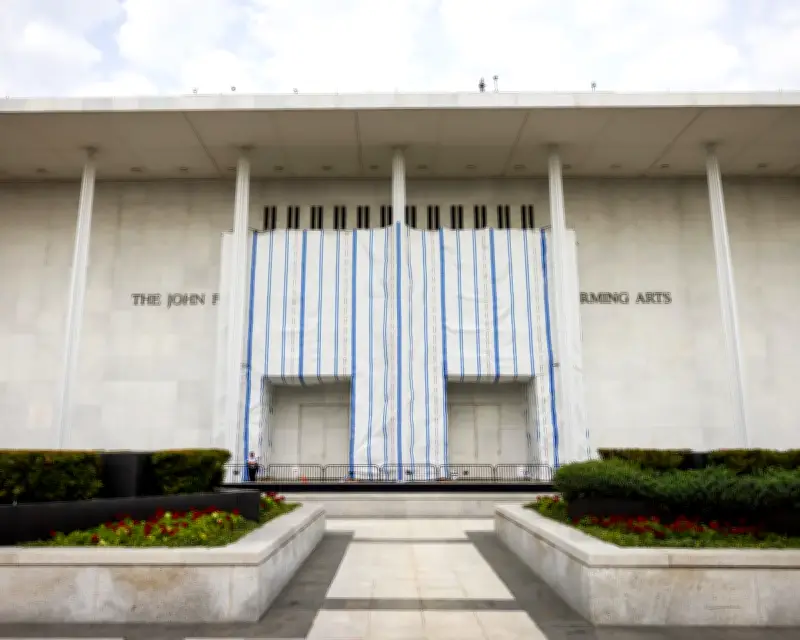
The board of the John F Kennedy Center for the Performing Arts in Washington DC has voted again to move forward with President Donald Trump's plan to temporarily close the main building for substantial renovations and to inscribe his name on the facade, despite a federal judge's order to remove it. The decision, reported by the New York Times, comes as the center faces a deadline to present its plan to the judge who blocked earlier efforts.
Board votes to close main building and add inscription
The board, largely composed of Trump allies, voted to close the Kennedy Center's main building while keeping the newer Reach addition open for limited programming, serving as an active memorial to John F Kennedy. Shortly after, the board also voted to add an inscription beneath the institution's signage reading: “Restored and Renovated by President Donald J Trump.”
The results were confirmed by Joyce Beatty, a Democratic US representative from Ohio who sits on the board, and by lawyers involved. This vote follows a May ruling by US district judge Christopher Cooper, who ordered Trump's name removed from the building's facade after it was added last year. Cooper ruled the addition was illegal, as only Congress has the authority to change the institution's name. The center removed Trump's name in June but is appealing the decision.
Judge's prior ruling and board's response
Beatty criticized the new vote, stating: “This latest development is a transparent effort to circumvent the Court’s ruling, and flies in the face of the statutes that Congress passed. I will continue to fight for this treasured national monument.” The Kennedy Center was contacted for comment, and the decisions will be subject to approval by a federal judge.
Cooper had also issued a temporary block on Trump's demand to close the arts institution for two years of renovations, which were due to start in July after the board voted unanimously in favor in March. Beatty sued over that decision, leading Cooper to shut down the initial plan, citing that the decision appeared “ill-informed and seemingly preordained.”
In his May ruling, Cooper stated: “In ratifying President Trump’s closure announcement, the Board was derelict in discharging the full range of its responsibilities to the Center. More specifically, the Board based its decision on an insufficient, one-sided presentation of information and neglected to consider the full range of its statutory obligations and potential adverse consequences of closure on programming and memorial functions.” He also noted the board's legal obligation to maintain the facility as a memorial to JFK.
Options considered and renewal project details
Ahead of the meeting, the Kennedy Center's management presented the board with three approaches, according to the Associated Press: a complete closure, a partial closure allowing some public access and limited programming in unaffected spaces, or a series of phased closures addressing only the most serious infrastructure needs while maintaining a full slate of programming.
The New York Times reported that the board was presented with a lengthy plan for a $250m “renewal” project, including significant repair work, new marble floors, “acoustical” improvements, and a proposal to “temporarily move the famous 3,000-pound bronze bust of JFK to another building” on the campus.
The Kennedy Center has until next week to share its plan with Cooper, who will review his decision to assess whether the board carried out sufficiently thorough due diligence ahead of the vote. The outcome will determine whether the renovation and name inscription proceed, with the judge's review serving as the final checkpoint.