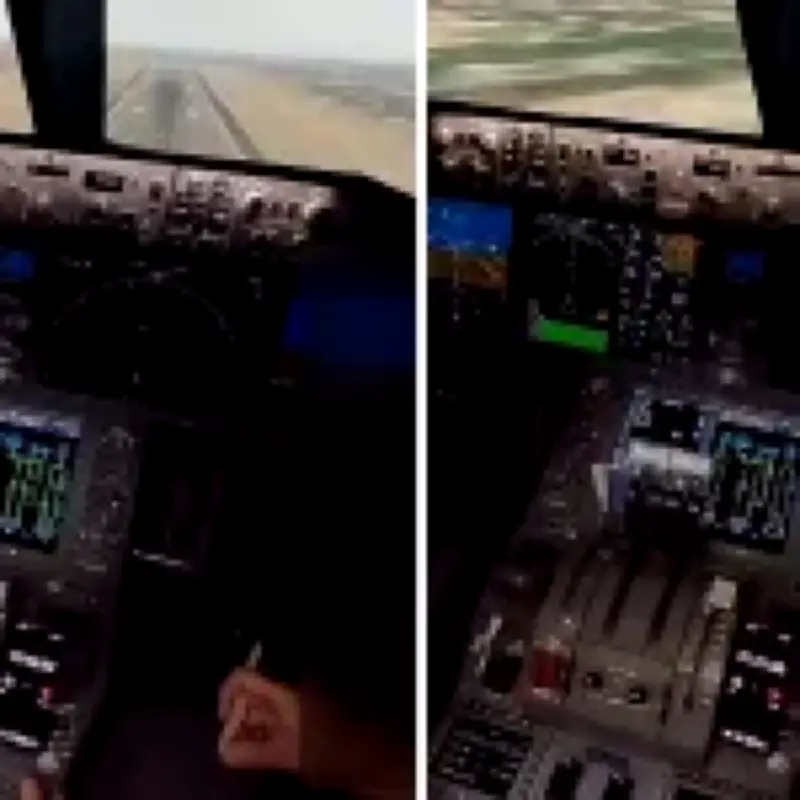
Newly obtained footage from a law firm's simulation of the Air India crash has cast doubt on the theory that pilot suicide was to blame, as the test results dispute the official timeline of events. The simulation, conducted by Beasley Allen, a law firm representing 130 victims and their families, focused on the deployment of the Ram Air Turbine (RAT), an emergency power source on the Boeing 787.
Simulation challenges AAIB's timeline
The Air India flight from Ahmedabad to London crashed on June 12 last year, killing 260 people, including 52 British nationals. The Aircraft Accident Investigation Bureau (AAIB) of India released a preliminary report in July 2025 suggesting that pilot action, possibly self-sabotage or error, was the cause. The report stated that the Boeing's fuel switches moved to the 'cut-off' position 'immediately' after take-off, halting fuel supply to the engine.
However, Mike Andrews, a lawyer at Beasley Allen, told Metro that his firm's tests dispute this timeline. The law firm brought in pilots to France and conducted flight tests on a high-level D simulator, focusing on the RAT, which rotates in the airstream to provide power when other systems fail. The AAIB's preliminary report claims the RAT was providing hydraulic power within five seconds of the fuel switches being cut off. But the test data analysis shows the RAT would need 14 to 18 seconds to provide power, meaning the emergency mechanism was deployed before the fuel was cut off, potentially while the aircraft was still on the ground.
Lawyer's concerns and next steps
Andrews said the timings in the AAIB report 'never made sense' and that the AAIB's argument about when the RAT deployed was 'not accurate'. He continued: 'We feel confident based on our testing that something else is happening. It's either going to require the AAIB to revise their timeline or they're going to have to come out and say they made a mistake.' The discovery has not pinpointed the cause of the crash, as there are 'so many things that can cause' the RAT to deploy.
Andrews has been sceptical of the pilot suicide theory, calling it 'just rank speculation and conjecture' in an interview with Metro last year. He has now written to India's AAIB, the US Department of Transportation, and UK officials with his findings. In the letter, seen by Metro, he told investigators: 'Taken together these pieces of evidence tend to indicate that the RAT deployment (a potential symptom of electrical system failure) was not caused by alleged pilot induced fuel system changes.'
AAIB's response and ongoing investigation
The AAIB was expected to release its final report in June this year but has now pledged to publish its conclusions in October. The body has also told India's Supreme Court that it has conducted its own flight simulation tests, according to India's The Economic Times. Andrews said: 'That is hugely significant because if you are so convinced in the pilot suicide narrative, why are you running expensive testing? It just means they have no faith in their theory. I am glad that they are doing these tests.'
When asked if he thought the AAIB would tell the public the truth about the crash, Andrews said: 'I have no way of knowing. I will say that over a year after the accident, we've not heard them backup from this suicide narrative at all. That is troubling to me. If I were confident that they were going to provide us with truth, we would not have had to go do our own tests.' Asked if he thought the AAIB had told the truth so far, Andrews stayed silent for 16 seconds before answering: 'I don't know'.
Boeing has consistently maintained that the 787 is safe, saying the firm's exhaustive testing procedures ensure this is the case. The company has told numerous outlets it would defer to India's AAIB to provide information about the investigation. The AAIB defended its interim report shortly after publication, insisting it was not meant to direct blame towards the pilots or encourage anyone to draw conclusions, which it called 'irresponsible'. In a statement in July, it said: 'The purpose of AAIB's investigation and preliminary report is to provide information about 'WHAT' happened. The preliminary report has to be seen in this light. At this stage, it is too early to reach to any definite conclusions. The investigation by AAIB is still not complete. The final investigation report will come out with root causes and recommendations.'
The investigative body said it has a 'flawless record' from looking into 92 accidents and 111 serious incidents since 2012. Air India's boss also defended the results of the AAIB's interim report in September, saying: 'For the moment, the preliminary report indicates nothing wrong with the aircraft, nothing wrong with the engines, nothing wrong with the airlines operation, but we've taken a significant safety pause to ensure all of our practices and procedures are fully embedded, and people are fully embracing a new normal of even extra focus on safety, and the focus continues to be on the people that were affected.'
Andrews added that the victims and their families he represents were 'understandably frustrated' with how the investigation has unfolded. He said: 'We're all looking at the AAIB to see what they're going to tell us, what their testing is going to show, what position they're going to take and if their theory is provable or not.' Air India, Tata Group and India's AAIB have been approached for comment.