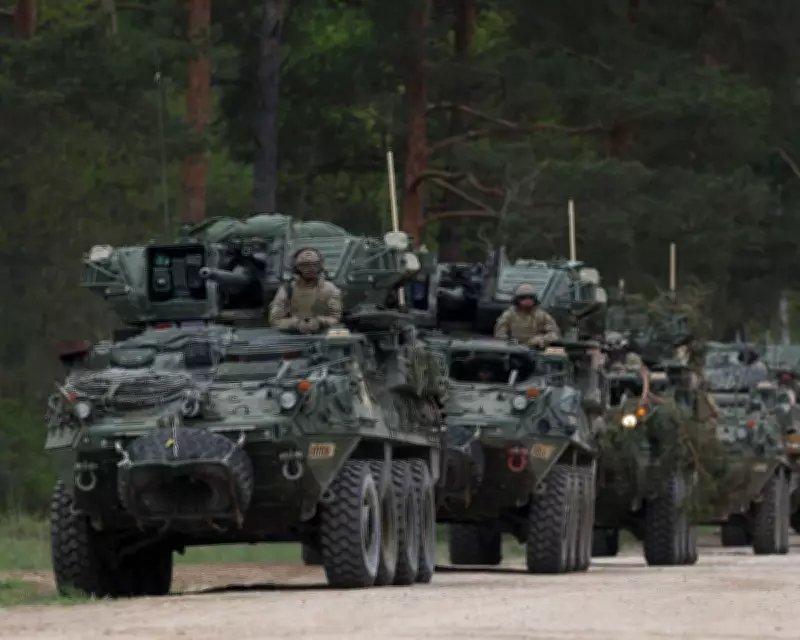
President Donald Trump has announced that the United States will deploy an additional 5,000 troops to Poland, marking a significant policy reversal days after the Pentagon delayed a planned rotation of forces. The announcement was made on Truth Social, where Trump cited his endorsement of Polish President Karol Nawrocki and their strong relationship.
Details of the Deployment
It remains unclear whether the new troops will be rotational or permanent, or if there is any connection to Trump's earlier decision to withdraw 5,000 troops from Germany. Currently, approximately 10,000 US troops are stationed in Poland.
The move appears to reverse the Pentagon's earlier decision to postpone the rotation of 4,000 troops from the 2nd Armored Brigade Combat Team, 1st Cavalry Division to Poland, as part of a broader review of US force posture in Europe.

Reactions from US Officials
Vice President J.D. Vance had defended the delay as recently as Wednesday, telling a Polish reporter that Europe should take more responsibility for its defense. He described the delay as "a very minor thing" and criticized media for overreacting. However, the initial decision caused anxiety among Polish leaders, who are concerned about Russia's assertive stance amid the ongoing war in Ukraine.
Secretary of State Marco Rubio, ahead of a NATO ministerial meeting in Sweden, criticized alliance members for not supporting the US-Israeli military campaign. He singled out Spain for denying the US use of its bases, questioning why such countries remain in NATO.
Poland's Strategic Role
Poland has long positioned itself as a key US ally in Europe, contributing troops to Iraq and Afghanistan and leading defense spending among NATO's European members. President Nawrocki thanked Trump for his friendship and emphasized the alliance's importance for European security.
Defense Minister Władysław Kosiniak-Kamysz described the decision as confirmation of strong Polish-American relations, stating that Poland is a "model and ironclad ally." Earlier this week, he had sought urgent talks with US Defense Secretary Pete Hegseth to clarify the original delay.