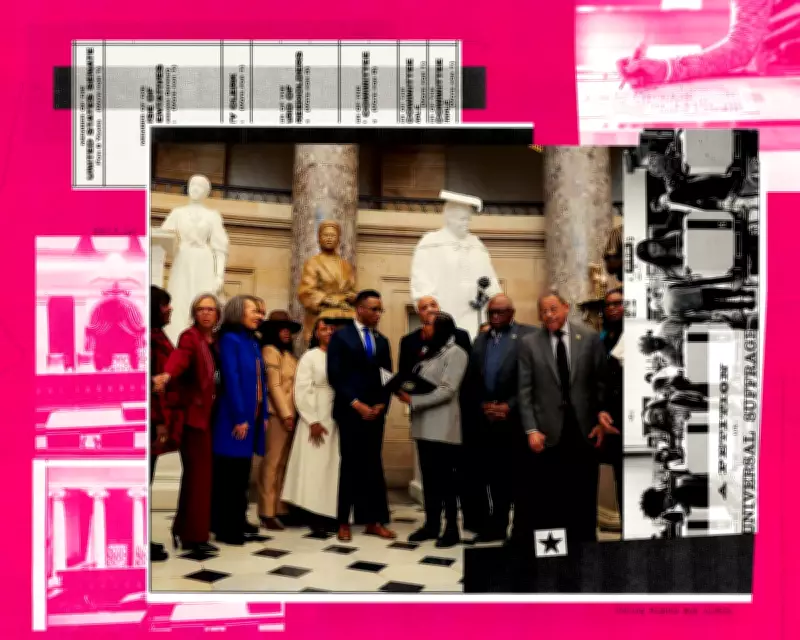
The Voting Rights Act was a political peace compact written in John Lewis's blood. The Callais v Landry decision by the US Supreme Court, which set aside much of Section 2 of the Voting Rights Act, whitewashed that blood from history, along with that of thousands of other Americans who fought segregationist white supremacists at lunch counters, bus stations, and courthouses for political equality.
Impact of the Callais Decision
With the Callais decision, which ruled that litigants must prove racial motivations in redistricting, Republican majorities will be able to marginalize Black political power across the US and especially in the South, where voting is highly racially polarized. The NAACP wrote in a statement following the decision: "This ruling is a major setback for our nation and threatens to erode the hard-won victories we've fought, bled, and died for."
Gerrymandering and Racial Politics
Gerrymandering works because voters of one party can easily be identified in geographic concentrations. The court concluded that race cannot be considered when drawing district lines; mapmakers need only consider political advantage. However, if non-white voters disproportionately choose Democrats, and those voters are concentrated in easily gerrymandered clusters, then Republican policymakers benefit from racial politics that rely on these clusters, making it easier to draw lines disempowering Democrats.

At the start of the 2025-26 session, 62 of the 435 members of Congress were Black, the largest number on record and the first time in American history that Black representation in Congress equaled its representation in the American population. Fifty-six Hispanic representatives serve in Congress, as do 21 Asian Americans. Four Black House members are Republicans, which also closely matches Black political demography. All four of those Republicans are retiring this year, either to run for higher office or because their district has been gerrymandered out from underneath them. More than half of Democratic representation in Congress is non-white, while less than 10% of Republican representation is non-white.
Carol Anderson, chair of African American studies at Emory University, said: "Our parties are so racially split, racial gerrymandering can use the fig leaf of partisan gerrymandering. It allows them to go full-bore hog-wild."
Concentration of Democratic Voters
When looking at a map of voting patterns in the United States, we find islands of blue surrounded by vast oceans of red. Democratic voters tend to be concentrated in densely populated urban areas. Black voters also tend to be concentrated in densely populated urban areas because suburban communities have a legacy of zoning laws making affordable housing harder to build there. According to 2023 and 2024 US Census Current Population Survey data, the median white household out-earns 75% of Black households, meaning only a quarter of Black people can afford to live where most white people live.
Roughly half of Americans in metropolitan areas live in highly segregated communities, according to the US Department of Housing and Urban Development. This is not solely a feature of the American South or of Republican-controlled states; these highly segregated areas include almost all of America's largest metro areas: New York, Los Angeles, Chicago, Detroit, and Philadelphia. The Callais decision punishes this concentration. As long as the resulting districts are contiguous and compact and lawmakers avoid mentioning anyone's ethnicity in hearing chambers, mapmakers in Republican states are free to crack urban districts into pieces and dilute their votes into oblivion.

Future Implications
James Woodall, a former NAACP president in Georgia, said that descriptions of the law being "gutted" may be premature. The court left space for challenges under Section 2, but the path is narrow: a case requires evidence that mapmakers used racial data to draw district lines, instead of simply looking at the plain effect of redistricting. However, the change is radical and will force a radical rethink of racial politics for Republicans and Democrats, he said. "Practically, what this now means is that black voters equal Democrat. And in order for black people to have political power, we will need to separate ourselves – and I hate to say this – we are going to have to separate ourselves practically from that assumption."