San Diego’s Muslim Community Picks Up the Pieces After Mass Shooting
Teacher’s assistant Iman Khatib was administering tests at the elementary school inside the Islamic Center of San Diego (ICSD) when she heard the bangs. She locked the classroom door, turned off the lights, silenced her phone and walkie-talkie, and crawled under a desk with her co-worker. In nearby preschool classrooms, three- and four-year-olds stayed completely silent, hiding in corners, following protocols learned during drills. Outside, the first-grade class was at recess when the first shot rang out.
“We were so grateful that we made it out alive,” Khatib said two days later. “None of us are sleeping. We don’t want to relive the things that we saw.” When police evacuated the staff and students, they passed the body of the security guard, Amin Abdullah, lying on the ground in front of the mosque. Abdullah, a father of eight and a convert to Islam, had radioed the lockdown and returned fire, keeping the two teenage gunmen from reaching approximately 140 children and 20 staff members.
Also killed were Mansour Kaziha, manager of the mosque store, and Nader Awad, who ran over from across the street when he heard the shots. The attack is being investigated as a hate crime. At a press conference, Abdullah’s daughter Hawaa shared through tears: “My dad was my role model and my best friend.” She had just received her teaching credentials last week, and her father couldn’t be there because he was working at the center.

A Welcoming Community Tested by Violence
The Islamic Center of San Diego, the largest mosque in San Diego county, serves a congregation spanning thousands and over a dozen nationalities. It runs an elementary school, holds five daily prayers, and has spent two decades building an extensive interfaith network. Imam Taha Hassane, who arrived from Algeria in 2001, responded to post-9/11 backlash by opening doors wider: hosting interfaith meetings, joining civic groups, and conducting Friday sermons in English.
“American Muslim institutions almost uniformly aspire to openness,” said Hatem Albazian, director of the Islamophobia Research and Documentation Project at UC Berkeley. “But very few have committed to it as completely, as publicly, and for as long as ICSD.” The mosque has faced pressure after October 7, 2023, with anti-Muslim incidents rising. The Council on American-Islamic Relations recorded 8,683 anti-Muslim complaints in 2025, the highest ever.
After the shooting, investigators found hate speech on one weapon and racial ideology in a suicide note. Tazheen Nizam of Cair San Diego said, “There are 22 other mosques in San Diego county. It is imperative for elected officials to come forward.” She also noted that no federal security funding was received by San Diego mosques in the last grant cycle.
Community Rallies Together
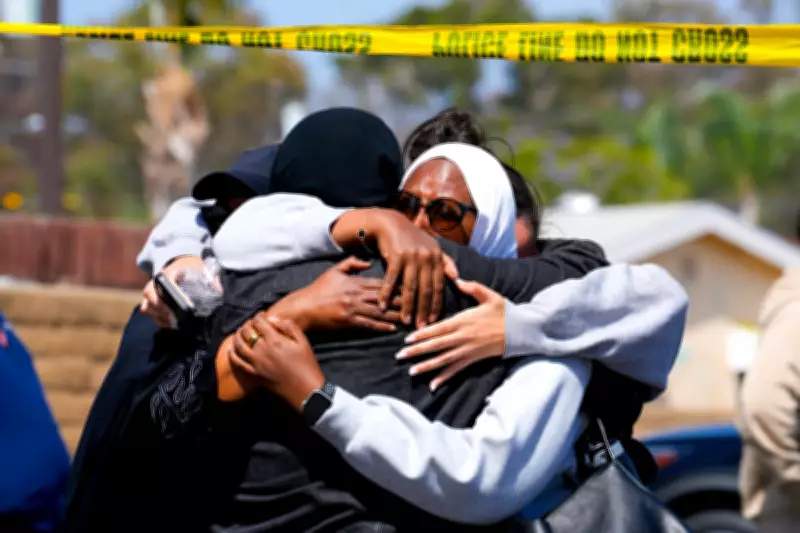
Two days after the shooting, staff retrieved personal items left behind. They gathered at the home of the kindergarten teacher whose husband was killed. Amin Abdullah’s sister, a police officer who worked security at the mosque, was also there. “Being together was exactly what we needed,” Khatib said. Hundreds gathered at a vigil, with faith leaders honoring the three men. “Hate and bigotry arise from ignorance,” said Nizam. “We’re just your neighbors.”
The mosque resumed daily prayers, though the school remains closed. A fundraiser has raised over $3 million. Khatib said staff will reunite children with belongings and ensure positive memories for closure. “The ones who pay the ultimate price are the children,” she said. “This is not a world that children should have to live in.”