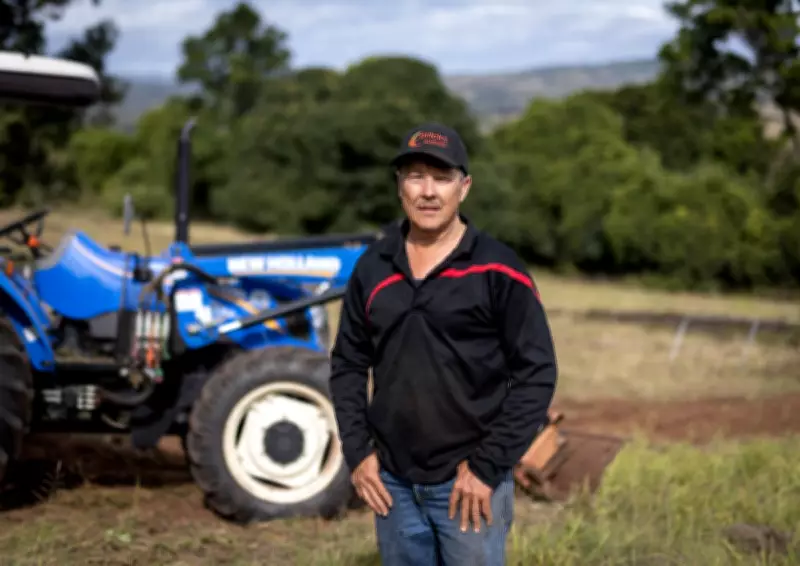
Down a red dirt track in the soft and rolling hills beyond Kingaroy, Darren Munt kills the engine of his tractor for a quick chat about politics as he clears lantana from a paddock. The cattle and dairy farmer has “always gone Nationals”, except for the odd dalliance with their insurgent rivals One Nation.
If a federal election was held tomorrow, though, Munt doesn’t hesitate to say he would cast his lot with the party of Pauline Hanson “straight away”. “I think she’s on the ball with her policies on immigration and housing,” he says. “Cause the housing out here has gone mental. My son, he’s 21 – he’s got no chance of getting a house now.”
A Growing Disconnect
Cafe owner Cath Kenny says she wrote an open letter to politicians in Canberra challenging them to “live as us” for three months. She never received a response. Sitting out the front of her 1950s US diner-style Burning Oil Cafe in nearby Nanango, roughly three hours north-west of Brisbane, she’s happy to elaborate on the letter’s contents. “I put them up for a three-month challenge to … live on our wage. That’s the only way they’re going to reset the country,” Kenny says.

To Kenny, all politicians appear the same – “higher up than us”. Except one. “Pauline Hanson has got her faults,” she says. “But she’s owned a takeaway shop. She’s lived the life of a standard person. She hasn’t just come out of Tafe and gone straight into politics.”
Kenny and Munt live in the eastern fringe of Queensland’s biggest federal electorate, Maranoa, which sprawls 731,297 sq km from the foothills of the Great Dividing Range to the Simpson desert. Held by the Nationals (including in its earlier Country party and later Liberal National iterations) since 1943, Maranoa is the party’s heartland. At the last federal election its status as the Coalition’s safest seat was retained by David Littleproud, then the National party leader.
Surely One Nation could not dethrone the Nationals in a seat John Howard once declared “the Kingdom of Maranoa”. Could they? Asked that question in February by the ABC, the Griffith University associate professor Paul Williams said the dial had shifted from “impossible” to “difficult”. “After Farrer, I’d say now it’s entirely plausible,” he says now.
The Ghost of Sir Joh
The ghost of Queensland’s longest serving premier, the Nationals’ Sir Joh Bjelke-Petersen, still holds a firm grip on the small town of Kingaroy with its big peanut silos. The town’s airport – a flat of green at the base of Bjelke-Petersen’s family property – is named after him, while his wife is commemorated with the Lady Bjelke-Petersen hospital. His picture is framed on the wall of the roadside boiled peanut van. Even Green-leaning support worker and back yard botanist Sacha Bruyn – tending “the only verge garden in Kingaroy” and wearing a T-shirt that reads “modern feminist” – has Bjelke-Petersen’s portrait inside her home. She laughingly attributes it to her partner, Dave, who “collects a lot of historical stuff”.
While the National party’s foundations in Kingaroy go deep, its fissures do too. In 2013, Bjelke-Petersen’s son John broke with the conservative establishment to run for Maranoa under the banner of the mining magnate Clive Palmer. He attracted 13.91% of first preferences, not too far off Labor (16.29%) but a distant third to the LNP (57.42%). John Bjelke-Petersen still lives in Kingaroy and runs the family estate, Bethany. He takes a quick break from cattle work to grab the two plastic jars of peanut butter he dipped into for lunch and upon which he has been ruminating ever since. The condiments are made in Australia – using imported nuts.
Jars in each hand, Bjelke-Petersen rails against three decades of economic policy he says allowed the import of peanuts higher in heavy metal contaminants and responsible for “decimating” the local industry. Both major parties, he says, have been beholden to a free trade agenda that has left the bush behind. “You go through the towns, having seen them in the past and what they are now – services have been cut,” he says. “Governments on both sides that have been in play have failed rural and regional areas.”

The former premier’s son considers his words when asked who he plans to vote for at the next election. “I think Pauline’s heading in the right direction,” he says. “She’s certainly saying the right things.”
Mixed Feelings
Not everyone in the district is swayed by Hanson’s rhetoric – nor amused by her antics. James Lane, 47, sells citrus, avocado and custard apples by the side of the D’Aguilar Highway on the outskirts of Yarraman. One Nation “is fine”, the farmer and labourer says. He wants to see a quota of gas reserved for the domestic market, as the party proposes, and he likes their “code of morality” – “looking out for the Australian family”. But, as a “very spiritual person”, Lane cannot forgive Hanson for her repeated stunt of wearing a burqa into parliament. “She’s dangerous, that woman,” Lane says of Hanson. “You don’t make fun of people’s religious garb, ever. Or even cultural dress – it’s just rude.”
Steve Oliphant, a retired high school manual arts teacher, watches his Kingaroy RedAnts take on the Murgon Mustangs under the eaves of a packed club house that he helped build – a task for which he was given life membership of the rugby league club. Oliphant reacted to the Farrer byelection result in disbelief. “I just shook my head,” he says. “I just can’t see One Nation doing any good.”
Australia’s most prominent psephologist, Antony Green, says there is “no doubt” that if One Nation continues to perform as it has been it will “poll very strongly in every rural electorate in the country”. “But rural electorates aren’t going to decide the next election,” he says.
Green says the National party – and rural and regional Liberals – are engaged in an existential battle with One Nation. To anticipate what might happen next, he raises two questions drawn from Queensland state politics around the turn of the century. In 1998, a nascent One Nation burst on to the scene with 11 seats and a higher primary vote than the Nationals and Liberals. By the time a scandal-plagued Labor minority government called a snap election three years later, however, One Nation had imploded. With chaos on the right, Labor won in a landslide. This time around, will Hanson’s band hold itself together until 2028?
Lessons from the Past
Among those who also draw lessons from that era in Queensland politics is Dorothy Pratt. Today, the retiree shares her Kingaroy home with her husband, Tony, who tends the dozens of fruit trees and vegetable patches that keep her “as healthy as she could possibly be” after being diagnosed with multiple sclerosis 25 years ago. She paints watercolours and collects ukuleles. But in 1998, Pratt won Bjelke-Petersen’s old state seat for One Nation – and was returned to parliament as an independent at the next four elections. “At the time, we were all pretty naive,” Pratt says of One Nation’s late-90s implosion.
She hopes Hanson has “learned an awful lot” about party structure over the last 30 years and “still respects Pauline immensely” – just as she did the late Bjelke-Petersen. Pratt also hopes that the Coalition stops “forgetting a lot of One Nation were once theirs” and avoids brawling with their conservative rivals. She likes the opposition leader, Angus Taylor’s rhetoric around immigration. If his Coalition can convince Pratt they “are honest”, she will vote for them in 2028. So Pratt’s vote is the Coalition’s to lose? “Absolutely,” she says. “And easily lost.”
Pratt’s point about voters detaching from traditional parties is one political experts such as Williams call “dealignment”. Australia, he says, is one of “the last countries in the world” to experience it. But over the past few electoral cycles, the erosion of party identification has intensified – particularly, for now, among conservatives. But he cautions against reading too much into one “trouble-maker’s ballot box”. “[Farrer] was a tremor,” Williams says. “An earthquake is when you’ve got – not just dealignment – but realignment. If we had an election and One Nation scored more seats than the Coalition, then that’s an earthquake. That hasn’t happened.” Like the Nationals, One Nation declined to comment for this article. But to statements like Williams’s they have elsewhere riposted: “yet”.