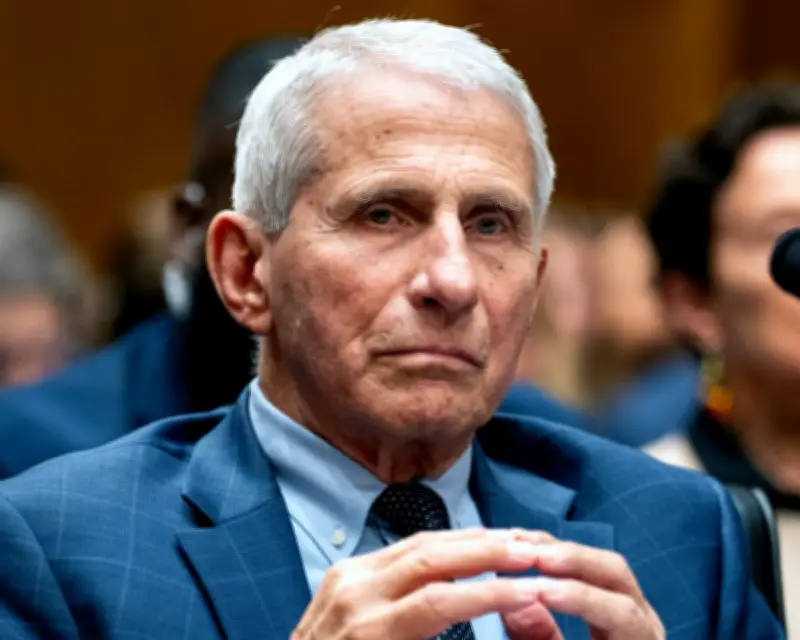
Dr. Anthony Fauci, the former director of the National Institute of Allergy and Infectious Diseases, appeared before a Senate committee on Wednesday under subpoena, invoking his Fifth Amendment right against self-incrimination. The hearing, chaired by Republican Senator Rand Paul of Kentucky, was ostensibly about investigating the origins of the COVID-19 pandemic but quickly devolved into a partisan attack on Fauci, who served as a key adviser to both the Trump and Biden administrations.
Rand Paul’s Pursuit of Fauci
Senator Rand Paul has long promoted the theory that the COVID-19 pandemic originated from a lab leak at the Wuhan Institute of Virology, a view less supported by virologists who favor a natural zoonotic origin. Paul argued that Fauci could be responsible for the pandemic because the National Institutes of Health provided a sub-grant to the institute. Fauci, however, described Paul’s investigation as an “unhinged obsession” with seeing him “behind bars.”
Fauci stated, “Although it pains me to do so, because of the respect I have for the legislative branch of government and my decades-long record of cooperating with Congress, under the advice of my attorneys I will invoke my right under the fifth amendment of the constitution to refrain from answering your questions.” Paul had prepared a copy of a law he claimed compelled Fauci to testify, but Fauci declined to answer.

Scientists Rally in Support of Fauci
A group of 155 scientists published an open letter condemning the “vilification and harassment of many American scientists.” The letter stated, “The charges against Dr. Fauci are baseless, suggesting he covered up the origins of Covid, that he bribed or persuaded other scientists to join his cover-up, that Niaid-funded research sparked the pandemic, that he personally holds patents on the virus, and that he’s working with intelligence agencies to suppress the true story of the pandemic. No credible evidence has been produced to support these absurd charges.”
Fifth Amendment Controversy
Fauci’s invocation of the Fifth Amendment became a central issue. He received a presidential pardon from Joe Biden before leaving office, leading to debate about whether the amendment can be invoked post-pardon. Senator Paul, visibly frustrated, told Fauci, “There will be repercussions to your refusal to testify today.” Paul later indicated he would call for a contempt of Congress vote next week. Senator Josh Hawley of Missouri added, “You don’t have any rights under the fifth amendment. This is about contempt: contempt for this body and contempt for the American people.”
Republican Criticism Across the Board
Multiple Republican senators attacked Fauci. Senator Ron Johnson of Wisconsin accused him of covering up unfavorable information about COVID vaccines, which Johnson described as “experimental gene therapy,” despite vaccines being credited with saving millions of lives. Senator Bernie Moreno of Ohio demanded Fauci apologize for military vaccine mandates, to Americans who lost businesses, and to a mother arrested for not wearing a mask at an outdoor football game. Moreno called Fauci a “total and complete disgrace.” Senator Joni Ernst of Iowa criticized the use of aborted fetal tissue in research.
Democratic Senator Gary Peters of Michigan argued the hearing was an attempt to “turn one person into a scapegoat for a crisis that hundreds of officials across the Biden and Trump administrations were responsible for handling,” warning it would deter other scientists from public service.
Politicizing Science as a Republican Strategy
The hearing reflects a broader Republican strategy to criticize science. The Trump administration has invoked the lab leak theory to critique past pandemic policies while cutting $11.4 billion in state and local health department funding. Disruptions to government funding for cancer and Alzheimer’s research have been justified as removing diversity, equity, and inclusion focus. A proposed rule would bring the $1 trillion federal grant-making apparatus under political appointees’ control, following trials at the NIH in 2025.

Senator Richard Blumenthal of Connecticut said, “For the past 18 months, the Trump administration has been engaged in a campaign to rewrite this history. Today’s proceeding, I fear, is part of that effort.”