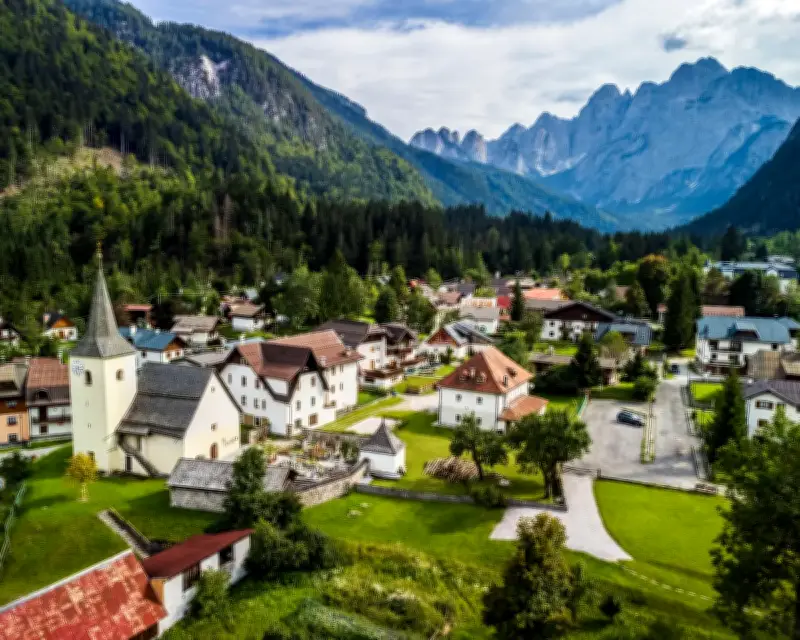
The Alpe Adria loop is an eight-day, 135km (84-mile) walking trail that crosses the borders of Austria, Slovenia and Italy, offering a moderate-graded, multicultural hiking experience. The route, jointly developed by the three nations, starts near Austria's highest mountain, Grossglockner (3,798 metres), and ultimately runs 750km (466 miles) to the Adriatic coast, but the shorter loop provides a week-long taster of the region's dramatic peaks, meadows, and cultural diversity.
An Alpine Borderland Where Boundaries Fade
On the Feistritzer Alm, a peaceful Alpine pasture at the meeting of Austria and Italy, hikers walked straight past the signpost marking the state border, mountain bikers used it to prop up their cycles, and cows grazed freely. Patrons of the Schutzhütte Oisternig enjoyed their cold beers regardless of which country they were in. While official boundaries have changed over centuries, the magnificence of the mountains has not.
The writer and her husband began their journey in the Austrian village of Feistritz, after breakfast at the Gasthof Alte Post, buying a loaf from the bäckerei and climbing past a 15th-century church into high Alpine meadows and into Italy. They had travelled from London via Eurostar to Amsterdam, then the Nightjet sleeper to Salzburg, and finally a train to Villach, where the loop begins.

From Austrian Meadows to Italian Villages
From the Feistritzer Alm, the trail descended through shade and butterflies to the village of Valbruna, where they stayed at the Valbruna Inn. The hotel featured the Julius Kugy Library, named after the writer-mountaineer born in 1858 in Gorizia, then part of the Austrian empire, now in Italy. Kugy, credited with opening up the Julian Alps, wrote in his introduction: "[This] tries to describe the mountains as a source of happiness, because such they were in my life."
The next day, the trail followed the Alpe Adria from Valbruna, across the Saisera River and up to the Sanctuary of Monte Lussari, a ridge-top pilgrim church and hamlet where the Virgin Mary is said to have appeared in 1360. After lingering to enjoy views of mountains scattered far and wide, they descended via alpenrose and ambling goats to Tarvisio, finding happiness in the town's gelaterias and later watching a storm from their balcony at the Hotel Nevada.
Glacial Lakes and a Mountain Refuge
Continuing along the Sentiero del Orso and a busy cycle path, the trail reached the Fusine lakes, twin glacial bowls with arrestingly blue-green water. The writer and her husband picnicked, listening to little grebes, before the afternoon's challenge: the haul up to Rifugio Zacchi, at 1,380 metres, tight-hugged by peaks marking the Slovenian border. The refuge served excellent food, including venison ragù, chargrilled peppers, and frico, a potato-pancake-like dish made with local montasio cheese.
The most striking route would have been over the forbidding Vratca Pass, which offered views east into Triglav national park but did not cross. Instead, the trail backtracked down the Italian side, following a path through the verdant Sava Valley to Kranjska Gora in Slovenia. The exit was spectacular: crossing the Karavanke Alps to conquer the highest point of the route, the 1,842-metre Schwarzkogel, an unrelenting climb with sublime views to the Julian peaks and Carinthia's electric-blue lakes.
A Trail That Brings Nations Together
Near the top, squat white marker-stones strung along the ridge marked the international border, more casually than most front gardens. The writer and her husband slalomed between the posts, enjoying both the freedom of movement and the majesty of nature. For millennia, the Alps have been physical and cultural barriers; the Alpe Adria is a bringing together, a source of mountain happiness.
The trip was provided by Walks Worldwide; the eight-day, self-guided Alpe Adria Tri-Country Trek is from £895 B&B. Accommodation in London was provided by Generator, with rooms from £75 and dorm beds from £11.