
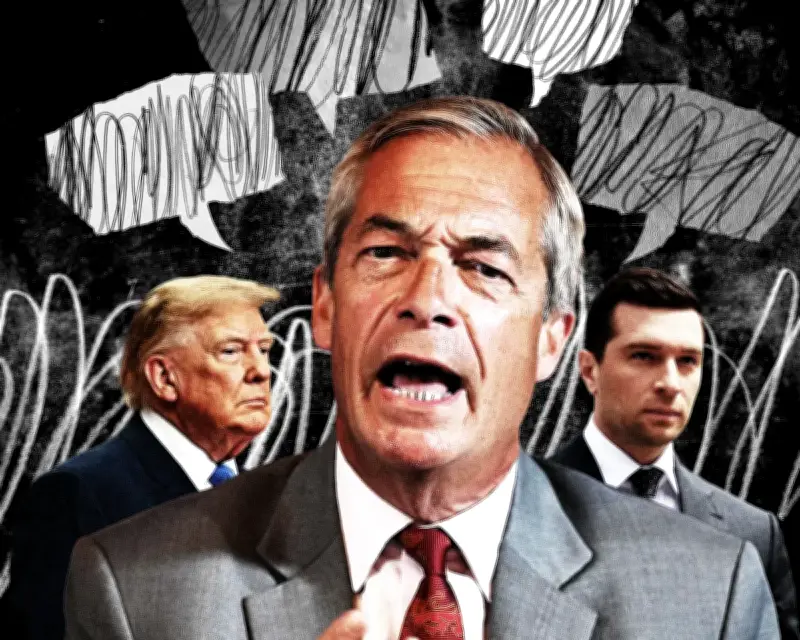
European democracies are facing a critical juncture as far-right parties, Maga ideology, and Kremlin money conspire to suffocate liberal idealism for another generation, according to Guardian columnist Rafael Behr. The recent victory of the Alternative für Deutschland (AfD) in Saxony-Anhalt, Germany, marks a shocking milestone, signaling a resurgence of nationalism that threatens the foundations of European democracy.
The Rise of the AfD and Germany's Historical Reckoning
The AfD's win in Saxony-Anhalt is not the largest electoral prize for a far-right party in Europe recently, but it is among the most shocking because it is Germany. No country had more to learn from history to immunize its democracy against extremism, and none pursued a more systematic program of inoculation, known as Vergangenheitsbewältigung—coming to terms with a shameful past.
The party's rise represents a knowing repudiation of atonement, flirting with Nazi imagery and embracing racist definitions of nationhood. The AfD is extreme enough to induce squeamishness in Marine Le Pen, leader of France's far-right National Rally (RN), who has spent years cultivating respectability and leads the polls ahead of next year's presidential election.
International Support and the Maga Connection
The AfD's appeal extends across the Atlantic, with Elon Musk using his control of X to boost the party's campaign messages. Last year, US Vice-President JD Vance met AfD co-leader Alice Weidel during a visit to Munich, with no time for then-German Chancellor Olaf Scholz. This aligns with Donald Trump's national security strategy, which pledges support for "patriotic resistance" movements committed to halting the "civilisational erasure" of Europe by immigration.
In Britain, Nigel Farage, once an early cheerleader for Trump, has lost ground in the competition for Maga accolades to parties and individuals even further to the right, including Rupert Lowe's Restore Britain and ultra-nationalist agitator Tommy Robinson. Farage's strategy of banking far-right support while feinting moderation is complicated by the reach and pungency of the US right, drenched in white supremacism.
Farage's Ambivalence and the Kremlin's Influence
Farage's attitude toward the AfD shows tension. He spoke at an AfD rally in 2017 but now describes the party as a "mixed bag," whose cultural stances are "utterly respectable and decent" but whose enthusiasm for dictators is "very difficult." He has called AfD support for Vladimir Putin "hard to understand," despite having described the Russian president in 2014 as the world leader he most admired, "as an operator, not a human being."
Proximity to the Moscow line is a reliable measure of fanaticism and venality on the far-right spectrum, as seen with Reform's former leader in Wales, Nathan Gill, serving a prison sentence for accepting bribes to make pro-Russian speeches in the European parliament. The same applies on the left, where a credulous appetite for Russian propaganda endures decades after the demise of Soviet ideology.
British Politics and the European Project
There is not much of a market in British politics for openly pandering to Putin, which is one reason Trump is also unpopular, though polls suggest Reform supporters view him more favorably than the wider public. Farage has stopped boasting of his White House connections, perhaps because they have dried up or because sycophantic flapping around a foreign tyrant doesn't project strength in a wannabe prime minister.
At Reform's annual conference last week, there was little mention of the rest of the world and Britain's place in it. Jordan Bardella, Marine Le Pen's protege, appeared and signed a legally meaningless "deal" with Farage on stopping small-boat traffic across the Channel, drawing criticism back home for selling out to the UK. The likelihood of a French far-right government taking in more migrants as a policy favor to the UK is close to zero.
Farage, as the architect of Brexit, is one of the most consequential politicians of his generation, but he can't plausibly claim it as an achievement. He might envy nationalist counterparts on the continent, who rail against liberal Europeanism while enjoying the economic and strategic privileges of EU membership. They play the Eurosceptic game, mobilizing resentments and targeting scapegoats, but modify demands recognizing that Farage's victory was pyrrhic. The ambition is to capture the European project, not destroy it, though it amounts to the same thing if the transformation happens through connivance with Maga ideology and Kremlin money.
This doesn't have to be Europe's destiny. Nationalists do not form a monolithic bloc; their egos generate rivalries, and their selfishness sabotages deals. Countervailing forces can be mustered. There is no law of history that says a height of liberal optimism must be followed by an equivalent fall into chaos. The "binding power of tolerance and conciliation" was not defeated in the 20th century and won't be suffocated in this one either. As Behr concludes, "We see the abyss. We can pass without plunging to the bottom."




