
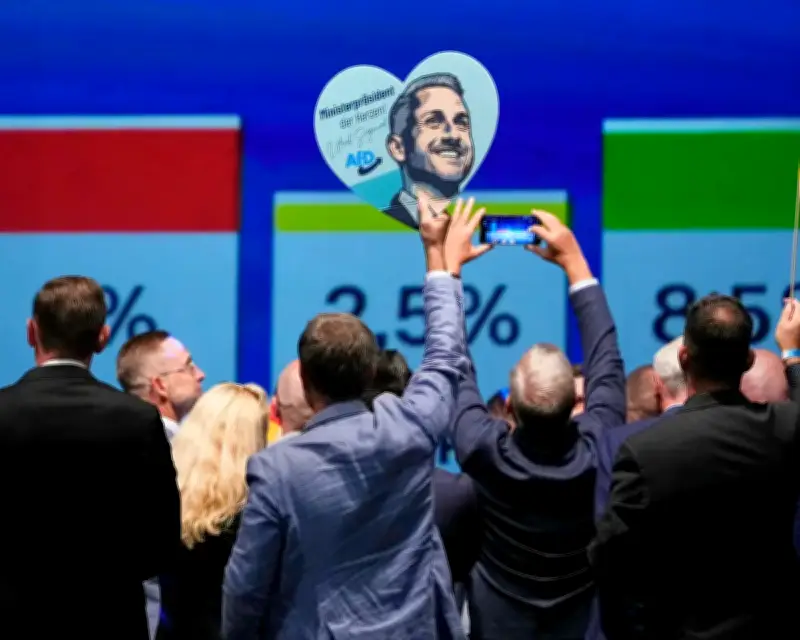
Germany's far-right party Alternative für Deutschland (AfD) has been confirmed as the winner of the Saxony-Anhalt state election, but without a majority in the state parliament, according to final results released early Friday. The outcome has set off intense political discussions about the path forward, including scenarios involving defections, a minority government supported on an issue-by-issue basis, or even a snap election to break the deadlock.
AfD's Victory and Political Reactions
The AfD, led in the state by Ulrich Siegmund, celebrated at an election party under the slogan “It begins here,” with federal leaders Tino Chrupalla and Alice Weidel also on stage. Despite the win, the party's inability to secure a parliamentary majority leaves the state in a political limbo, prompting speculation about potential alliances or alternative governance models.
Chancellor Friedrich Merz, facing mounting pressure, is expected to address the nation around lunchtime. German media have circulated images of a grim-looking Merz in the backseat of his car, suggesting the political strain is taking a toll. Across Europe, political reactions are pouring in, with more anticipated throughout the day.
Implications for Germany and Europe
The election result is a significant development for Germany's political landscape, as the AfD's far-right platform has sparked concern among mainstream parties. The lack of a clear majority means that coalition talks will be complex, with the far-left Sahra Wagenknecht Alliance potentially playing a kingmaker role if it agrees to support a minority government.
Observers are closely watching how Merz navigates this crisis, as his leadership could be at stake. The outcome may also influence national politics ahead of future federal elections, with the AfD's success serving as a bellwether for far-right sentiment in the country.
Other European Developments
Meanwhile, European Commission President Ursula von der Leyen is traveling to Greenland amid renewed US interest in the territory, a move that underscores geopolitical tensions in the Arctic. Additionally, the funeral of Bosnian Serb war criminal Ratko Mladić is taking place, drawing attention to lingering war crimes issues in the Balkans.
As Europe wakes up to these developments, the focus remains on Germany's political future and the broader implications for the European Union. The coming days will be critical in determining whether a stable government can be formed in Saxony-Anhalt or if voters will be called back to the polls.




