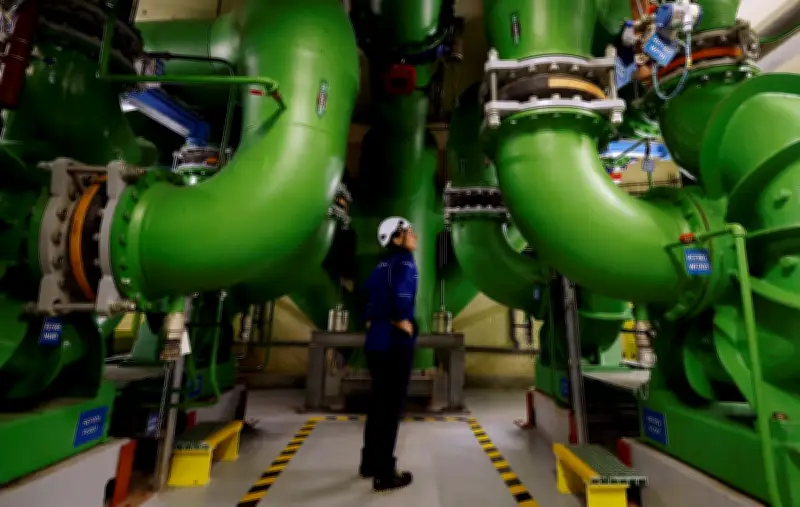
Paris is expanding its underground district cooling network, aiming to triple its size by 2042 to combat rising heatwaves and reduce reliance on individual air conditioning units. The system, one of the world's largest, uses chilled water from the Seine River circulated through 120 kilometers of underground pipes to cool museums, offices, hospitals, and schools, including the Louvre and Grand Palais.
How the system works
Cold river water from the Seine is pumped through one pipe, while a separate pipe carries warm water from buildings. A heat exchanger allows heat transfer without the fluids mixing, cooling the building water. The cooler water is then circulated through connected buildings, and the Seine water is returned slightly warmer.
According to Thibauld Voïta, an energy expert at the Jacques Delors Institute, “It’s a kind of miracle solution in the era of global warming.”
Expansion plans
The network, owned by the city and operated by RATP and Engie under a 20-year contract renewed in 2022, is run by Fraîcheur de Paris. The company plans to extend the network to all arrondissements, reaching over 3,000 buildings, including hospitals, schools, and retirement homes. Tim Guigon, a spokesperson for Fraîcheur de Paris, stated: “The figure of 3,000 … reflects a realistic development trajectory. The ambition is to move from a historic network focused on large tertiary buildings to a city-wide infrastructure.”
Environmental benefits
The system aims to prevent Parisians from buying air conditioners, which expel heat into streets. Sophie Parison, a researcher on urban heat, noted: “Everything that requires energy releases heat, and that heat has to go somewhere.” While the network returns warmer water to the Seine, studies show temperature changes remain within environmental limits. Pauline Lavaud, director of climate transition for the city, said the system “offers much higher energy and environmental performance than individual cooling systems.”
Charles Simpson, a senior researcher at University College London, added: “The energy consumption should be much less than if the same cooling were provided by modular systems.”
Challenges for other cities
Other cities like Stockholm and Toronto have similar systems, but replication faces hurdles. Lavaud noted: “Developing a district cooling network requires substantial investment. For the project to be economically viable … a city must have sufficiently concentrated cooling demand.” The 20-year contract for Fraîcheur de Paris was valued at €2.4 billion. In London, the Thames lacks ideal water flow and temperature, and underground congestion poses challenges. Emmanuel Gendreau, an ecologist at the Sorbonne, emphasized: “Actions must always be adapted to the type of city and local issues. It is crucial not to simply apply adaptations that have already worked in one city directly to another.”