
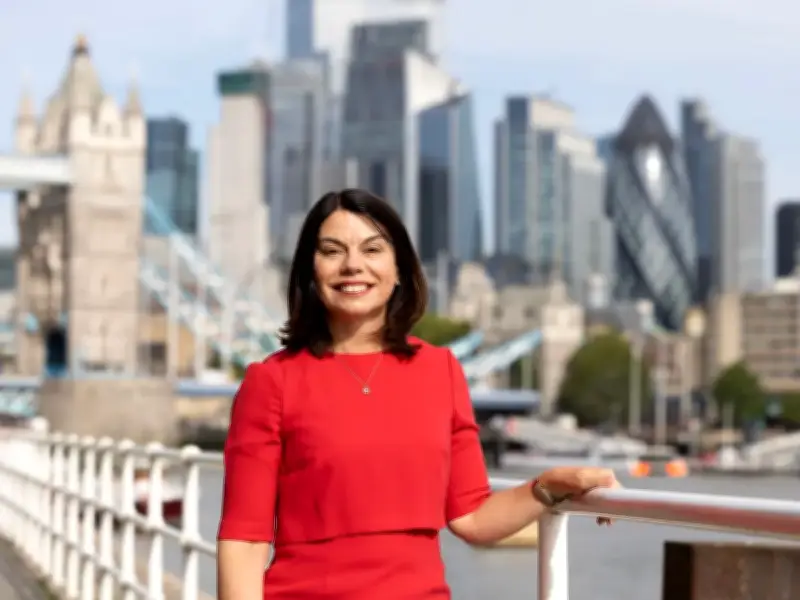
Liberal Democrat MP Sarah Olney has officially launched her campaign to become the party's candidate for the 2028 London Mayoral election, promising a "bold and optimistic campaign" aimed at breaking what she calls the Labour-Conservative duopoly at City Hall. At her launch event in Southwark, Olney, who represents Richmond Park, outlined a platform centered on boosting London's businesses, tackling the housing crisis through estate regeneration, and creating a strategic authority for river crossings.
Challenging Labour's dominance
Despite recent polling placing the Liberal Democrats in fifth place in London, Olney expressed confidence that an ambitious digital campaign—"the likes of which has never been seen before"—could reach the capital's six million voters and position her party as the main challenger to Labour. Speaking exclusively to the Local Democracy Reporting Service (LDRS), she said, "This is going to be one of the most consequential mayoral elections we've had. It's high time Labour had a real challenge in this city. I don't think that challenge is going to come from the Tories - they haven't got the support across London."
She added, "The Liberal Democrats have a real opportunity, if we run a bold and optimistic campaign, to really gather the kind of support that can actually provide a challenge to Labour. We can provide a program that Londoners all across the city will feel that they can vote for."
Uphill battle and polling reality
However, the party faces a steep climb. A recent poll by Savanta UK for the Mile End Institute put Labour at 33 per cent, the Conservatives and Reform UK at 18 per cent each, the Greens at 17 per cent, and the Liberal Democrats in single digits. In the 2024 election, the party finished a distant third with just 5.8 per cent of the vote. Olney acknowledged the need to expand appeal beyond their South-West London strongholds.
"A lot of it will come down to the way we campaign, and I think London gives us an opportunity to really send out a bold message right across the city," she said. "We have got the opportunity to really attract support from all sorts of places where possibly they haven't been used to voting for the Liberal Democrats before. We've seen in Richmond, Kingston, and Sutton in the local elections - where people have got Liberal Democrat representation, we've grown our support, we've increased our vote share."
Policy platform: business, housing, and policing
Olney's policy platform focuses on boosting London's businesses, increasing housing standards and quantity through estate regeneration, and reversing cuts to police station front counter opening hours. A key proposal is to make the Deputy Mayor for Business an elected position, chosen by a consortium of business leaders rather than appointed by the Mayor. "We need to boost the economy at every level and get London moving again," she said. "Businesses will have someone speaking for them directly in City Hall, so that they're right there at the table when policy is being formulated across London that impacts businesses."
The current Deputy Mayor for Business, Howard Dawber, was appointed by Sir Sadiq Khan in 2023 and has faced criticism from opposition Assembly Members for not explicitly condemning the impact of National Insurance hikes on hospitality firms. Olney said she met Dawber for the first time earlier this year and had previously been unaware of his role. "The Deputy Mayor for Business and the Economy in London needs a much higher profile, and I think a directly elected Deputy Mayor can really help to deliver that," she insisted. "It wouldn't be a party political person. The whole point of them is to be the voice of business in City Hall to whoever the Mayor is—that's the whole point. They're not there to represent a party line; they're there to represent the voice of business in London, and that's why it should be an elected post."
River crossings and housing regeneration
On infrastructure, Olney pledged to avoid "sagas" like the Hammersmith Bridge closure by bringing all river crossings under a single strategic authority, which would also ensure projects like the planned Canary Wharf to Rotherhithe crossing are delivered. She called housing Sir Sadiq's "most significant and visible failure" and said she would immediately explore further regeneration opportunities. "We've got some great examples in my own constituency where dilapidated housing has been replaced with new housing," she added. "Not only can you add more housing and more units, but you can also rebuild in an energy-efficient, accessible way that is designed to suit modern ways of life. I'm really interested to see what more can be done with that, both on a large scale and a small scale, right across the city. That's the sort of thing where you can get things going quite quickly and really move forward at speed."
Olney also criticized the Met Police's decision to close some station front counters and reduce hours at others, a move that breaks a 2024 manifesto promise by the current Mayor to keep at least one open in every borough. "By breaking that promise, he's really breaking a very important link between the police and the general public," she said. "People are feeling that: they feel the police are not in their communities, they feel the police are not responding when they report crime, and they don't know where to go to submit evidence or report a crime. My big priority would be to try and repair that relationship between the police and the communities they serve."
The Liberal Democrats will select their candidate in early 2027, and Olney is the first to declare her interest.




