
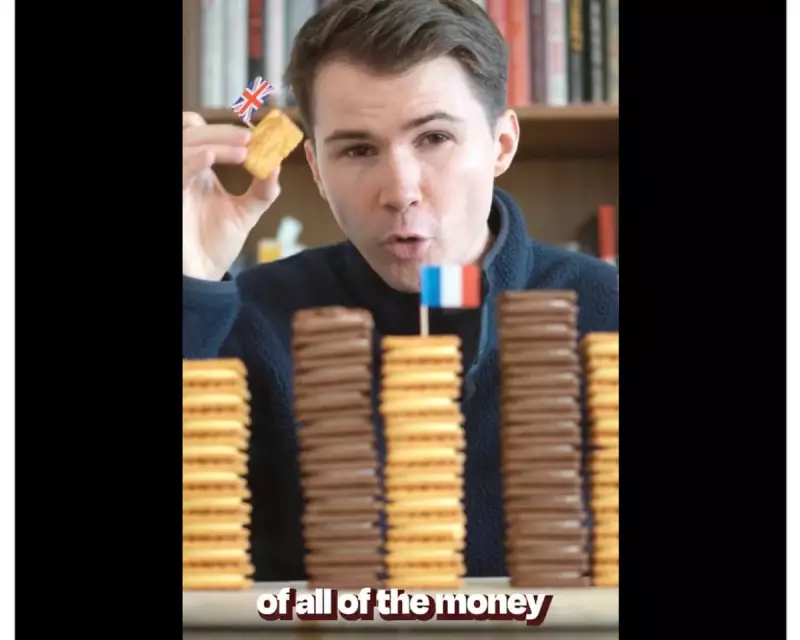
A Labour MP has sparked a new trend in political communication after a video in which he used biscuits to explain the UK's national debt racked up millions of views online.
Biscuits, Pasta, and Bond: The New Language of Politics
Gordon McKee, the MP for Glasgow South, created a 101-second clip demonstrating the UK's debt-to-GDP ratio using stacks of Marks & Spencer's custard creams and chocolate bourbons. The video has been viewed more than 3.3 million times on X, formerly Twitter, highlighting a shift in how politicians are trying to connect with the public.
McKee is something of a pioneer within the parliamentary Labour party, being the only backbencher known to have hired a dedicated digital content creator. This investment has paid off with a series of professional, analogy-driven videos designed for virality. "I feel like I should apologise for having started this!" McKee joked, before stressing that digital communication is now essential for modern politicians.
He is not alone. Other Labour MPs are now following suit. Richard Burgon, MP for Leeds East, used 200 packets of Sainsbury's fusilli pasta to visualise £1 billion compared to an average UK salary of £33,000, garnering nearly 650,000 views. The 106kg mountain of pasta was later donated to London food banks.
Meanwhile, Jeevun Sandher, the MP for Loughborough and an economist, produced a James Bond-themed video during budget week to explain government bond rates. "I'd love it if people read my 2,000-word essays but they don't. You have to find a way of being engaging," he said.
A Party-Wide Push for Digital Modernisation
The grassroots experimentation aligns with a formal push from the Labour leadership. On 21 November, Keir Starmer emailed MPs announcing a "significant investment" in a new digital campaigning training programme. Internally, the party has launched 'Operation Second Term' to overhaul its campaign methods, acknowledging that the tactics used in the 2024 general election will not suffice for 2029.
This modernisation drive extends to junior ministers and the cabinet. Treasury Exchequer Secretary Dan Tomlinson filmed a casual pre-budget clip on his way to Greggs, while Energy Secretary Ed Miliband used ASMR (Autonomous Sensory Meridian Response) techniques to promote an announcement on small modular reactors.
A Labour source noted the challenge: "During the general election we had a big old team to support people doing this stuff and now they're having to do that within their own offices. It's harder when you're not attacking and instead having to defend and make a positive story."
Reaching Audiences Where They Are
For McKee, the motivation is clear. After speaking at a high school in his constituency, he asked how many students read a newspaper daily. Only one hand went up. When he asked how many were on Instagram, every hand was raised.
"The way people consume information has changed enormously in the last 10 years but the way politicians and MPs communicate with their constituents hasn't as much," he stated. His focus is now on platforms like Instagram, TikTok, and YouTube Shorts, which reach beyond the politically hyper-engaged audiences typically found on X.
McKee argues the communication challenge is particularly acute for progressive politicians. He points out that right-wing figures like Nigel Farage and Shadow Justice Secretary Robert Jenrick are skilled at delivering simple, clear narratives. "The task from progressives is to articulate a complex argument that is realistic and ambitious but also real and deliverable – and to do that in an interesting, engaging way," he concluded.
As traditional media consumption declines, the humble biscuit tin and packet of pasta have become unlikely but powerful tools in the battle for public understanding and engagement.




