
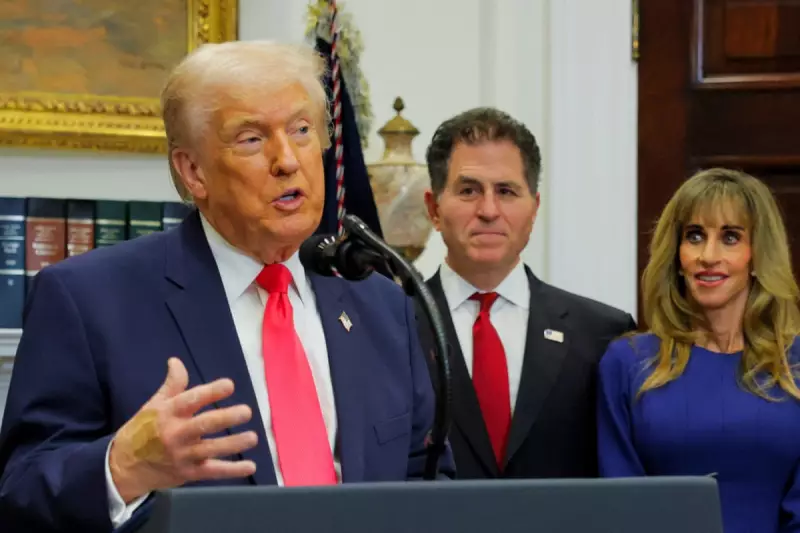
In a move that has reignited debates about wealth, power, and political access, tech billionaire Michael Dell and his wife Susan announced a staggering $6.25bn donation to a federal programme championed by Donald Trump. The event, held at the White House on 2 December 2025, saw the CEO of Dell Technologies publicly align himself with the former president's signature policy initiative.
A Record Gift for 'Trump Accounts'
The donation, one of the largest single philanthropic gifts in American history, is earmarked for the so-called 'Trump Accounts'. This programme, established under Trump's Big Beautiful Bill Act, mandates a $1,000 federal payment into an account for every child born during his presidency. The Dell's contribution will provide a $250 top-up for an estimated 25 million children.
Standing alongside Trump, Michael Dell was quick to frame the massive donation as a non-partisan act of generosity. "I don't think this is in any way a partisan activity," he told the New York Times. However, the sheer scale of the gift, directed to a pet project of a politically divisive figure, has led many observers to question the underlying motives.
Philanthropy or Political Currency?
This incident has cast a harsh spotlight on the long-standing practice of the ultra-wealthy using charitable foundations to gain favour and influence. The analysis suggests that what is often presented as pure altruism can frequently be a strategic tool for currying access with those in power.
Dell is not an isolated case. The pattern is well-documented:
- Timothy Mellon, a major Trump backer, donated $130m to pay troops during a government shutdown, earning a presidential commendation as a "patriot".
- A cohort of tech executives contributed $1m each towards Trump's inauguration festivities.
- A consortium of crypto billionaires and business leaders helped finance a $300m White House ballroom.
Academic research supports this cynical view. A study titled "Tax-Exempt Lobbying: Corporate Philanthropy as a Tool for Political Influence" found corporate donations often strategically target charities linked to members of Congress who sit on relevant committees. Giving frequently dries up when those politicians leave office.
The Systemic Issue of Tax-Exempt Influence
The structure of American philanthropy itself facilitates this dynamic. Charitable donations offer significant tax breaks for the wealthy and corporations, allowing them to funnel money into projects that, while not profitable in a traditional sense, yield returns in political capital, social status, or legacy building.
With total US charity amounting to over $592bn annually—roughly 2% of GDP—taxpayers are effectively subsidising this form of influence, which operates largely free from democratic oversight. Critics argue this system becomes increasingly problematic as giving is dominated by an ultra-rich elite pursuing increasingly niche or futuristic causes, like Meta's Mark Zuckerberg pivoting his philanthropy solely to AI and biology.
While Michael Dell's $6.25bn gift is ostensibly for children today, its timing and destination raise profound questions. When philanthropy becomes intertwined with the agendas of powerful political figures, it challenges the very notion of disinterested generosity and highlights how the super-rich can dress influence as charity.




