
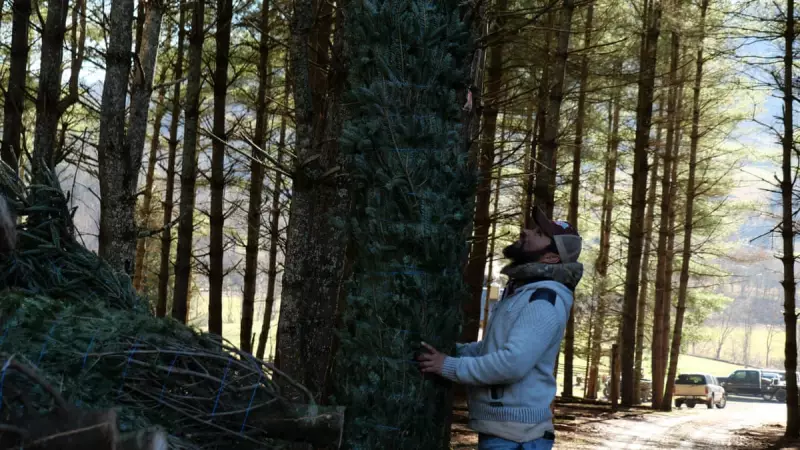
On a frigid December afternoon in Cullowhee, North Carolina, a crew of Mexican workers loads the final Christmas trees of the season onto a truck. Nearby, others warm themselves by a barrel fire. This scene at Wolf Creek Tree Farm and Nursery marks the end of another gruelling harvest, sustained by a legal but vulnerable workforce that now faces an uncertain future under new US policies.
The Backbone of a £115 Million Industry
These men, here on H-2A temporary agricultural visas, are the engine of an industry where nearly one in every four Christmas trees sold in the United States originates from North Carolina. The state's native Fraser fir is highly prized, and in 2022, sales from over 3 million trees injected more than $144m (£115m) into the local economy. The work is year-round, involving weeding, fertilising, pruning, and shearing trees that take eight to nine years to reach market height.
Nahuel Hernández Nabor, 50, has made the annual journey from Tlaxcala, Mexico, for 26 years. "We do it for the money," he states plainly. The sacrifice is significant—long months away from his wife and two teenage children. During the peak harvest from October to December, 12-hour days, often seven days a week, are the norm. "The hardest part is the time away from family," he admits.
A Workforce Under Threat: Wages and Worries
This economic calculus is now under direct threat. The US Department of Labor, under the Trump administration, has instituted new wage guidelines for the H-2A programme that could slash pay by $5 to $7 an hour. For workers like Margarito Salcido, who has laboured at Wolf Creek for 13 years, the prospect is stark. "$11 [per hour] is too little," he says bluntly.
Renée Beutell, president of the family-run Wolf Creek farm, acknowledges the dilemma. "These guys work really, really hard," she says, expressing reluctance to cut wages but fearing competition from growers who will. The H-2A programme, which issued 318,000 visas in the 2024 fiscal year, is recognised as indispensable to US agriculture, yet the proposed cuts could save employers billions annually at workers' expense.
Beyond economics, a climate of fear persists. Despite a lack of recent ICE activity reports in the area, workers like Roberto Ceballos feel nervous. "We were seeing in the news that these ICE agents aren't even respecting citizens or legal residents," he explains. Leticia Zavala of the non-profit El Futuro es Nuestro notes many workers now limit essential trips off-farm, wary of racial profiling.
Isolation, Health, and the Grind
The job's physical and mental toll is severe. Marianne Martinez, CEO of healthcare provider Vecinos, frequently treats musculoskeletal injuries, vision problems from sun exposure, and the psychological strain of rural isolation. Employers provide housing and basic amenities, but this dependency can breed vulnerability. Some workers have reported withheld food or poor-quality meals, and past efforts to organise have highlighted issues of underpayment and exposure to toxic chemicals.
"It's like being in prison," Salcido says of the intense harvest period. The one-month return to Mexico at year's end offers a precious respite. "When you get to Mexico, you feel different, like you're free."
An Uncertain Harvest: What Comes Next?
The potential exodus of experienced workers poses an existential threat. The industry is already grappling with rising costs and competition from artificial trees. "If we were... to never sell one more Christmas tree because there are no more coming out of the field, that would be a devastating blow to our regional economy," warns Martinez. The impact would ripple nationwide, as North Carolina trees are shipped across the country.
Ceballos, who has built a life and studied law online over 14 seasons, hopes growers value seasoned crews. "It wouldn't be good business for them to start over with people they have to train from zero." Yet, he and others are making contingency plans, with some even considering Canada.
"We feel like what we do – our work – isn't valued," Ceballos concludes. "We're an economic pillar for Mexico, but also for the United States... So when our wage is cut, yes – we feel bad, we feel humiliated." As the political landscape shifts, the future of this festive tradition hangs in the balance, dependent on the workers who nurture it from seedling to centrepiece.




