Former Homeland Security Watchdogs Sound Alarm Over Immigration Enforcement Expansion
Former Department of Homeland Security officials who were ousted from their positions are issuing urgent warnings about what they describe as an "alarming" acceleration in deputizing local police departments to enforce federal immigration laws. These ex-watchdogs assert that the Trump administration's dismantling of independent oversight mechanisms while dramatically expanding the controversial 287(g) program creates significant risks for civil rights violations nationwide.
Gutted Oversight and Rapid Program Expansion
The 287(g) program, named after a section in the Immigration and Nationality Act, grants local, county, and state law enforcement officials extraordinary powers to detain, arrest, and interrogate immigrants before transferring them to federal immigration authorities. Since Donald Trump's return to the White House, this program has experienced exponential growth, with critics arguing it lacks sufficient safeguards against abuse and threatens to erode trust between immigrant communities and local police.
"The office doesn't exist now – at least not in its previous form. How could there be meaningful oversight of the 287(g) program?" questioned Peter Mina, former deputy officer for the Department of Homeland Security's Office for Civil Rights and Civil Liberties (CRCL). Mina was among several officials removed from their positions last spring when the Trump administration eliminated their jobs. He has since resigned and now practices civil rights law in Washington DC.
Suppressed Report and Missing Guardrails
Before their dismissal, the civil rights watchdogs had completed a congressionally-mandated report examining the 287(g) program. According to sources familiar with its contents, this report identified red flags regarding suspected civil rights violations by some local police and sheriff agencies partnering with Immigration and Customs Enforcement (ICE). The report has not been published, and its current status remains unclear, leading former officials to suspect political suppression to avoid unfavorable scrutiny.
"Taking a problematic enforcement program, that reintroduces models of enforcement that were discontinued because of demonstrable civil rights violations and super-sizing it while removing all internal guardrails, is more than alarming," stated Katerina Herodotou, another former CRCL official ousted last year. "It is a threat to civil rights nationwide."
Dramatic Increase in Arrests and Partnerships
Statistical evidence reveals the program's dramatic expansion. From January to mid-October 2025, approximately 7,000 people were arrested through the expanded 287(g) program, according to ICE data collected by the Deportation Data Project. This represents a sharp increase from 2024, when the program recorded just over 3,000 arrests. The Department of Homeland Security claims even greater success, reporting "40,000 arrests in Florida alone" through local law enforcement partnerships, though the agency declined to provide detailed explanations for this figure.
The number of participating jurisdictions has skyrocketed from fewer than 200 in January 2025 to more than 1,400 local, county, and state agencies currently signed on to assist DHS with immigration enforcement. In the first weeks of 2026 alone, nearly 150 additional local agencies joined the program.
Shift from Jail-Based to Task Force Model
Historically, the 287(g) program primarily focused on immigration enforcement within jails, where officials could identify undocumented immigrants already incarcerated. However, the Trump administration has reintroduced and aggressively expanded the more powerful task force model, which had been discontinued in 2012 following concerns about civil rights abuses.
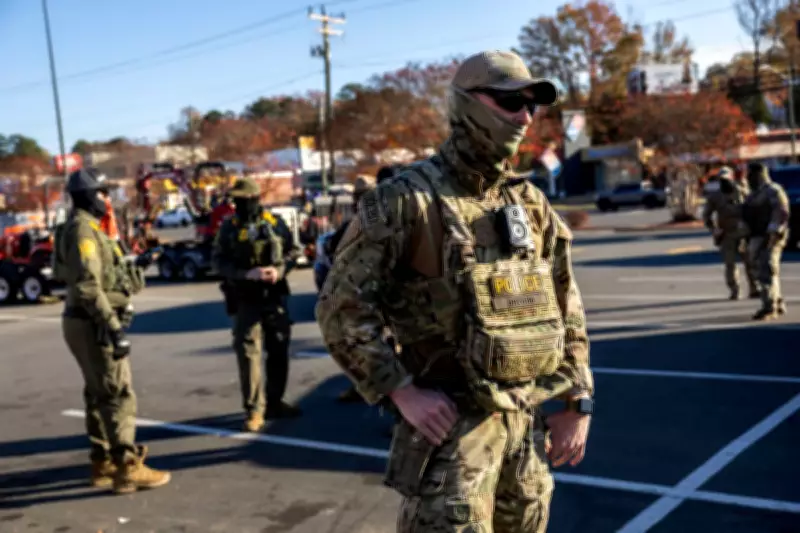
Under this revived model, deputized local officials can interrogate anyone they suspect of being in the United States unlawfully during routine police work. They can detain individuals and transfer them to ICE based solely on immigration suspicions, without requiring a criminal arrest pretext, despite immigration violations being federal civil offenses rather than criminal matters.
Financial Incentives and "Bounty Hunter" Concerns
The program's expansion has been accompanied by substantial financial incentives that critics describe as creating a "bounty hunter system." Funding from legislation known as the Big Beautiful Bill provides $7,500 for equipment per new task force officer, $100,000 for new vehicles per agency, and full reimbursement for each task force officer's salary and benefits.
In October 2025, the administration introduced "monetary performance awards" offering local agencies up to $1,000 per officer per quarter based on the number of undocumented immigrants they identify. "They have essentially set up a bounty hunter system and are incentivizing local/state law enforcement to detain anyone who appears to be undocumented," one former CRCL official told the Guardian.
Historical Precedents and Current Risks
The program's troubled history includes the case of Maricopa County, Arizona, where federal investigators in 2011 found Sheriff Joe Arpaio and his agency violated constitutional civil rights through racial profiling of Latinos and illegal detentions. Arpaio was convicted in 2017 for refusing to stop his anti-immigration patrols, though he received a presidential pardon from Donald Trump shortly afterward.
"We recommended that the task force model be terminated," recalled Muzaffar Chishti, a senior fellow at the Migration Policy Institute who has studied the program for years. A 2011 report by his institute documented both alleged and proven civil rights violations by local law enforcement in 287(g) arrangements.
DHS Defense and Limited Pushback
The Department of Homeland Security defended its current approach in a statement: "The DHS Office for Civil Rights and Civil Liberties (CRCL) receives, reviews, and investigates complaints against 287(g) task force officers. DHS CRCL is performing all legally required functions, but in an efficient and cost-effective manner and without hindering the department's mission of securing the homeland."
The agency characterized the departed watchdogs as having "obstructed immigration enforcement" and functioning as "internal adversaries that slowed down operations."
Despite the program's expansion, some jurisdictions are reconsidering their participation. Danny Ceisler, the new Bucks County sheriff in Pennsylvania, recently terminated his agency's 287(g) partnership involving 16 task force officers. "The certain public safety costs of this ICE partnership are greatly outweighed by any potential public safety benefits," Ceisler explained.
As the program continues to grow with diminished oversight, former officials warn that the combination of financial incentives, aggressive enforcement models, and reduced civil rights protections creates dangerous conditions for vulnerable communities across the United States.