
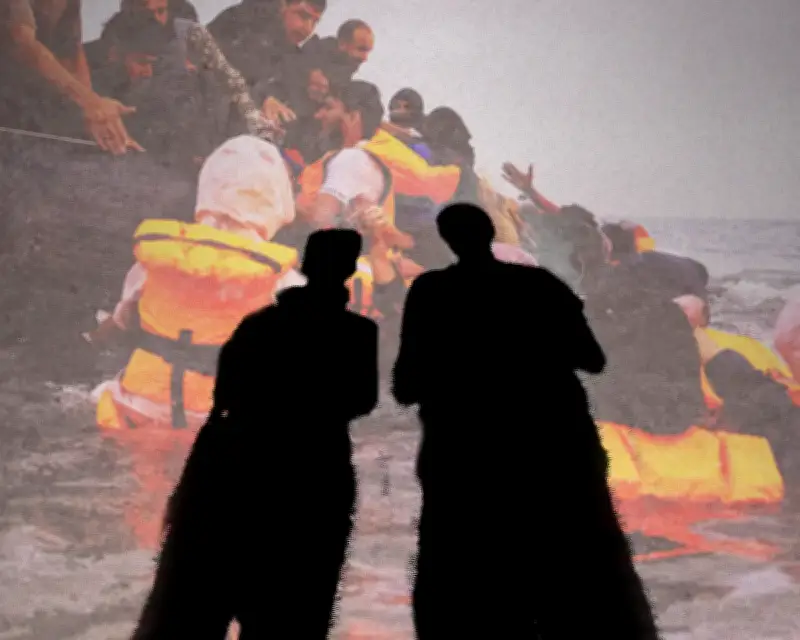
Two Iranian men, Aso and Baran, who fled persecution and crossed the Channel together, were both returned to France under the UK's one-in, one-out scheme. After risking their lives to reach Britain again, they now face very different fates: Baran is sleeping under a tree in Lille, while Aso has been granted bail in the UK. Their stories reveal the brutal arbitrariness of the UK asylum system and the controversial government policy.
Escape from Iran and the Channel crossing
At the end of last year, Aso, 28, converted from Islam to Christianity, putting his life in imminent danger. “I had to keep my conversion to Christianity a secret,” he says. “I knew if I was caught, I risked being executed by the Iranian regime … one of my relatives, who I trusted, paid smugglers to get me out last November.”
Baran, 33, fled at the end of December after being politically active against the Iranian government. He says he “feared being punished by the ministry of intelligence. I had previously been targeted by the Iranian authorities, shot at with rubber bullets and hit on the back of my head. My house was raided by intelligence officers one day when I wasn’t at home. They confiscated my ID. Relatives contacted me and warned me not to return home. They took me to another village and, from there – with the help of these relatives, who paid smugglers – I was taken out of Iran and crossed the border to Turkey.” A rubber bullet remains lodged in his genitals.
The men made their way separately to northern France, where their paths converged. In January, they boarded the same small boat bound for the UK. Aso says the crossing was “terrifying”. His legs had been hit with a pipe by the smugglers the night before, and he spent eight excruciating hours in the dinghy on his knees. “There was no room to sit, and the waves were crashing into us. It is the most frightening thing in the world.”
The one-in, one-out scheme
On arrival, they were taken to a detention centre, where they finally met. Aso says he could immediately see that Baran “was a good and kind person, despite the difficult conditions in the detention centre – being locked in our cells for up to 12 hours a day, not knowing what was going to happen to us and feeling terrified of being returned to France. Despite all the stress, Baran was very calm and I always felt comfortable with him.”
Their fears were well founded. The one-in, one-out scheme was announced last July by then prime minister Sir Keir Starmer and France’s president, Emmanuel Macron. It is being piloted until 1 October and aims to deter people from crossing the Channel in small boats. Since it began, more than a thousand asylum seekers have been selected by the Home Office, apparently at random, to be returned to France.
The scheme works by forcibly returning one person who arrived in the UK by small boat to France, in exchange for another brought legally to the UK from France. Those brought to the UK have not previously tried to cross the Channel. The aim is to make the UK so unappealing that refugees choose somewhere else. In effect, people like Aso and Baran are used as reluctant human shields to protect the border.
Return to France and its consequences
In January, when Baran first realised he was at risk of being returned to France, he begged the Home Office not to deport him. His detention notes, shared with the Guardian, refer to his “food and fluid refusal” – a hunger strike – and it is recorded that he told officials: “I would rather die than return to France.” They ignored him, and he was returned to Paris in mid-February.
“When I was returned to France, I was in so much pain from the bullet lodged in my genitals that I travelled to the local hospital to see if they could treat me,” he says. The smugglers knew the location of the shelter where he was housed and found him there. “Because I was sent back to France, rather than staying in the UK, my family did not pay the smugglers, so they came after me to catch me and punish me, because they didn’t get their money.”
“After they caught me, they took me to the Jungle in Dunkirk [an informal refugee encampment], beat me with sticks and with their hands, and threatened me with guns. I was a slave for the smugglers. They forced me to wash dishes and clothes for eight to 10 hours every day, without breaks … even to go to the toilet. When I did not follow their instructions, they hit me in the mouth and used a log to hit me in the leg.”
Many returnees, after failing to access immigration lawyers, have boarded the flight from Stansted to Paris’s Charles de Gaulle airport in a quietly hopeless state. There have also been protests against forced removals inside detention centres, and multiple suicide attempts.
Divergent fates
In March, a month after Baran was sent back, Aso was also returned to France. He says he was accompanied by Home Office guards on the flight, which he found frightening. “It really is a terrible feeling. Two officers hold you and sit right next to you on the plane, treating you as if you’ve committed a major crime, as if you had killed someone or you are a dangerous person. My mental health was completely shattered.”
On arrival, Aso was placed in an immigration camp in Paris “that was incredibly cold, with inhumane conditions and inadequate food”. He sent a message: “Please help me. I don’t know what to do here. We cannot have a shower because the water is ice cold. We are completely lost and confused. I am so scared. Please let me be safe. I don’t want to die. I want to live. I am deeply heartbroken. It has been four months since I last had any news of my mother and my country is now torn by war. If I am sent back to Iran, I will be executed, because I converted to Christianity.”
He was later evicted from the shelter – returnees are generally only accommodated for a few days – and left homeless. “I found no support in Paris, and went back to the Jungle in Dunkirk, living in the forest there with a couple of other people I knew.” On 28 March, Aso sent a WhatsApp message from the Jungle: “l am terrified here. These smugglers are heartless. They will hurt me wherever they find me.”
While Aso was searching for a safe place, Baran had already returned to the UK. At the beginning of March, he travelled back in a lorry, was found hiding in it, arrested, and returned to a UK detention centre for the second time.
The Guardian has tracked more than 30 people who have been forcibly returned to France after arriving in the UK on a small boat. All say they have received minimal support in France and, at times, outright hostility. Some have crossed borders to Italy, Germany, Sweden, Spain and the Netherlands. While critics and Home Office officials call this “asylum shopping”, the asylum seekers say they are looking for a place they can live safely without being thrown out, detained, or forcibly returned. Asylum seekers themselves estimate that approximately 200 of those deported have returned to the UK, some by lorry, a route smugglers have been using increasingly since the start of the scheme.
The Home Office accepts that about 50 returnees have been detained a second time after returning to the UK. The Guardian has been given names, ages and nationalities of more than 30 returnees from 10 different countries, including Somalia, Georgia, Afghanistan and Syria, some of whom are living under the radar.
Baran was detained for more than four months on his return, longer than the usual timeframe. While in detention, he was told he needed surgery to remove the rubber bullet from his genitals. The Home Office declined to arrange it and said the surgery could be performed in France. In July, France accepted the readmission request that had been made in March. Baran drafted a note to the Home Office stating: “I can’t go back to France because over there is not safe for me. Don’t let them to send me back.” Since being returned, he has been unable to access any health, housing or welfare services.
Aso’s life took a different path. While in detention, a friend in Swansea offered to support and accommodate him, and he was granted bail. “I feel like I’m getting better. I’m feeling safe,” he said in a message on 12 August. “It’s very hot here. I’ve decided to hit the beach for a dip to cool off.” But Aso is concerned about his friend: “I really don’t know why they sent Baran back to France for the second time but have allowed me to stay in the UK. It is honestly such a sad situation for Baran.”
The number of asylum seekers who have crossed the Channel so far in 2026 is down 40% on the same period last year, but that is in the context of asylum seeker arrivals to Europe being down significantly overall. Windy weather has also made crossings more difficult, and some people are travelling to the UK from France in lorries, uncounted in the immigration statistics. The Home Office has been reticent about what, if anything, will replace one-in, one-out when the pilot scheme finishes.
In Lille, Baran remains downcast. He says, “I don’t have any friends in France or any plan. A few guys who live near the park I’m sleeping in help me with food and sometimes let me have a shower at their place. The smugglers caught me before and I am frightened all the time that they will catch me again. My only hope is to find a way to return to the UK. But I don’t know how.” Baran last made contact with the Guardian just before midnight on 24 August; his current whereabouts and condition are unknown.




