
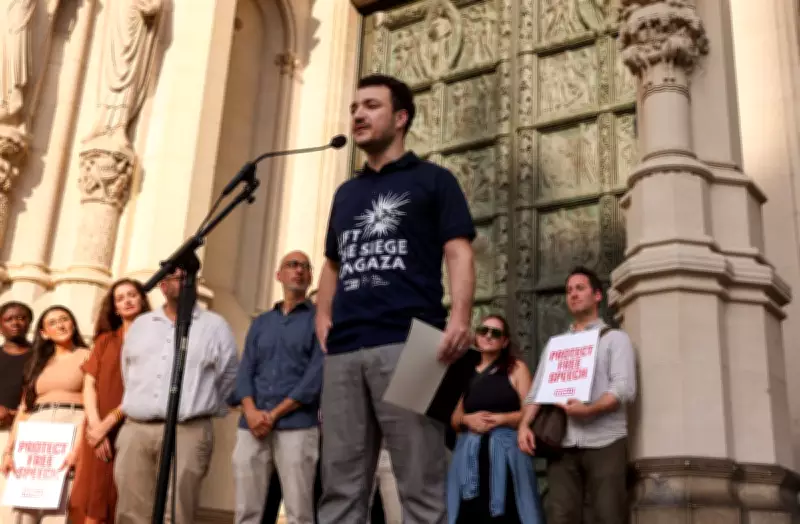
Attorneys for Mahmoud Khalil, the former Columbia University student who became a symbol of the Trump administration’s crackdown on pro-Palestine speech, will ask the US Supreme Court to intervene after a federal appeals court opened the door for the government to detain and deport him.
Appeals Court Ruling
On Friday, the Third Circuit Court of Appeals upheld a January ruling by a three-judge panel that reversed a lower-court decision ordering Khalil’s release on bail last June. The ruling marks the latest chapter in Khalil’s months-long legal challenge. The appeals court’s decision is a significant setback, but his lawyers insist he cannot be deported for now.
“We hope the Supreme Court will recognize how dangerous the Third Circuit’s decision was, not just for Mahmoud but for other non-citizens the administration has its vengeful sights upon,” said Baher Azmy, legal director of the Center for Constitutional Rights and part of Khalil’s legal team. “That ruling greenlights holding someone in prolonged, brutal detention conditions without access to meaningful judicial review in order to punish them and deter others from dissenting from US foreign policy.”
Split Decision and Dissent
The Third Circuit judges were split, with six voting against and five in favor of Khalil’s request to reverse the earlier ruling. In a dissenting opinion, three judges argued that the majority’s ruling “ignores canons,” “strains precedent,” and “imperils the civil liberties of [Khalil] and similarly situated noncitizens.”
Khalil’s attorneys plan to ask the court to pause the decision’s implementation so they can bring the matter to the US Supreme Court. Khalil is also fighting the government’s attempt to remove him in a separate immigration court case. Earlier this month, his legal team filed a motion to reopen and throw out that case after evidence emerged that the Trump administration had improperly fast-tracked it and tried to predetermine its outcome.
Broader Implications
Friday’s ruling is a notable loss for Khalil and sets a dangerous precedent for others challenging their detention in federal court at a time when the Trump administration has politicized the immigration court system. “What the administration wants to do is litigate his removability in the immigration court process – what I call the president’s courts,” said Azmy. “It’s a total sham process that’s designed to carry out their plan to deport him.”
Khalil, a US permanent resident married to a US citizen, was detained in his Columbia University housing in March 2025, the first of several foreign students targeted over pro-Palestine advocacy. He had been a lead negotiator between the university and student protesters during the spring 2024 encampments.
Khalil’s Advocacy
Khalil has remained defiant and since his release has become a more prominent advocate. “The administration wants to arrest, detain and deport me to intimidate everyone speaking out for Palestine across this country, and they are willing to violate longstanding US rules and procedures to do it,” he said recently. “But no lies, corruption, or ideological persecution will stop me from advocating for Palestine and for everyone’s right to free speech.”
Khalil missed the birth of his first son while in detention in an ICE facility in Louisiana last year. His lawyers argued he would suffer “irreparable harm” if forced to remain in detention, and a federal court sided with him, finding the government’s actions likely unconstitutional. An appeals court struck down that decision in January, concluding the federal judge lacked jurisdiction.
Legal Arguments
Attorneys for Khalil warn that the panel’s decision effectively blocks anyone in immigration proceedings from challenging their detention on First Amendment grounds until those proceedings end. The dissenting judges agreed, writing: “The Judiciary ‘serves as an inseparable element of the constitutional system of checks and balances’ protecting civil liberties and checking legislative and executive discretion. We cannot fulfill that role if we write ourselves out of relevance and leave the Executive Branch to check itself.”
The Trump administration originally claimed Khalil posed a threat to foreign policy objectives in fighting antisemitism, citing a McCarthy-era immigration statute. That claim has not been tested in court. Government lawyers later argued Khalil omitted details in his green card application, which his lawyers deny. Courts have expressed reservations, and a federal judge in Boston ruled last fall that detentions of pro-Palestinian students were unconstitutional and designed to chill speech.
Despite the administration calling Khalil a “Radical Foreign Pro-Hamas Student” and “terrorist sympathizer,” he has been a nuanced critic of Israel and spoken out against antisemitism. “I grew up in a community that valued human rights and valued principles beyond religion, beyond race,” he said in a recent interview. “I know it might sound like a very ideal utopia, but this is what we should aspire for: to get a place where there’s no more conflict, no more killing in that place and it’s open to anyone who wants to call it their home or their Holy Land.”




