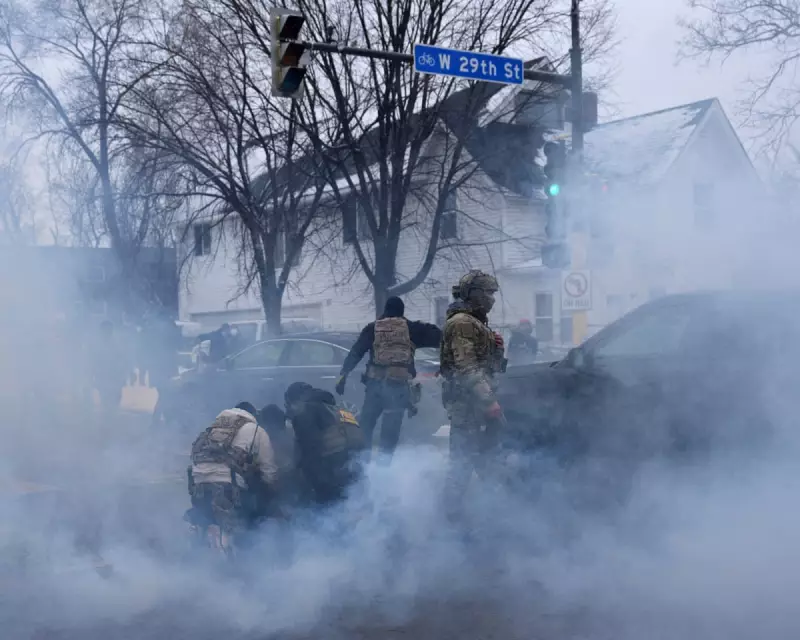
When Fear Becomes Routine: How ICE Enforcement Reshapes Daily Life in America
A knock at the door now carries a weight far beyond its physical sound – it has become a symbol of transformation in American communities. On 15 June 2025, the Trump administration issued an official statement directing US Immigration and Customs Enforcement (ICE) to begin what it described as "the largest mass deportation operation in American history." Major cities including Los Angeles, Chicago, and New York were identified as primary targets, with federal agents rapidly becoming part of many residents' everyday realities.
The Everyday Management of Fear
The stated goal of keeping communities "safe and free from illegal alien crime, conflict, and chaos" has created an environment where fear has shifted from exceptional emergencies to routine management. Shortly after the announcement, warnings circulated through professional networks with practical advice: "Stay home. Don't go out." This precautionary approach has become increasingly normalised, marking the point where law enforcement moves beyond legal domains to become a structuring force in daily existence.
From a sociological perspective, fear operates as a social reality rather than merely a personal feeling. When people shape their behaviour based on constant possibilities rather than direct experiences, fear becomes embedded in the everyday fabric. In this environment, arrests don't need to happen daily – the mere knowledge that something might occur is sufficient to alter behaviour patterns fundamentally.
Transforming Social Interactions and Trust
Immigration enforcement now extends far beyond geographic borders. A knock on the door carries new meanings, while contacting government offices transforms from ordinary administrative acts into anxiety-filled procedures. Migration studies describe this condition as "living on alert" – existing under the shadow of perpetual possibility. The consequences manifest through subtle but significant behavioural changes:
- Reduced outdoor activities and public engagement
- Avoidance of government offices and official interactions
- Decreased problem reporting and civic participation
- Withdrawal from community activities and social networks
Consider a family with school-aged children. After hearing reports about immigration officers in their neighbourhood, parents may restrict outdoor activities, delay educational follow-ups, and gradually reduce participation in school and community events. This simple example illustrates how fear reshapes everyday behaviour and social relationships in tangible ways.
The Psychological Burden on Children and Families
Children within the Afghanistan diaspora in the United States bear particular psychological burdens from heightened immigration scrutiny. According to the 2024 American Community Survey, approximately 46.6% of people in Afghanistan diaspora households – nearly 100,000 individuals – are children, many born in the US or arriving at very young ages. For these children, fear circulates through multiple channels:
- News about ICE activities and deportation rumours spreading through peer networks
- Anxieties transmitted through classroom conversations and school environments
- Family concerns about uncertain immigration statuses
The consequences manifest through defensive behaviours including reduced speaking, classroom withdrawal, and attempts at invisibility. These experiences correlate with sleep disturbances, irritability, concentration difficulties, declining academic performance, and weakened institutional trust. The normalisation of fear in educational environments threatens both long-term social integration and next-generation resilience.
Fear Travels Beyond Immigration Status
This pattern extends far beyond undocumented immigrants. Mixed-status families – where some members hold citizenship while others don't – demonstrate how fear spreads through social connections rather than legal documents. Even legally protected citizens adjust their daily lives with increased caution and self-censorship.
In recent months, Afghan friends in the US have described how American citizens without immigration concerns warn them to "be extra careful these days" or "call me immediately if the police stop you." These statements represent neither political positions nor exaggerations – they illustrate how fear has entered everyday language of care and solidarity, transforming from individual experience to shared social reality that reshapes human relationships.
Community-Wide Impacts and Social Belonging
For the Afghanistan diaspora and other Middle Eastern communities, fear has long been part of daily life, particularly regarding ICE presence and activities. Everyday routines – from commuting and school participation to simple social interactions – are quietly shaped by potential encounters with immigration authorities.
Following incidents like the Afghan immigrant accused of shooting US national guard members, collective anxiety intensifies and everyday caution increases. Many community members fear allegations against individuals might be unfairly generalised to entire communities, with concerns about renewed "security threat" labelling affecting daily interactions.
It's crucial to emphasise that violent acts remain unethical and inhumane. The Afghanistan diaspora consists of people who have endured war, displacement, and profound loss. One person's actions cannot define the moral character of an entire community that has suffered extensively.
Yet in this environment, daily existence becomes calculated – accents, appearances, travel routes, and even ordinary jokes become matters of careful consideration. Fear, amplified by generalisation logic and enforcement structures, transforms everyday life into constant vigilance and anxiety.
Redefining Social Belonging and Community Foundations
A common misunderstanding frames current situations as simply "immigration issues." What's actually occurring is a quiet redefinition of social belonging – the sense that individuals belong within communities, living alongside others with rights to participate without fear or discrimination. When certain groups are considered "suspicious" or "outside" by default, this sense of belonging gradually erodes.
In such environments, unfair generalisation and labelling can extend to race, social class, accent, appearance, and visible signs of difference. The fundamental question shifts from who faces deportation risks to who can live ordinary lives with security and belonging.
The issue isn't law existence but law experience within society. Law enforcement represents not merely administrative or security processes but social practices that can either build trust or make fear permanent. When fear becomes routine, it shapes behaviour while reshaping trust and social cohesion, ultimately undermining community life foundations.
This examination deliberately avoids policy recommendations – not from caution but because clear problem recognition must precede meaningful solutions. The final question remains simple yet profoundly uncomfortable: does a society truly become safer when part of its population learns to live in constant fear, and when that fear becomes an unspoken rule of everyday existence?